
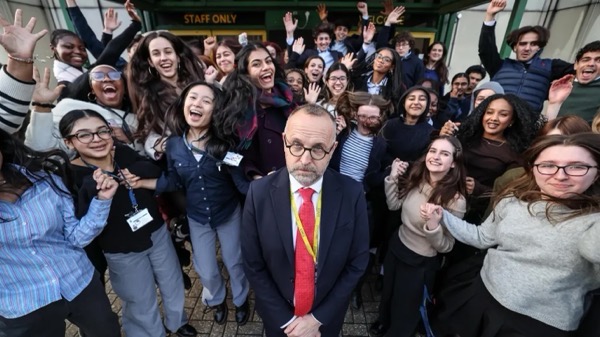
Alex Crossman, head of LAE, with some students (from his Substack)
A recent feature in The Times Magazine (paywall) painted a glowing portrait of the London Academy of Excellence (LAE), a state-funded sixth-form college in Stratford, East London. This year, 62 of its 247 Year 13 students received offers from Oxford or Cambridge — a ratio that rivals the most exclusive private schools in Britain. The school’s head, Alex Crossman, was given generous space to make his case: that LAE proves disadvantaged young people can compete at the very highest level when given the right environment. On the surface, it is a compelling story and one that our local MP has bought into. But it is also one worth examining rather more closely.
More than an exam factory?
Crossman is predictably keen to distance the school from the “academic boot camp” label often attached to the school. He points to extracurricular activities, elective programmes, and a teaching staff of whom more than a third hold PhDs. In a Substack post written in direct response to the Times coverage, he insists the school is not “unashamedly selective” but “unashamedly specialist.” He also highlights an admissions practice that rarely makes the headlines: students eligible for free school meals are prioritised, and around 40 percent of the intake in recent years has been admitted ahead of applicants with better grades but richer parents.
These are genuine points. But they sit alongside a rather more awkward history. Earlier reporting raised concerns that LAE had been removing students mid-course who failed to meet the required academic threshold — effectively managing its results by shedding those least likely to succeed. Critics argued this placed an unfair burden on nearby comprehensive sixth forms, most obviously Newham Sixth Form College (NewVIC), which were left to absorb ex-LAE students on considerably tighter funding. The charge was not that the school was running a boot camp, but something potentially more troubling: that its impressive numbers were partly a product of careful curation. One critic stated “LAE should not be applauded for rigging their success.”
Eddie Playfair, at the time principal of NewVIC, argued that “academic selective system at 16 is now emerging” in London, “and that means you get social sorting happening at the same time, and I think that is probably bad for social mobility.”
The selection question
Crossman’s response to selection critiques is that all A-level provision is selective — every course requires minimum GCSE grades — and that LAE simply selects with social purpose. This is true as far as it goes. But it sidesteps the more pointed question about what happens to the students who don’t make the cut, either at entry or during Year 12. The school’s entry requirement of grade 7 or above in eight GCSEs places it firmly at the top end of the selective spectrum, drawing from a pool of the highest-achieving 16-year-olds in the country. The free school meals priority is a meaningful corrective, but it does not change the fundamental character of the institution: a highly selective school that takes the best-prepared students and gives them an intensive, well-resourced education. That this produces good results is not, in itself, surprising. And neither is the knock-on effect of relatively weaker overall results in neighbouring institutions, who are then criticised for not doing as well.
Where do the students actually come from?
The geographic picture complicates the narrative further. LAE presents itself as rooted in Newham, one of London’s most deprived boroughs, yet the Times piece acknowledges – almost in passing – that many pupils commute in from Essex or from other parts of London. With Stratford now a major hub on the Elizabeth line, the school is easily accessible from a very wide catchment area. Its admissions policy reserves half its places for Newham residents — but that still leaves significant room for students travelling in from considerably more prosperous areas. Research into similar “super-selective” 16-19 free schools has consistently found patterns of recruitment well beyond the notional home borough, drawing ambitious, well-prepared students from a much wider pool than the local community framing suggests.
A model to be replicated — or a cautionary tale?
The Times argues the LAE model should be rolled out nationally. But even setting aside the political obstacles — the current government rightly suspended the Tories’ ‘Free Schools’ programme in late 2024 — the systemic questions would remain unanswered. A school that skims the most academically able students from across a wide urban area, concentrates them in a well-funded specialist institution, and then presents the results as evidence of social mobility may be telling a story that is true for the individuals involved but deeply misleading about the system as a whole.
Indeed, the school’s existence may actually harm social mobility by concentrating the most able students away from their local comprehensive sixth forms. A point supposedly progressive politicians should bear in mind.
 forestgatedotnet
Not very persuasive. Brampton does just as well. The real issue is the obsession with Oxbridge.