Archive | February, 2026

The East End ‘Eton’: A Social Mobility Miracle, or a Mirage?

23 Feb

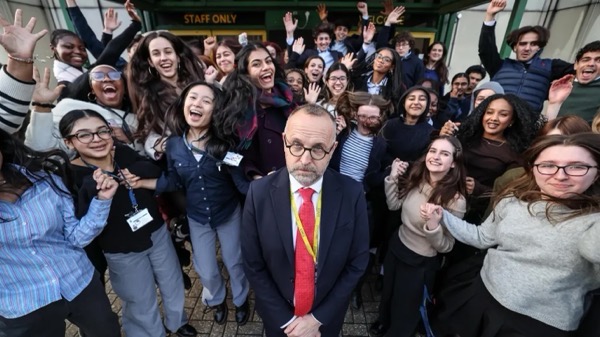
Head teacher Mr Crossman with LAE students

Alex Crossman, head of LAE, with some students (from his Substack)

A recent feature in The Times Magazine (paywall) painted a glowing portrait of the London Academy of Excellence (LAE), a state-funded sixth-form college in Stratford, East London. This year, 62 of its 247 Year 13 students received offers from Oxford or Cambridge — a ratio that rivals the most exclusive private schools in Britain. The school’s head, Alex Crossman, was given generous space to make his case: that LAE proves disadvantaged young people can compete at the very highest level when given the right environment. On the surface, it is a compelling story and one that our local MP has bought into. But it is also one worth examining rather more closely.

More than an exam factory?

Crossman is predictably keen to distance the school from the “academic boot camp” label often attached to the school. He points to extracurricular activities, elective programmes, and a teaching staff of whom more than a third hold PhDs. In a Substack post written in direct response to the Times coverage, he insists the school is not “unashamedly selective” but “unashamedly specialist.” He also highlights an admissions practice that rarely makes the headlines: students eligible for free school meals are prioritised, and around 40 percent of the intake in recent years has been admitted ahead of applicants with better grades but richer parents.

These are genuine points. But they sit alongside a rather more awkward history. Earlier reporting raised concerns that LAE had been removing students mid-course who failed to meet the required academic threshold — effectively managing its results by shedding those least likely to succeed. Critics argued this placed an unfair burden on nearby comprehensive sixth forms, most obviously Newham Sixth Form College (NewVIC), which were left to absorb ex-LAE students on considerably tighter funding. The charge was not that the school was running a boot camp, but something potentially more troubling: that its impressive numbers were partly a product of careful curation. One critic stated “LAE should not be applauded for rigging their success.”

Eddie Playfair, at the time principal of NewVIC, argued that “academic selective system at 16 is now emerging” in London, “and that means you get social sorting happening at the same time, and I think that is probably bad for social mobility.”

The selection question

Crossman’s response to selection critiques is that all A-level provision is selective — every course requires minimum GCSE grades — and that LAE simply selects with social purpose. This is true as far as it goes. But it sidesteps the more pointed question about what happens to the students who don’t make the cut, either at entry or during Year 12. The school’s entry requirement of grade 7 or above in eight GCSEs places it firmly at the top end of the selective spectrum, drawing from a pool of the highest-achieving 16-year-olds in the country. The free school meals priority is a meaningful corrective, but it does not change the fundamental character of the institution: a highly selective school that takes the best-prepared students and gives them an intensive, well-resourced education. That this produces good results is not, in itself, surprising. And neither is the knock-on effect of relatively weaker overall results in neighbouring institutions, who are then criticised for not doing as well.

Where do the students actually come from?

The geographic picture complicates the narrative further. LAE presents itself as rooted in Newham, one of London’s most deprived boroughs, yet the Times piece acknowledges – almost in passing – that many pupils commute in from Essex or from other parts of London. With Stratford now a major hub on the Elizabeth line, the school is easily accessible from a very wide catchment area. Its admissions policy reserves half its places for Newham residents — but that still leaves significant room for students travelling in from considerably more prosperous areas. Research into similar “super-selective” 16-19 free schools has consistently found patterns of recruitment well beyond the notional home borough, drawing ambitious, well-prepared students from a much wider pool than the local community framing suggests.

A model to be replicated — or a cautionary tale?

The Times argues the LAE model should be rolled out nationally. But even setting aside the political obstacles — the current government rightly suspended the Tories’ ‘Free Schools’ programme in late 2024 — the systemic questions would remain unanswered. A school that skims the most academically able students from across a wide urban area, concentrates them in a well-funded specialist institution, and then presents the results as evidence of social mobility may be telling a story that is true for the individuals involved but deeply misleading about the system as a whole.

Indeed, the school’s existence may actually harm social mobility by concentrating the most able students away from their local comprehensive sixth forms. A point supposedly progressive politicians should bear in mind.
How a new voting system could end Labour’s grip on Newham

2 Feb

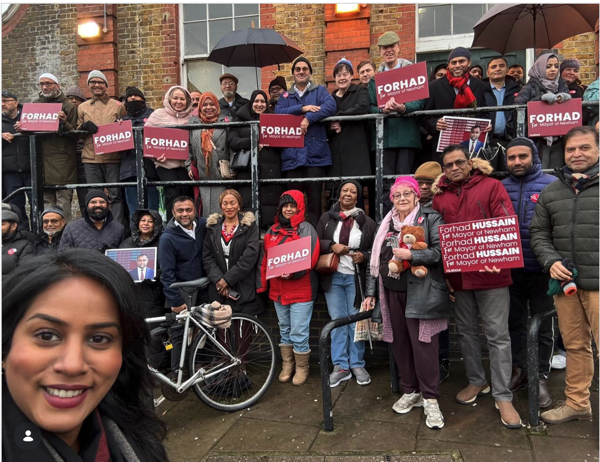
Forhad for Mayor.

Uma Kumaran MP on Instagram

For decades, Newham has been synonymous with Labour dominance. The borough has consistently delivered some of the party’s strongest results anywhere in the country. But as we approach the May 2026 mayoral election, a perfect storm of a changed electoral system and political upheaval threatens to end that era.

The System That Protected Labour (though it rarely needed it)

Until now, Newham’s mayoral elections used the Supplementary Vote system, where voters could express both first and second preferences. If no candidate secured over 50%, second choices were redistributed between the top two. In practice, this rarely mattered — Labour won outright on first preferences in five of six elections. Only in 2006, when George Galloway’s Respect Party mounted a strong challenge, did Labour need second preferences to win.

Had the Tories not abolished this system in 2022 it would have provided Labour with a crucial safety net this year. Progressive voters could have backed the Greens or another party as their first choice, knowing they could return to Labour via second preferences. Even with Labour’s support weakened by the unpopularity of the Starmer government, the party would likely have benefited from transfers from other progressive voters keen to keep less appealing alternatives out.

That buffer has for the time being disappeared. Despite introducing legislation to reinstate the supplementary vote, parliament has not yet passed it into law, so the 2026 election will use First Past the Post. One vote, winner takes all, regardless of whether they achieve a majority.

Historical Strength, Meet Historic Weakness

To understand how extraordinary the current situation is, consider the numbers. In 2018, Rokhsana Fiaz won with a commanding 73.4%. Even in 2022, when her support dropped significantly, she still secured 56.2%.

Historically, Newham Labour’s candidates have outperformed national polling by 25-40 percentage points. For example, when the party polled 29% nationally in 2010, their mayoral candidate won 68% locally. Newham has always been a Labour bedrock.

Fast forward to January 2026, and Labour is polling at a catastrophic 17-22% nationally — the party’s worst position since monthly polling began in 1983. Even with the usual level of out-performance versus the national party, Newham Labour may struggle to hit even 40% this time.

And with the early messaging from Labour candidate Forhad Hussain suggesting he is running against the current mayor’s record rather than the Opposition, that is doubtful. “Labour’s made a mess of it, vote Labour” is s hard message to sell.

The Challengers Emerge

Given the polls and the change to the voting system, this election is genuinely competitive.

The Newham Independents’ candidate, Councillor Mehmood Mirza, represents the largest opposition group on the council with four seats (or is it five?). His populist platform — council tax freezes, free parking, public events, even more free parking, and free sports gear for every child — taps into dissatisfaction over street cleaning, parking charges, and council governance, as well as anger over Labour’s stance on Gaza. Whether his ambitious spending promises can be delivered within a balanced budget is questionable, but the appeal is undeniable. Promises cost nothing, and by the time voters find out he can’t actually deliver them, it’s too late.

The Green candidate, Councillor Areeq Chowdhury, defected from Labour in 2024. His candidacy provides a direct bridge for disillusioned Labour supporters into another progressive option. The Greens already hold the Stratford Olympic Park ward and are targeting council seats in Stratford, Forest Gate and the Royal Docks. They came second with 17.4% in the July 2024 general election in Stratford & Bow, demonstrating organised support across the borough’s younger and more affluent areas. His promise to “ensure we have a clean, green place to live in” will resonate with those voters.

The central structural problem for Labour is that they and their main challengers sit broadly within overlapping political spaces. They share concerns about housing quality, street cleaning, regeneration, and accountability. Despite his regressive policies on climate and tax, Mirza enjoys the endorsement of Jeremy Corbyn, while the Greens have also attracted support on the Left with positive messaging on migration and calls for a wealth tax.

If Chowdhury attracts environmentally-minded and younger voters, while Mirza consolidates anti-establishment and community-based support, Labour’s vote could be eroded from two directions at once.

Reform UK adds another layer of complexity. Newham is not an obvious Reform stronghold. It is younger, more ethnically diverse, and more urban than the areas where Reform has typically done best. Its core base — older, white, socially conservative voters — is relatively smaller here. But the party’s emphasis on social conservatism and cultural issues may resonate with some older and more religious voters who feel detached from Labour’s current direction. Without much in the way of local campaigning infrastructure they secured around 17% in the recent Plaistow South by-election. Reform doesn’t need to win to make a difference because it draws votes from multiple pools: disaffected Labour supporters, residual Conservatives, and general protest voters. Ten or twelve percent could reshape the contest by lowering the threshold for victory.

The Fragmentation Factor

Put these elements together, and the outcome is unprecedented fragmentation and a potentially knife-edge result. Something along these lines is entirely plausible:

  • Labour: 32-40%
  • Newham Independents: 25-33%
  • Greens: 18-25%
  • Reform: 10-15%
  • Others: 5-10%

Labour might win with barely a third of the vote, meaning a large majority preferred someone else. Alternatively, if one challenger consolidates better or is more effective at turning out its vote, the party could lose out entirely.

The Irony of Simplification

Historically, Newham’s mayoral elections were about majorities – often big majorities. In 2026, they’ll be about pluralities. Labour’s dominance was built on strong first-preference support, reinforced by second preferences when needed. Under FPTP, only the first layer remains. Its proponents claim it’s a simpler system, easier to understand. Ironically, it could lead to a result that is more complicated and unpredictable.

For Labour, the task is clear but difficult: hold the vote together in an unfavourable national climate and prevent further defections. Their current strategy, focusing on parking and traffic management, is seriously puzzling. Why add salience to issues that Mirza is actively campaigning on and at the same time risk alienating younger and environmentally conscious voters, for whom the Greens are already an attractive option? 

For the challengers, the dilemma is opposite. Each has a case against Labour, but collectively they risk canceling each other out. Fragmentation may hand Labour victory by default.

Whatever happens, 2026 will produce a mayor backed by fewer people than any of their predecessors. In a borough long accustomed to clear mandates, that would mark a profound shift in how local power is won — and how legitimate it feels. Labour may be about to learn a harsh lesson about the vagaries of first-past-the-post in an age of political volatility.