
Newham’s mayor talking about employment and the Olympic legacy on BBC Radio 4’s The World at One today:
#dangleboris
2 Aug
Something of an Internet meme has sprung up since the blond Bullingdonian got himself stuck on a zip wire.
This is one I made, but there’s far more fun to be had over at http://dangleboris.wordpress.com/
Scratching the Surface
6 Jul
Last week Microsoft summoned journalists to Hollywood for a major product announcement. What they unveiled was Surface, a new tablet computer that will run Windows 8.
Microsoft is going to control both the hardware and software platforms for this device. It will be manufactured and marketed as a Microsoft product and compete directly for sales with companies that are otherwise partners in the PC business.
Although Microsoft is no stranger to this approach in the games market – its Xbox console is among the market leaders – this is a major change of strategy in the mainstream PC market, where previously the company has licensed its software to a range of 3rd party vendors and left them free to design, build and sell the hardware it runs on.
This strategy led to mega-profits, as the marginal cost of each new copy of Windows and Office sold was close to zero. Microsoft dominated the technology sector and was for a time the world’s most valuable company. So why change a winning formula? And why risk antagonising a whole raft of your most valuable partners?
A hint lies in the identity of the company that is now wears Microsoft’s old crown and is rated the world’s most valuable business: Apple.
Apple now exceeds Microsoft (and incidentally Google) in operating margin percentage, despite the vast majority of their revenues coming from hardware sales. Apple’s thing has always been controlling the whole customer experience through tightly integrated hardware and software. Its model is cheap (or free) software running on moderately priced hardware; Microsoft’s has always been expensive software running on cheap hardware.
Mobile industry analyst Horace Dediu estimates that Microsoft makes a net operating profit of $78 per PC sold, assuming that PC has both Windows and Office installed (and most do). Apple, by contrast, makes $195 of operating profit per iPad sold.
Sure, Microsoft has bigger volumes – there were 336 million Windows PCs sold last year – but that will change. The iPad has created a new market that is growing rapidly, which is disrupting the PC market and in which there is almost no competition. It is a market in which Microsoft’s traditional model is doomed to failure. It simply cannot maintain its current per-device profits selling Windows and Office to 3rd party vendors when Android is free and Office-like software is available at a fraction of the cost.
Surface offers the Redmond giant a way out. If it can sell the devices at the same prices Apple sells its iPads for it can maintain its profits (at least on a per device basis).
The problem will be making and selling enough of them. And as we still don’t know – more than a week after the launch event – when Surface tablets will be available or how much they will cost, it is hard to know if they will succeed. While the PC market is not going to die anytime soon Microsoft needs a new strategy – for now, Surface looks like its big bet.
A place to live, work and stay?
6 Jul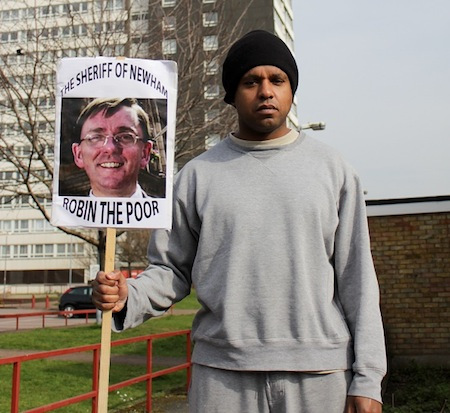
The Carpenters Estate, on the fringes of the Olympic Park in Stratford, is going to be demolished to make way for a new east London campus for University College London. The residents are, understandably, not happy about this and I have a great deal of sympathy for their position.
It seems perverse at a time when there is a desperate need for affordable housing in London that an estate of perfectly serviceable homes is to be bulldozed and replaced by a university campus.
The borough’s motto is ‘a place to live, work and stay.’ How are people supposed to stay if you knock their homes down?
It is all very well Sir Robin banging on about building resilient communities, but how can communities develop resilience if they are scattered to the four corners of the borough – or indeed beyond – because their homes are demolished and they can’t afford anything else? How many of the flats in the shiny new blocks springing up in Stratford are truly ‘affordable’ to Newham people?
The mayor says, “you can’t do things for people, they’ve got to do it for themselves. All we can do is help. They have to build personal capacity, and that means being able to deal with the things that life throws at you. Grit, determination, aspiration, you have to build it in to communities.”
This language of ‘resilience’ is basically about blaming the poor for their own condition. Too poor to afford some where to rent or buy? Don’t know how to negotiate the bureaucracy to get yourself re-housed? Confused by complex forms and processes? The services you use and rely on no longer exist because of budget cuts? Tough. Not our problem. Go away.
Sir Robin claims to be ambitious for Newham, but he seems not to have much empathy for the people who actually live here.
[a version of this was posted on the Newham Issues e-democracy forum]
Image from The Cheese Grater
Fortress Wanstead Flats. Olympic police base takes shape. Bloody enormous.
27 Jun
on Instagram http://instagr.am/p/MYSvPckB3k/ – June 27, 2012 at 02:49PM
These are sprouting up all over Newham. Must be something going on!
27 Jun
on Instagram http://instagr.am/p/MYRf77EB2-/ – June 27, 2012 at 02:38PM
Queens Park votes to set up parish council
29 MayQueens Park, in the City of Westminster, has voted to set up its own local, community council:
http://www.guardian.co.uk/society/2012/may/28/peoples-republic-of-queens-park…
Good news for local democracy.
London Mayor & London Assembly Election 2012 – Newham Results
16 May
The ward-by-ward and borough-level results from the recent Mayoral and London Assembly elections have been released.
In the mayoral election, Newham voted (unsurprisingly) overwhelmingly for Labour’s Ken Livingstone. On first preference votes, the results were:
Siobhan Benita (independent) – 1,536 (2.33%)
Carlos Cortiglia (BNP) – 918 (1.39%)
Boris Johnson (Conservative) – 12,139 (18.42%)
Jenny Jones (Green) – 1,630 (2.47%)
Ken Livingstone (Labour) – 47,388 (71.89%)
Brian Paddick (Liberal Democrat) – 1,413 (2.14%)
Lawrence James Webb (UKIP) – 893 (1.35%)
In the London Assembly election for the City & East constituency, the results were:
John Biggs (Labour) – 47,226 (71.18%)
Paul Borg (BNP) – 1,773 (2.67%)
Paul Davies (Communist League) – 447 (0.67%)
Richard Macmillan (Liberal Democrat) – 2,064 (3.11%)
Kamran Malik (Communities United Party) – 3,677 (5.54%)
John Moss (Conservative) – 6,578 (9.91%)
Chris Smith (Green) – 3,078 (4.64%)
Steven Woolfe (UKIP) – 1,505 (2.27%)
For the election of the London-wide members:
BNP – 1,428 (2.15%)
Christian Peoples Alliance – 1,701 (2.56%)
Conservative Party – 6,753 (10.14%)
Green Party – 2,988 (4.49%)
Labour Party – 48,241 (72.47%)
Liberal Democrats – 1,620 (2.43%)
National Front – 247 (0.37%)
House Party – 245 (0.37%)
Trade Unionist & Socialist Coalition – 400 (0.60%)
UKIP – 1,569 (2.36%)
Rathy Alagaratnam – 227 (0.34%)
Ijaz Hayat – 688 (1.03%)
So, what do we learn from all this?
Across London Ken Livingstone polled behind the Labour Party, which is why he lost the mayoral election when his party made big gains in the Assembly. But that didn’t happen in Newham. His vote and the general Labour vote were all but identical.
That wasn’t true for the the Tories though. Boris was close to twice as popular in Newham as his party. The Conservatives continue to be – in vote terms, at least – the main opposition party in the borough, although their share of the vote was somewhat lower than at the general election (around 10% this time compared to 15% in 2010).
It’s also worth noting that Labour’s share of the vote was up from the 2010 general election, where Lyn Brown (West Ham) took 62.7% and Stephen Timms (East Ham) took 70.4%.
The Liberal Democrats did hopelessly badly. It’s hard to see even a spark of life for a party that finished with fewer votes than the Christians and barely beat UKIP.
These results, along with those from the general and council elections in 2010, confirm that the far-right has no meaningful presence or support in Newham. We should be grateful for that.
How many Trots does it take to change a lightbulb?
15 MayHow many Trots does it take to change a lightbulb?
- 15 on the central committee to issue an edict denouncing broken lightbulbs and calling for change…
- 10 to hand out “hands off *insert country*” placards to passers by…
- …and 50 to try to sell them papers…
- 25 to collect signatures for a petition demanding the government do something about changing the lightbulb…
- 30 to set up a front group called “Right to Light”…
- 30 Student’s to set up a front group called “Youth Fight For Light”…
- …and 15 to form a break-away group demanding a return to candle light.
So about 175 at conservative estimates.
But the lightbulb remains unchanged.
via @majsaleh and @RooftopJaxx on Twitter.
Cannes Update
30 AprThe Newham Recorder has published the list of sponsors for the Mayor’s trip to Cannes.
These were:
- Bougyes Development
- Strand East
- Westfield Stratford City
- Countryside Properties
- Swan New Homes
- the Ballymore Group
- Capita Symonds
- the Cathedral Group
- the University of East London
- Ardmore Construction
- Urban Initiatives, and
- Savills
According to the Recorder, all “have denied any suggestion that their involvement in the trip would mean they received favourable treatment when it came to future development opportunities.”
They’re all just very generous, public-spirited people… obviously.
 forestgatedotnet