How Newham Labour Lost the Campaign
Newham Labour’s 2026 campaign was not simply unsuccessful. It was strategically self-destructive.
At the centre of the campaign sat an extraordinary political decision: to make parking, Low Traffic Neighbourhoods (LTNs) and opposition to active travel one of the defining themes of the election.
The flagship proposal — free first parking permits for every household alongside one hour of free parking borough-wide — amounted to a tax cut for motorists unprecedented in London local politics. No other borough currently offers such a policy. Nor does any major London political party advocate something similar.
The policy was introduced without meaningful consultation with sitting councillors or candidates, despite the campaign simultaneously criticising the Fiaz administration for failing to consult residents. More importantly, it fundamentally misread both the borough’s politics and Labour’s own electoral coalition.
Rather than neutralising anti-LTN sentiment, Labour instead gave salience and legitimacy to exactly the political terrain on which the Newham Independents wanted the election fought. Parking and LTNs became central campaign issues because Labour itself elevated them into central campaign issues.
This was politically disastrous.
As one now ex-councillor put it on X “Imitating the [Newham Independents] was such a bad move. We needed to stand out as different – and we didn’t.”
Grievance politics around LTNs and motorists tends to work best for insurgent outsider movements positioning themselves against “the voice of people” and “the establishment”. It is far harder for the incumbent party to wage that kind of campaign without simultaneously undermining its own credibility and record in office.
Labour ended up in the absurd position of validating anti-council narratives while being the council.
At the same time, the campaign alienated a significant part of Labour’s own progressive and environmentally conscious voter base, particularly in the north and west of the borough. Stratford, Maryland, Forest Gate and parts of the Royal Docks contain large numbers of younger, graduate and environmentally minded voters who are generally supportive of active travel, clean air measures and safer streets.
Instead of consolidating those voters, Labour antagonised them.
The campaign repeatedly signalled hostility toward active travel schemes. LTNs and Healthy School Streets were discussed with open contempt. A Labour Group motion reportedly sought to halt new schemes. Candidates were discouraged from publicly defending them. Even support for clean air and cycling infrastructure became politically sensitive within the campaign.
The rhetoric often descended into culture war politics. “Middle-class elites”, lattes and Waitrose deliveries became recurring themes despite the obvious absurdity of deploying anti-metropolitan populism in one of London’s fastest-changing inner-city boroughs.
Meanwhile, the Greens understood precisely where Newham’s political trajectory was heading.
Rather than attempting to fight every seat, they focused on carefully selected target wards and expanded cautiously only as momentum grew. Their campaign was disciplined, strategically coherent and aligned with the demographics of the areas they were contesting.
Crucially, they openly defended active travel policies, including the Woodgrange and Capel Road LTN, while advancing policies such as weight-based parking permits that reflected a coherent environmental and urban policy framework.
The electoral results demonstrated the consequences of Labour’s strategic failure.
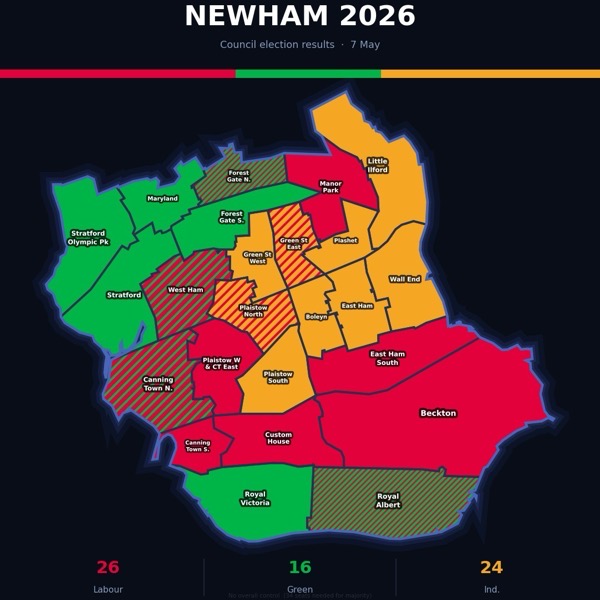
The Greens comprehensively held Stratford Olympic Park and then won Maryland, Stratford and Forest Gate South from Labour. In Forest Gate North, they topped the poll and secured one of the ward’s two seats.
These were not random losses. They reflect a political realignment already underway within parts of Newham.
Labour had convinced itself it could tack sharply right on environmental issues because eco-conscious, socially liberal and younger voters had nowhere else to go. The campaign proved otherwise. The fact that the Greens won the two wards that include both the (allegedly controversial) West Ham Park LTN and the much-consulted-on-but-as-yet-undelivered Woodgrange /Capel LTN should give the new administration a clue as to what voters actually care about.
The Newham 65 blog captured it perfectly: Forhad elected, but LTNs win
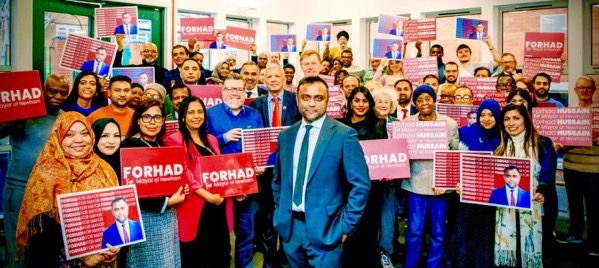
Operationally, matters were no better. The campaign was highly centralised and overwhelmingly focused on the mayoral candidate himself. Much of the literature delivered across the borough concentrated almost entirely on his personal story and profile rather than on local candidates or ward-level campaigns. Perhaps that focus explains why Labour retained the mayoralty while losing control of much of the council chamber. The campaign appeared structured around a presidential-style contest rather than the realities of fighting multiple hyper-local elections simultaneously.
The organisational culture reflected this centralisation. On polling day itself, candidates were reportedly instructed not to organise their own leaflets or canvassing operations locally, but instead to travel to a small number of central campaign hubs to collect literature and information about which polling districts to target. They were only given enough material for a limited number of rounds before having to return later to collect more. In practice, some candidates wasted significant time travelling back and forth during the most important day of the election campaign — time that could have been spent getting the vote out.
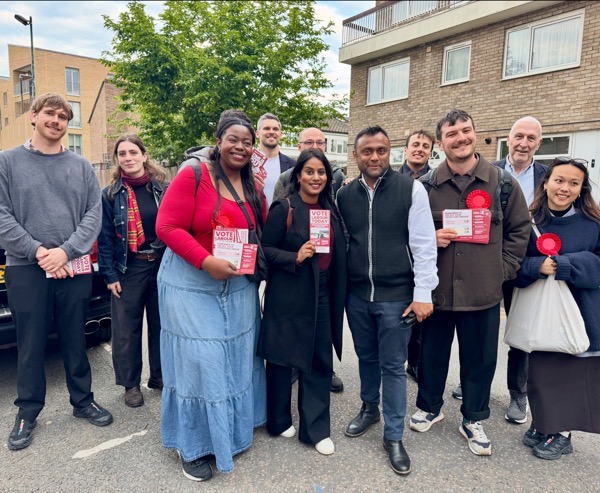
Basic campaign discipline also appeared absent. One Labour member remarked after the election that he had been canvassed four separate times by the same candidate despite already displaying a large Labour poster in his window. As he put it, the “basic tradecraft” of campaigning seemed to have disappeared.
Despite significant social media activity, much of Labour’s online output also appeared amateurish and unfocused. Campaign training around data collection and targeting quickly gave way to optimism bias and poor strategic discipline. Labour behaved as though nearly every ward remained competitive, with little meaningful prioritisation of resources despite clear warning signs that substantial losses were likely.
The Greens, by contrast, understood exactly which voters they were speaking to and exactly where victory was achievable.
Ultimately, Newham Labour fought a campaign rooted in nostalgia for an older political coalition that no longer exists. By centring parking and anti-LTN politics, it simultaneously strengthened its opponents’ narrative while fracturing its own support base.
It was not simply a poor campaign. It was a campaign that fundamentally misunderstood the borough, the electorate and the political moment.
Tags: Labour, Local Elections 2026