Tag Archives: Mehmood Mirza

Who’s side are you on – redux

27 Apr

AI image of Mehmood Mirza being showered in cash

AI-generated image of Mehmood Mirza, posted by a user on the Nextdoor website

Four years ago, Mehmood Mirza ran for Mayor of Newham as an independent. He was not yet a councillor and the Newham Independents Party, which he now leads, was but a twinkle in his eye. At that election he was very much an outsider with little chance of making the second round, let alone winning.

This time he is a serious contender.

Despite posturing as a left-wing socialist and enjoying the endorsement of Jeremy Corbyn, Cllr Mirza is a significant private landlord. He and his property company, Phoenix M Properties Ltd (No.10216604), own or control at least 10 homes in Newham. Filings at Companies House show that Mr Mirza is the sole director of the company. His register of interests as councillor lists the street addresses of seven properties other than his home, though this understates the size of his rental portfolio as several of them are divided into flats.

The availability of good quality, affordable housing is a huge issue in Newham. Latest estimates show that around 40% of households in the borough live in the Private Rented Sector and data released last week by the Office for National Statistics show rents rising by 7.7% in the past year – far outstripping the rate of inflation. Many of these homes suffer from overcrowding, disrepair and have poor standards of amenity and thermal efficiency at a time when energy costs are heading skywards. Combatting abuses by private landlords and improving standards has been a priority for the council under both the Wales and Fiaz administrations.

Were he to be elected, Mehmood Mirza would have a significant conflict of interest to manage between his role as Mayor in enforcing the Council’s policies on the private rented sector and his role as a rentier property owner whose actions would be regulated by, er, himself. It is unclear as to how he would resolve these conflicts.

Mirza has said very little about how he would treat the private rented sector if he were elected as Mayor of Newham. His published leaflets are silent on the matter.

At last week’s hustings on Revive FM Cllr Mirza was not in attendance – just as he dodged similar events in 2022 – so voters were unable to ask him about this.

So here are some questions he needs to urgently answer ahead of the polls on Thursday week. Readers with long memories will recall I asked an almost identical set four years ago, so he’s had plenty of time to think of some answers:

  • 40% of homes are in the private rented sector in Newham. How can the residents of these homes expect you to treat them fairly when you are a significant private landlord?
  • As a significant private landlord, explain how there would be no conflict of interest between your role as a landlord seeking to maximise your profits and your role as Mayor policing the private rented sector in Newham and rooting out wrongdoing?
  • If you were elected Mayor would you rid yourself of all interests in the property you own or control and, if so, how would you do this? If not, how would you resolve your conflicts as a private landlord with the responsibilities of the Mayorality?
  • How would you ensure that all the decisions you made on the private rented sector were open and accountable to scrutiny?
  • What lawful policies would you pursue as Mayor to increase the supply of social rented homes and reduce that of private rented homes?
  • Do you agree that the Council should crack down on private landlords, campaign for security of tenure for private tenants and for rent controls? Should the Council issue Compulsory Purchase Orders on the homes operated by private Landlords in Newham who misbehave?
  • How much income do you receive in either salary or dividends from the homes that you own/control/have a beneficial interest in, directly or indirectly? Four years ago you pledged to only take a Living Wage from the Council if elected as mayor. Are you making the same promise again and, if so, are you able to do so because of your property income?

The people of Newham deserve answers. Will they be voting for someone who is on their side, or the side of landlords?
A Failure of Leadership

19 Mar

Ballot box
“We will consult properly and use community ballots to make sure decisions on important changes to your local street and environment are made by you.” So says Forhad Hussain on his current election leaflet, under the heading ‘Leadership you can rely on.’

Similarly, Newham Independents candidate Mehmood Mirza promises to “cancel all proposed LTNs and properly consult on the existing ones.”

When local politicians champion “community ballots” or “proper consultation” on schemes like low traffic neighbourhoods, they frame it as ‘democracy in action’—giving residents the final say on their streets. The reality, however, is that this is an abdication of leadership at precisely the moment when communities need it most.

The fundamental problem with these ballots is that they reduce complex policy decisions to binary choices. Traffic management isn’t about whether people like or dislike a scheme in isolation. It’s about balancing competing needs: child safety versus driver convenience; air quality versus journey times; long-term health outcomes versus short-term disruption. These are exactly the kinds of trade-offs we elect representatives to navigate on our behalf, using evidence and expertise alongside public input.

Moreover, the playing field for these ballots is far from level. Well-organised opposition groups, amplified by outside actors with their own agendas, flood communities with disinformation. Claims about emergency vehicle access, economic decline, or displacement of traffic are often exaggerated or outright false, yet they resonate emotionally because people are nervous about change. Meanwhile, the diffuse benefits—cleaner air, safer streets for children, reduced through-traffic, less noise pollution—are harder to mobilise around, even though the evidence supporting them is strong.

As a result communities become battlegrounds. Neighbours who previously coexisted peacefully find themselves on opposite sides of an artificially sharpened divide. Social media arguments replace constructive dialogue. The ballot doesn’t build consensus; it entrenches positions and creates winners and losers. Conflict instead of cohesion.

True leadership means making difficult decisions based on evidence, even when they’re initially unpopular. Of course it means consulting communities and listening to concerns: schemes can be adapted where legitimate issues arise—but ultimately it’s about taking responsibility for the outcome. Politicians who instead defer to referendums are passing the buck, hoping to avoid accountability by ‘listening to the people’.

If a scheme is genuinely worthwhile, the mayor and council should implement it, monitor its effects, and be prepared to modify or reverse it based on real-world outcomes. This is governance. Community ballots, by contrast, are a recipe for division. Elevating the loudest voices over the best evidence isn’t leadership, it’s the exact opposite.

Newham deserves better than politicians who mistake populism for democracy and ‘community ballots’ for governing.

Free Parking Isn’t Really Free

11 Mar

Parked cars

Two of the leading candidates for mayor of Newham in May’s election are promising voters “free parking.” Labour’s Forhad Hussain says he will give residents an hour a day, anywhere in the borough. Mehmood Mirza of the Newham Independents has trumped that, offering 2 hours a day.

While that parking might ‘free’ in the sense that drivers don’t have to pay for it, it comes at a very considerable cost to the wider community.

Free parking is presented as a simple way to support residents with the cost of living and help local shops. The logic seems intuitive: if parking is cheaper, more people will visit the high street. But that ignores a well-established concept in transport economics known as Induced Demand.

Induced demand is what happens when the cost or difficulty of a particular activity is reduced. When something becomes easier or cheaper, people do more of it. In transport, this principle is most often discussed in relation to road building—new road capacity tends to attract additional traffic which quickly wipes out the advantage of having built it. The same dynamic applies to parking.

If parking becomes free, especially for short stays, it changes how people make everyday travel decisions. When parking costs money or requires effort—finding a machine, worrying about time limits—people think twice before driving a short distance. They may walk, cycle, or combine several errands into one trip. Removing the cost component changes that calculation. Suddenly, a quick car journey for a single item or a short visit feels worthwhile – it’s ‘free’ so why not?

As a result, free parking generates extra trips that would not otherwise have occurred. People may drive for errands they previously would have walked; make several separate trips instead of combining them; or return multiple times during the day because each visit includes a free parking period (neither candidate has explained how they would prevent people abusing the system like this). Even if the number of parking spaces remains unchanged – road space is a finite resource – the number of vehicle movements increases.

Parking spaces are limited, particularly in busy town centres like Green Street, Stratford and Forest Gate. When there’s a free hour of parking these spaces are often occupied by very short visits—coffee pickups, takeaway collections, or quick errands. These trips generate more traffic but do not necessarily contribute much to the local economy.

At the same time, the increased turnover of parking spaces means more cars circulating through the area: drivers searching for spaces, pulling in and out of bays, and making short journeys between nearby destinations. Research has shown that a notable share of city traffic consists of vehicles simply looking for some where to park. And all of those cars are generating pollution – exhaust fumes, brake pad dust, and micro-particles of tyre rubber.

Free parking can also have unintended consequences for the broader transport system. When driving becomes artificially cheap, it weakens the relative attractiveness of other ways of getting around. Walking, cycling, and public transport all become slightly less competitive compared with the convenience of driving door-to-door. Over time, this can reinforce car dependency and increase traffic volumes on local streets. In dense urban environments like Newham, that brings knock-on effects such as congestion, noise, and poorer air quality. These impacts affect everyone, including the very large number of residents who do not drive. 

Giving residents free parking for an hour (or more) daily sounds fair, but it isn’t. Only half of Newham households own or have access to a car, so the benefits are skewed to towards those well-off enough to own and run a car, while everyone faces more traffic, noise, and pollution.

Parking policy is not just a revenue issue – though it definitely is and giving up millions of pounds a year in income will have knock-on consequences elsewhere in the council budget – it’s a transport management tool. Pricing and regulation help balance access to public space with the need to manage traffic and support healthier, more sustainable travel choices. 

In short, while free parking may appear attractive, it comes with consequences. By lowering the cost of driving, it t encourages more car journeys—particularly short ones—adding pressure to already busy streets and undermining wider transport and public health goals. And in a borough with an epidemic of inactivity and obesity, it is the worst possible policy.

Not so independent

14 Jun

The defintion of independent

The Oxford English Dictionary defines ‘independent’ as “not belonging to or supported by a political party.”

Which creates a paradox for Cllrs Mehmood Mirza, Sophia Naqvi and Zuber Gulamussen.

At the start of June the Electoral Commission approved the Newham Independents Party’s application to register as a political party. So now the Independents are a party, they are no longer independents.

Further matters of interest

5 Jan

Cllr Sophia Naqvi posing with former Labour leader Jeremy Corbyn

What does Jeremy think about buy-to-let landlords?

Cllr Sophia Naqvi’s register of interests has been published and it reveals that she, like the leader of her political group, is a multi-property owning landlord.

In addition to the home they live in, Cllr Naqvi and her partner own a further five properties in Newham – two in her own name, two in her spouse’s and one jointly owned. No doubt a tax-efficient arrangement of assets.

The latest recruit to the Landlords Alliance is former councillor Idris Ibrahim, who will be one of the three candidates for Green Street West. As the final register of interests from his single previous term shows, he is very much a junior member – just the one extra house. 

WTF just happened, part 2

14 Dec

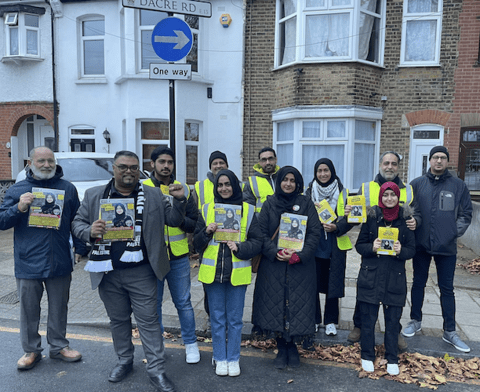
Newham Independents camapigners in yellow h-viz jackets

Newham Independent campaigners wearing the uniform of right-wing populism, the gilets jaune

Unless you’ve been living under a rock for the past couple of weeks you’l know that Sophia Naqvi, Mehmood Mirza’s candidate, won the Plaistow North by-election by a handy margin, handing Labour a second consecutive defeat.

Mirza and Naqvi have been joined in a new group on the council by Zuber Gulamassen (Plashet) who defected from Labour. The Newham Independents are now the largest opposition group on the council. Which hands Cllr Mirza an extra £7,900 a year ‘special responsibility allowance’ as leader. 

What did the local blogs and commentators have to say?

From the Left of the local political spectrum Newham 65 reported

Labour has been comprehensively beaten in Plaistow North by the misnamed ‘Newham Independents’, who generally represent a populist anti-Labour/pro-car platform. On this occasion the campaign undoubtedly focussed on the national Labour Party’s position refusing to call for a ceasefire in Gaza. The failure of local MP Lyn Brown to join Stephen Timms in supporting parliamentary efforts to call for a ceasefire didn’t help the atmosphere.

Newham’s ‘Old Labour’ Right could barely contain their glee

The defeat in Boleyn was a disaster. The defeat in Plaistow North is a humiliation.

Predictably they blamed that humiliation on the mayor, but added

For the first time in decades, Labour is facing an opposition that wants to win. It is an opposition that builds its support on an ethno-religious communitarian base. Labour currently has no response … But they will have to decide whether they will confront this new party on principle or will appease them in the hope of retaining some of the votes, say in parliamentary elections. Meanwhile they face a campaign that aims to attack local Labour and its record at every opportunity.

Writing for the On London blog, Lewis Baston observed

There is an electoral malaise in this ancestral Labour heartland at the moment. Mirza polled only eight per cent in the mayoral election in 2022 as an Independent candidate but would clearly be doing better now as leader of what amounts to a local opposition party. After all, Lutfur Rahman and Aspire returned to power in neighbouring Tower Hamlets last year with a familiar blend of Leftist and Islamic rhetoric, populism and somewhat conservative campaigning on issues like Low Traffic Neighbourhoods.

However, the hurdle at which past challenges to Labour’s hegemony in Newham have fallen is the ability to campaign across the whole borough. That is a bigger task than picking off a ward or two where issues and personalities come together. Mirza’s political operation is not yet ready for that. Even so, its growth is a headache for Labour in a borough where the party has become accustomed to winning everything.

Mirza and his followers have already started to address that last point, inviting applications to be his candidates in a swathe of wards across the centre of the borough from Green St West to Little Ilford. Those selected are encouraged to be ‘community champions’ for their wards. It should be a wake up call to Labour and an antidote to complacency among its sitting councillors.

Moaning Mirza

25 Sep

Cllr Mehmood Mirza was none to happy about my previous post. He took to Twitter to tell me to 

get a life man, do you have anything better to do?

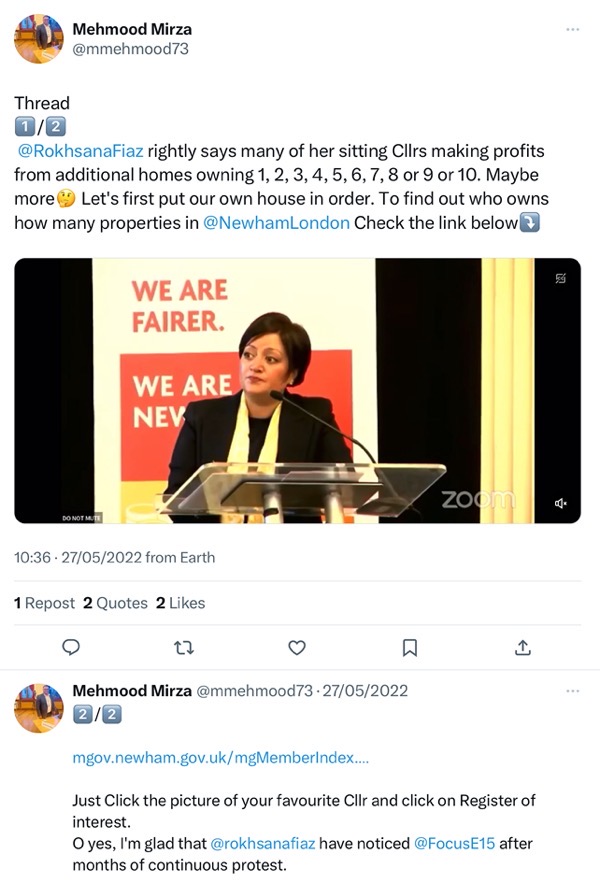
And yet here he is in May last year, encouraging his followers to check the registers of interest to see how many ‘additional homes’ councillors owned:

Mehmood Mirza on Twitter

Which was a bit rich, given he had just stood for council – unsuccessfully on that occasion – while owning multiple ‘additional homes’ himself.

Anyway, he’s a councillor now and subject to the exact same levels of scrutiny he wanted for others.

Matters of interest

20 Sep

Cllr Mehmood Mirza

The recently elected councillor for Boleyn ward, Mehmood Mirza, has published his register of interests.

And it is, to say the least, interesting given his personal brand as a Corbynite man of the people.

In the section on land, he declares that he owns eight properties, either directly or through his company Phoenix M Properties Limited. Addresses for seven are provided: 

  • 79B Selsdon Road E13 9BZ 
  • 28 Eversleigh Road E6 1HQ 
  • 29 Patrick Road E13 9QA 
  • 11 St Martin’s Avenue E6 3DU 
  • 47 Central Park Road E6 3DZ 
  • 24 Orwell Road London E13 9DH 
  • 76 Strone Road London E7 8EU

The location of the eighth is withheld as

The Monitoring Officer has agreed the disclosure of the Member’s home address is a sensitive interest under s.32 of the Localism Act 2011.

While declaring eight properties in the borough might meet the legal requirement, Cllr Mirza is being modest about the extent of his rental empire. Three of the houses are sub-divided into flats on which he either currently or has in the past had selective (which is to say landlord) licenses. These are 76 Strone Road, 24 Orwell Road and 28 Eversleigh Road. 

Cllr Mirza was granted a selective licence for the ground floor flat at 76 Stone Road on 3 August 2023, after he was elected; Phoenix M Properties was granted a licence for the first floor flat on 22 June. The contact address for both applications was First Floor Flat, 24 Orwell Road. In 2010 Mirza was granted a “Certificate of Lawfulness for an Existing Use as 2 x 1 bedroom flats” at Orwell Road.

At 28 Eversleigh Road, Mirza has held a selective license since December 2020 for Flat 2 at that address. And documents publicly available on the Companies House website show that Phoenix M Properties has two mortgages on the house – one for 28 and another for 28A.

This extensive portfolio of rental units puts Mirza top of the league of Newham councillor-landlords. No mean achievement given the number of competitors.

Elsewhere in Mirza’s declaration, Labour officials will raise an eyebrow at section 2. This is where councillors declare who has made donations to, among other things, their election expenses. Mirza lists Unite the Union and the GMB. As both unions are affiliated to Labour it is unlikely that either would contribute to a candidate running against the party. I suspect that Mirza has simply filled the form out incorrectly. His union memberships should appear in section 8 – other interests. Though quite why a company director and landlord should be a member of two trade unions is a bit of a mystery.

Companies House records show that Cllr Mirza is the sole director and company secretary of Phoenix M Properties Limited. He is the sole ‘person with significant control’, owning more than 75% of the shares and voting rights in the business. His occupation is given as ‘Property Management’. However the section on his register of interests where he is asked to “state any employment, office, trade, profession or vocation carried on for profit or gain” he doesn’t mention being either a company director or property manager; he says he is a legal advisor.

Now that the extent of his property holdings is public it will be entertaining to see how his supporters square this with the idea he is a left-wing hero.

WTF just happened?

17 Jul

This was not the news I was expecting to wake up to on Friday morning:

Boleyn (Newham) council by-election result:

IND: 42.5% (+42.5)

LAB: 32.1% (-27.0)

GRN: 21.1% (+3.5)

CON: 2.5% (-15.6)

REF: 0.8% (+0.8)

LDEM: 0.8% (+0.8)

Votes cast: 2,710

Independent GAIN from Labour.

The Independent in question is Mehmood Mirza, a figure well-known (and not necessarily in a good way) to local Labour people.

For those fortunate enough not to have encountered him before, the excellent Newham 65 blog addressed the question Who is Mehmood Mirza? 

Mehmood Mirza has surprised many by winning Thursday’s by-election in Boleyn ward. But who is he, and what does he stand for?

He has described his occupation variously as a legal adviser, a campaigner and a human rights activist, but he is also a significant private landlord. He currently owns ten properties in the borough, which will make him – since the departure of Ayesha Chowdhury from the council last year – the most propertied Newham councillor-landlord.

The piece is worth reading in full for a flavour of what we can expect to see in council meetings over the next three years. His first outing as Cllr Mirza will be on Wednesday. 

Lewis Baston, writing for the On London blog tried to take a broader view of why Labour had lost a seemingly safe seat.

Mirza’s win came as a surprise to most observers, although he had obviously run an effective campaign on the quiet. While Labour dominates in Newham, other candidates poll a third of the votes cast even at a peak Labour elections such as 2018. There – particularly with the focus of a local by-election – there is still the critical mass required for a challenge in the right ward at the right moment.

I don’t think anyone in Boleyn would have described the Mirza campaign as being run on the quiet. But the point about a potentially critical mass of non-Labour voters that can coalesce around the right message is well made. As Baston notes

Boleyn was one of the three best Newham wards for Respect in 2006, when it mounted the most successful recent challenge to Labour’s ascendancy. Mirza’s vote in 2023 mobilised some of this left of Labour and independent strand of opinion, and he was assisted by left wing campaigners. Some of Mirza’s policies were not particularly socialist – he said he was in favour of free car parking and a lower council tax, so he might have attracted some Conservative-inclined voters too.

Some? The Tory vote collapsed completely! Mirza basically stole their local policies – opposing LTNs and parking charges – and combined them with a hefty dollop of anti-establishment populism. As in May 2022, Mirza’s actual policy platform – as opposed to his left-wing posturing – was indistinguishable from the Conservatives.

Open Newham, the voice of the dispossessed ancien regime, wasted no time in pointing the finger

This is an indictment on Mayor Fiaz. In five years, she has taken Labour from a seemingly impenetrable position to one in which Labour appears vulnerable; she has alienated her colleagues on the council; and faces serious accusations of bullying of staff and colleagues.

The two constituency parties remain suspended by the Labour Party. There is a real doubt that Fiaz would have been reselected if the members had been allowed to choose in 2022.

The election of Mehmood Mirza will not mean that the voting arithmetic on the council has significantly altered. It will mean that there is a consistent and hostile, independent opposition voice who will seek to hold the mayor to account. If Fiaz experienced some discomfort at council meetings before, we can only anticipate that this will increase in the future.

Over on Twitter the Jeremy Corbyn fan club was in equally jubilant mood, declaring

Seat taken by a staunch Corbyn supporter standing as an independent – up yours Akehurst and co

And

Newham folk don’t like being stitched up by Central Office & [having] candidates foisted on them.

Which ignores two inconvenient facts. Firstly, that in neighbouring Wall End ward Labour’s vote share went up by 12 percentage points with a candidate selected in the exact same way

And secondly, that staunch Corbyn supporter is a buy to let landlord with multiple properties who swans round the place in a huge Mercedes & campaigns on lowering taxes, abolishing parking charges and removing LTNs.

Maybe get your head out of your arse, understand that most voters neither know nor care about Labour’s internal processes and recalibrate your political compass.

None of which is to ignore the fact that this result is an absolute disaster for the Labour party in Newham. Losing two seats to the Greens is one thing; losing a third to a populist campaign like Mirza’s is altogether more threatening. Just look across the borough boundary to Tower Hamlets. 

Who’s side are you on?

2 May

Mcg sd kxnwCu7Pp

Mehmood Mirza is standing as an independent candidate for the Mayor of Newham.

At a Mayoral hustings last week, at which Mr Mirza did not appear in person – preferring instead to be represented by a member of his campaign team – the issue of his property portfolio was raised.

Despite posturing as a left-wing socialist Mehmood Mirza is a significant private landlord. He and his property company, Phoenix M Properties Ltd (No. 10216604), own or control at least 10 homes in Newham. Filings at Companies House show that Mr Mirza is the sole shareholder and director of the company.

The availability of good quality, affordable housing is a huge issue in Newham. According to the Office for National Statistics 35.5% of households in the borough live in the Private Rented Sector. Many of these homes suffer from overcrowding, disrepair and have poor standards of amenity and thermal efficiency at a time when energy costs are heading skywards. Combatting abuses by private landlords and improving standards has been a priority for the council under both the Wales and Fiaz administrations.

Were he to be elected, Mehmood Mirza would have a significant conflict of interest to manage between his role as Mayor in enforcing the Council’s policies on the Private Rented Sector and his role as a rentier property owner whose actions would be regulated by, er, himself.  It is unclear as to how he would resolve these conflicts.

Mirza has said very little about how he would treat the Private Rented Sector if he were elected as Mayor of Newham. His published leaflets are silent on the matter.

By contrast, the Labour manifesto for Newham is quite clear on its approach to the private rented sector, stating that the next Labour Council will:

  • Seek Government approval to extend the private landlord registration scheme for an unprecedented third term of 5 more years.  It will include all Temporary Accommodation.
  • Introduce an enhanced inspection regime for the private rented sector in Newham, zero tolerance of poor landlords and provide the staffing resources needed for rigorous enforcement activity.
  • Set clear property standards so that landlords have to provide high quality housing that has good space standards, is safe and well managed.
  • Place particular emphasis on establishing minimum standards of energy efficiency so that private rented homes meet EPC Band C where practical, cost effective and affordable and also have high standards of security. 
  • Campaign for a future Labour Government to introduce both rent controls and security of tenure, subject to cause, for private rented sector tenants.

So here are ten questions Mr Mirza needs to urgently answer ahead of the polls on Thursday:

  1. How many homes do you and any companies that you have an interest of any sort in, own in Newham?
  2. Do you charge more than the Local Housing Allowance to any of your tenants/occupants and by how many percent have you increased your rents in the last one, two, five and 10 years?
  3. Are (or have) any of the homes that you own/control /have a beneficial interest in ever been in a state of disrepair or had repairs outstanding for more than a short period of time?
  4. 35.5% of homes are in the Private Rented in Newham. How can the residents of these homes expect you to treat them fairly when you are a significant private landlord?
  5. As a significant private landlord, explain how there would be no conflict of interest between your role as a landlord seeking to maximise your profits and your role as Mayor policing the private rented sector in Newham and rooting out wrongdoing?
  6. If you were elected Mayor would you rid yourself of all interests in the property you own or control and, if so, how would you do this? If not, how would you resolve your conflicts as a private landlord with the responsibilities of the Mayorality?
  7. How would you ensure that all the decisions you made on the private rented sector were open and accountable to scrutiny?
  8. What lawful policies would you pursue as Mayor to increase the supply of social rented homes and reduce that of private rented homes?
  9. Do you agree that the Council should crack down on private landlords, campaign for security of tenure for private tenants and for rent controls? Should the Council issue Compulsory Purchase Orders on the homes operated by private Landlords in Newham who misbehave?
  10. How much income do you receive in either salary or dividends from the homes that you own/control/have a beneficial interest in, directly or indirectly, and is this the income that allows you to say that you will only take a Living Wage from the Council?

The people of Newham deserve answers. Will they be voting for someone who is on their side, or the side of landlords?