
Vietnamese banquet, cooked by the winning team (inc. me!)
via Instagram
In the wake of Michael Gove’s call for schools to teach ‘British values’ the mayor was invited onto Radio 5 to discuss the matter with Shelagh Fogarty.
This is what he had to say:
 Sir Robin meets a developer who’d rather pay cash than provide social housing
Back at the end of March I submitted a Freedom of Information request to Newham council about the amount of new housing built in the borough since the award of the 2012 Olympics:
Since 6th July 2005 to today’s date:
1. How many dwellings have been built in Newham by private developers?
2. How many of these have been added to the borough’s social housing stock through section 106 agreements?
For both questions, please provide total figures for the borough and a breakdown by ward.
For the purposes of this question, a dwelling means a self-contained unit of accommodation. Self-containment is where all the rooms (including kitchen, bathroom and toilet) in a household’s accommodation are behind a single door which only that household can use.
The due date for a response was 30 April, three weeks before the local elections.
I finally got an answer on Friday, two weeks after the election (make of that what you will). It makes for some pretty dismal reading:
| Ward | Housing completions from all sources | Of which built for social rent (of which delivered through a S106 agreement) | Of which built as Council social rented stock |
|---|---|---|---|
| Beckton | 467 | 33 (23) | – |
| Boleyn | 83 | 2 | – |
| Canning Town North | 538 | 113 (93) | – |
| Canning Town South | 1882 | 158 (153) | – |
| Custom House | 196 | 78 (33) | 6 |
| East Ham Central | 175 | 34 | – |
| East Ham North | 132 | 16 (9) | 7 |
| East Ham South | 66 | 12 | – |
| Forest Gate North | 299 | 76 (61) | – |
| Forest Gate South | 378 | 49 (2) | – |
| Little Ilford | 131 | 11 (10) | – |
| Green Street East | 105 | 0 | – |
| Green Street West | 249 | 40 (26) | – |
| Manor Park | 124 | 6 | 2 |
| Plaistow North | 426 | 220 (38) | – |
| Plaistow South | 184 | 9 | 1 |
| Royal Docks | 552 | 95 (16) | 6 |
| Stratford and New Town | 2292 | 475 (363) | – |
| Wall End | 47 | 0 | – |
| West Ham | 361 | 156 (85) | – |
| Total | 8687 | 1583 (912) | 22 |
(all figures are no. of units)
The council’s Core Strategy document says, on the subject of affordable housing:
The Council will ensure that our communities are places where residents can afford to live, and are adaptable to their changing economic circumstances.
To achieve this we will:1. Aim to ensure 50% of the number all new homes built over the plan period [2004 – 2013] are affordable;
2. Seek all new developments or redevelopments on individual sites with capacity for 10 units or more to provide between 35-50% of the number of proposed units affordable housing, comprising 60% social housing
On the basis of the figures provided to me, that’s a big fat fail. Why haven’t developers been required to stick to the plan? Why are blocks of apartments being built that can be advertised to overseas ‘investors’ as ‘100% private; no social housing’?
In recent years Newham has received millions of pounds from central government in new homes bonus and next to none of this has been spent on housing, despite the acknowledged need for more affordable housing in the borough.
Newham has also been handed millions in payments from developers in lieu of social housing provision where “exceptionally” it has been judged impractical to provide it.
Hopefully (I’m not holding my breath) our newly elected local councillors will ask the questions residents want answered: where are the affordable homes we desperately need and where has the new homes bonus and S106 money been spent?

On the eve of the Newham North East by-election – 20 years ago today – Alec Kellaway, the sole opposition councillor and Liberal Democrat candidate, defected to Labour.
His friends and supporters who had campaigned tirelessly for him for weeks were devastated. It was, they said, a bitter blow.
So congratulations to Councillor Alec Kellaway on 20 years as a member of Newham Labour party. I’m sure the champagne is on ice at Building 1000.

Newham’s electorate and turnout at borough-wide elections since 1964 (source: LBN)
| Year | Electorate | Turnout |
|---|---|---|
| 1964 | 179,870 | 29.4% |
| 1968 | 177,134 | 25.1% |
| 1971 | 183,134 | 29.4% |
| 1974 | 176,445 | 22.5% |
| 1978 | 176,760 | 31.1% |
| 1982 | 163,758 | 31.4% |
| 1986 | 160,536 | 34.9% |
| 1990 | 157,951 | 36.5% |
| 1994 | 151,895 | 37.6% |
| 1998 | 139,273 | 28.4% |
| 2002 | 157,505 | 25.5% |
| 2006 | 187,702 | 34.5% |
| 2010 | 195,058 | 52.74% |
| 2014 | 195,419 | 40.6% |
A few random observations:
Firstly, citizen engagement with local politics remains appalling low. Only once in the history of the borough has turnout exceeded 50% and that was driven by the general election being held on the same day. Even the lure (ahem) of the European elections wasn’t sufficient to get 60% of voters to bother.
Why don’t more people make the effort? This isn’t just a Newham problem. Across London turnout for local elections hovered around the 40% mark. Despite having come a long way from the low point of 22.5% turnout in 1974 there’s a looming crisis of democratic legitimacy.
The lazy answer is that we just need to make voting easier. But it’s already ridiculously easy: polling stations are within walking distance and open for 15 hours; postal votes are available on demand. It has to be about making local politics relevant and engaging people in conversations about things that are important to them and their communities; it has to be about making people feel their vote will count; and it has to be about making local politics more than just getting the vote out once every four years.
Secondly, take a look at the size of the electorate in 2010 and 2014. Thousands of new homes are being built in the borough and there’s been a significant increase in over-crowding. We know the local population is rising rapidly, yet the number of registered voters has grown by less than 400.
Does that strike you as odd?
Then there’s the difference between the size of electorate for local elections and for the European election.
According the results published by Newham, turnout for the Euros was 43.6% based on an electorate of 173,606. That’s almost 22,000 less than for the local election.
People entitled to vote in local government elections are all also entitled to vote in European elections – British citizens, Irish citizens, Commonwealth citizens and EU citizens living in the UK. So where did all those voters go? Were people who wanted to vote in the European election turned away?

Councillor Rohima Rahman has been named as the new community lead councillor for Forest Gate.
The announcement was included in a list of Sir Robin’s new line-up of cabinet members and advisors published on the council website.
Our previous lead councillor, David Christie, has been promoted and is now mayoral advisor for ‘Small Business Programme and Local Enterprises’.
It is a strange appointment. Councillor Rahman does not represent either of the two Forest Gate wards, nor does she live here.
Councillor Mas Patel of Forest Gate South qualifies on both counts, but he has been appointed as lead councillor for Stratford and West Ham.
Besides Mas Patel there are many other councillors who are local residents, or who represent us, and are not otherwise occupied advising the mayor or scrutinising him – Seyi Akiwowo, John Gray, Alan Griffiths or Rachel Tripp, to name just a few.
Why could Sir Robin not have given one of them the job?

Newham council would look very different under PR
Last week the Hackney Citizen reported that in their borough the Greens would have won seven seats under a proportional voting system, whereas they actually got none – despite getting more than 20% of the vote. In total PR would have delivered twelve opposition councillors, rather than the seven actually elected (four Tories, three LibDems).
Things in Newham are even worse.
For the second election running, not a single opposition councillor was elected, despite one-third of voters choosing candidates from parties other than Labour. According to the council’s own results webpage, the Conservatives got 24% of the vote.
Using exactly the same analysis as the Hackney Citizen – applying the proportional representation system used in the European elections to the Newham results – the Tories would have won twelve seats, making them the largest opposition group. And, despite standing in only a handful of wards, UKIP would have two councillors.
Labour would have won all three seats in six of the 20 wards – Boleyn, Canning Town North, Forest Gate North, Little Ilford, Stratford & New Town, and West Ham – and two in all the rest. UKIP would have taken a seat in Canning Town South and in Custom House, with the Tories taking a seat in each of the 12 remaining wards.
How did I work this out?
The system used in the European election relies on voters selecting a single party, rather than vote for individual candidates as they do in ‘first past the post’ elections. To get around this I averaged the votes for the candidates for each party. I did this in every ward. From this I could then apply the D’Hondt method to calculate the results.
Taking Forest Gate South as an example, this is the actual result:
| Candidate | Party | Votes | |
|---|---|---|---|
| Masihullah Patel | Labour | 2209 | Elected |
| Dianne Walls | Labour | 2095 | Elected |
| Winston Vaughan | Labour | 2023 | Elected |
| Mahboob Rizu Ahmed | Conservative | 993 | |
| Asif Choudhary | Conservative | 976 | |
| Tim Roll-Pickering | Conservative | 693 | |
| William Heron | Liberal Democrat | 293 | |
| Niall Mulholland | TUSC | 238 | |
| Dieutane Jean Parson | Christian Peoples Alliance | 179 | |
| Malcolm Williamson | Christian Peoples Alliance | 159 | |
| Ionel Vrancianu | Independent | 101 |
This gives an average party vote of:
| Party | Votes |
|---|---|
| Labour | 2109 |
| Conservative | 887 |
| Liberal Democrats | 293 |
| TUSC | 238 |
| CPA | 169 |
| Independent | 101 |
Since Labour has the most votes they win the first of the three seats available.
For the second seat the votes for each party are divided by the number of seats they have won, plus 1. So Labour’s vote is divided by two and the other parties are divided by one (so they stay the same), which gives us:
| Party | Votes |
|---|---|
| Labour | 1055 |
| Conservative | 887 |
| Liberal Democrats | 293 |
| TUSC | 238 |
| CPA | 169 |
| Independent | 101 |
Labour still has the most votes and wins the second seat.
For the third and final seat the votes for each party are again divided by the number of seats they have won, plus 1. So now we divide the original Labour vote by three, as it has already won two seats, and the other parties stay the same:
| Party | Votes |
|---|---|
| Labour | 703 |
| Conservative | 887 |
| Liberal Democrats | 293 |
| TUSC | 238 |
| CPA | 169 |
| Independent | 101 |
In this round the Conservatives have the most votes, so they win the last seat. Forest Gate South has two Labour and one Conservative councillor.
A note of caution
These are only approximations since there’s no way of calculating with absolute certainty the result under proportional representation because of the differences between this system and first past the post. There’s also no way of knowing if changing the voting system changes people’s voting behaviour. Or if a different voting system would encourage more parties to stand candidates in more seats.
But it does provide a reasonable basis – using real results and a system actually used in the UK – to argue that our current voting system for local government is broken. It delivers an unfair result and a council that does not truly reflect the diverse political opinions of the community it is meant to serve.
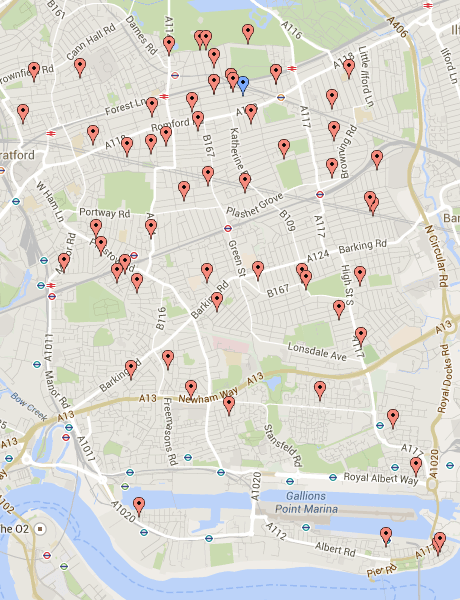
A map showing where the 60 Newham councillors (red) and the mayor (blue) live.
There’s a notable clustering in the north of the borough, with less than a third of them living south of Barking Road.
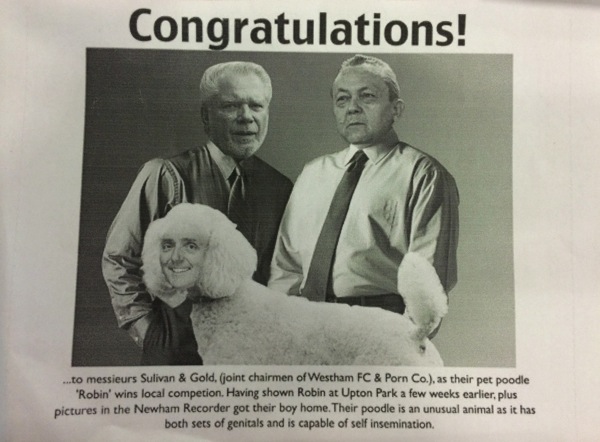
I got back from holiday last night to find this waiting on my doormat. I gather a number of my neighbours have also received copies.
I’ve no idea who’s behind this, or the similar one that appeared just before the election, but they have quite an imagination!
 forestgatedotnet