
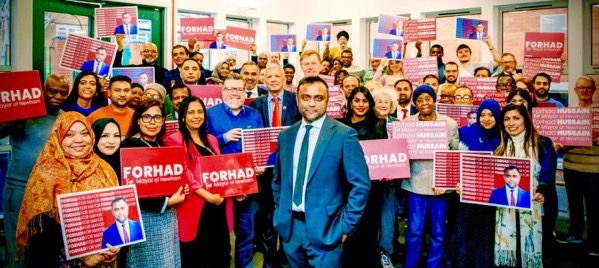
The votes have been counted and the results are in. Labour has retained the mayoralty and remains the largest party on the council, but beneath that headline lies a starker truth: the party has endured its worst ever result in Newham. Forhad Hussain’s victory was achieved with just 30.4% of the vote – a huge drop from the 56.2% achieved by Rokhsana Fiaz four years ago. And the 26 seats on the council is less than half the number they were defending.
What went wrong?
According to people I have spoken to, the first warning signs appeared long before polling day. They emerged during candidate selections, where factional manoeuvring and internal patronage appeared to matter more than competence, experience or public credibility.
Several deselections left sitting councillors deeply uneasy. A Black female councillor was removed amid a mixture of factional politics and personal hostility, while another was the subject of a strategically time complaint. In both cases, replacements were selected despite appearing less qualified or experienced.
At the same time, councillors who had previously broken the Labour whip — once treated within the party as a serious offence — remained in favour. Even more remarkably, Hanif Abdulmuhit who had expressed climate scepticism, congratulated an independent victory against Labour and campaigned for the Conservatives only two years earlier was re-selected as a Labour candidate. His wife – another former councillor – was also selected, despite a ‘rule’ applied to several others that married couples should not be both selected. ‘Standards’ became flexible when politically convenient.
The result was a perception of hypocrisy and stitch-ups. Increasingly, advancement appeared less dependent on merit than on factional usefulness, loyalty and personal connections. One councillor told me it resembled a patronage system rather than a modern political party.
This is not solely a local problem. Across London local government, experienced councillors are being sidelined while weaker but better-connected candidates advance. But Newham demonstrated the problem in particularly stark form.
At the centre of this culture was a small number of individuals outside of Labour Group exercising influence far beyond any democratic legitimacy. In the absence of a functioning local party – due to the five year-long suspension of the CLPs – London Region presided over selections. Environmentally-minded and left-leaning members were marginalised, while ideological flexibility was rewarded when politically expedient.
And then there’s the extraordinary influence granted to individuals with little meaningful modern local government experience. Despite the complexity of contemporary urban governance — housing delivery, transport planning, climate adaptation and regeneration — major strategic influence, including writing the 2026 manifesto, rested with people whose political instincts are rooted in an earlier political era.
The consequences extended beyond the selections themselves. A broader climate of intimidation and ideological management emerged during the campaign. Candidates were reportedly discouraged from publicly supporting active travel policies or defending Low Traffic Neighbourhoods and Healthy School Streets. Some feared that even mild dissent from the mayoral campaign’s political direction could jeopardise future opportunities within the party.
This reflected a deeper and long-standing institutional problem. With the local parties suspended there is no space for ordinary members to discuss or debate policy. Detached from any sense of what the membership wants or thinks, internal Labour Group politicking became more important than policy or governance. Influence flowed not from expertise, delivery or public persuasion, but from factional positioning inside the party machine. Internal manoeuvring displaced serious political debate.
That culture may once have been survivable in a borough where Labour dominance was virtually guaranteed. But, as this election has demonstrated, Newham is no longer politically monolithic. It is more fragmented, more competitive and more politically diverse than at any point in its history. A party that selects candidates primarily through internal factional logic rather than electoral credibility is ultimately selecting for decline.
What emerged during these selections was therefore not merely a series of isolated controversies, but evidence of an internal political culture that had become insular, complacent and detached from the borough it seeks to govern.
Part 2 – Manifesto for a borough that no longer exists
Part 3 – How Newham Labour lost the campaign
Disclosure: I applied to be a Labour candidate at this election and was unsuccessful. The panel declined to pass me on the basis of two social media posts in which I criticised Keir Starmer (here and here). Feel free to judge the above accordingly.


Leave a Reply