Archive | Politics RSS feed for this section

Money works

2 Jul

Newham Labour M 012

In his 2014 local government manifesto Sir Robin Wales promised to address the problem residents face from the high cost of credit and rip-off pay-day loans by setting up a council-run alternative: 

Labour will set up a one stop shop – Money Works – which will provide a range of support to responsible residents including:

  • Pay day loans – at fair rates
  • Access to loans for white goods – at fair rates
  • A life changing fund which provides loans when people have a realistic and sensible idea which could change their lives – at fair rates
  • Access to low cost home furnishings
  • Crisis loans
  • Access to credit to clear loans in certain instances
  • Support, guidance and loans to help you with your energy bills.

The basis of this one-stop shop will be that residents will only be able to access loans if they are responsible. Any failure to repay the money owed will mean they can never get any support again for Money Works.

On the face of it, that sounds like a good idea – though, given that Sir Robin thinks 80% of London market rents are ‘affordable’, quite what his idea of ‘fair rates’ might be is anyone’s guess.

But it’s actually completely redundant – an alternative source of low cost affordable finance for residents already exists – Newham Credit Union:

NewCred is a community based credit union. It is a not-for-profit organisation owned and run by its members. As part of a worldwide credit union movement it provides financial services to the people of Newham. NewCred strengthens social networks and contributes to the local economy.


NewCred aims to be the primary provider of low cost affordable financial services in Newham. [emphasis added]

Why would the mayor want to go to the trouble and expense of setting up and then managing an in-house operation rather than simply point residents to NewCred? Given that credit unions are cooperatives, owned and run by their members, this would be a good way for Sir Robin to help build the more self-reliant, resilient community he talks about.

And supporting NewCred would fit in with Labour policy nationally. Ed Miliband has promised his government will impose a levy on the profits of payday lenders that would be used directly to fund the expansion of credit unions.

So why not do it? I asked some of the candidates – now councillors – before the election and the answer that came back was a “concern about scale.”

But the council could help NewCred overcome that and make it a genuine local alternative to the likes of Wonga. It would take a bit of investment. NewCred’s office’s on Romford Road are not exactly prominent, so retail store fronts in, say, Stratford shopping centre and East Ham high street would be a huge boost. Newham has ready access to exactly that kind of commercial property, which it could lease at favourable rates.

And the council could become a depositor – if Newham can put £7 million into risky Icelandic banks, why not the rock-solid local credit union?

Then there’s advertising and promotion. Perhaps Sir Robin could be persuaded to have his photo taken at NewCred’s offices opening his own savings account and published in the Newham Mag. Stories could be placed in the Recorder. I know he’s normally a bit reticent about that sort of thing, but he could be persuaded for a good cause!

I suspect though that the real objection to building up NewCred is one of control. For all his talk of fostering independence and building resilience, Sir Robin wants everything to come from Building 1000. Even your white goods and home furnishings.

Making plans for Robin

26 Jun

Scene: the mayor’s office in Building 1000. Sir Robin Wales is meeting representatives from ‘executive recruitment consultants’ Moneyfore Olderope & Co.

Date: sometime in the distant future

Sir Robin: Thanks for coming in, guys. We need some help finding someone to chair the board of our private housing rental business Red Door Ventures. People who can give us the independent advice we need so that we make the right choice for our residents. 

Moneyfore:  At Moneyfore Olderope we know that’s what really matters. You can rely on us.

Sir Robin: It’s an important job. Red Door Ventures is owned by the council, but operates as a private business. We’ve used the borrowing power of the council – backed by public money – to build 3,000 new homes and buy 500 others. But we’ve done it in a way that means we aren’t obliged to let any of them to people on the housing waiting list. Most of the homes are let at full market rates which, as you can imagine, puts them out of reach of those kinds of people. But for appearance’s sake – after all, we are supposed to be a Labour council – some of them are rented at what we call ‘affordable’ rates.

Olderope: ‘Affordable’?

Sir Robin: 80% of the market rate. 

Olderope: So they’re still quite expensive then?

Sir Robin: Oh yes, way too much for people who need social housing.

Moneyfore: 3,500 homes at London rents. Even with a few of those [makes air quotes gesture] ‘affordable’ units you have quite a business there. £5 – £6 million a month in revenues?

Sir Robin: In that ballpark.

Olderope: Which is why you need a big name to chair the board. Give it the profile it deserves.

Sir Robin: But not just any big name. We need someone with knowledge of the local area. Someone who knows how to keep the press onside. Someone the councillors on the board can look up to and respect, who can provide the leadership and vision they are used to.

Moneyfore: So they’d need political as well as business experience.

Sir Robin: Absolutely. And it would be good if you could find a candidate with previous experience as a director on a big public sector delivery project. Like the Olympics, say.

Olderope: [scribbles the word LOCOG on notepad] Go on…

Sir Robin: You know, I always think a title adds a bit of gravitas. A lord, or a Sir. Always looks good on the letterhead.

Moneyfore: Those people are quite hard to find. And they don’t come cheap.

Olderope: Are you thinking this is a full time role, or a day or two a week?

Sir Robin: Part-time. Something that might suit someone who’s recently retired but wants to keep their hand in, so to speak. And earn a little to top up their pension.

Moneyfore: A little?

Sir Robin: We were thinking in the region of £40 – 50,000 a year for a 2 day week.

Olderope: Very reasonable.

Moneyfore: Well, leave it with us Sir Robin. We’ll have a think about possible candidates. Come back to you in a week or so with a list.

They stand up and shake hands.

Sir Robin: Oh, before you go… this isn’t public yet but I’ve decided not to stand for re-election next year. It’s time to wind down a little. But it would be nice to still have a little something…

Moneyfore: … to keep your hand in, so to speak.

Olderope: And top up the pension.

Sir Robin: Exactly. So if you hear of anything suitable…

Moneyfore: Funny you should mention it, but we’ve just received this interesting new brief…

Fade to black

Disappearing act

17 Jun

Photo by Karls Kamera

According to Wikipedia, the oozlum bird is a legendary creature found in folk tales that, when startled, will take off and fly around in ever-decreasing circles until it manages to fly up itself, disappearing completely.

After reading this account of goings-on within Left Unity and this piece on relations between them and TUSC I am pretty sure the definition applies equally to the hard Left.

30 years ago, when I was briefly a student member of the now utterly discredited and irrelevant SWP, it was much the same. Then it was ‘us’ versus the WRP, Militant, RCP, IMG and a whole alphabet soup of teeny-tiny groups, all arguing over paper-thin differences of interpretation of what Trotsky said at some conference in 1937. Like anyone cared

Now it’s LU versus TUSC. And even worse, within LU itself, the ‘Socialist Platform’ versus the ‘Communist Platform’. The party is less than a year old and already it has a disputes committee. Does anyone think this sort of thing is remotely appealing to the rest of the world?

In the recent mayoral election TUSC got less than 2% of the vote, despite standing against a Labour incumbent with a depressingly right-wing record. 

Unless and until the non-Labour Left gets its collective head out of its arse and focuses its energies on engaging real people in the real world about the real problems they face it’s doomed to decades more of irrelevance. 


Money (that’s what I want)

13 Jun


The best things in life are free, but you can keep them for the birds and bees

Details of the allowances paid to the mayor and councillors in the last financial year (2013/14) have been published in the ‘Summer Edition’ of the Newham Mag.

The Mag’s version of the table lists councillors in alphabetic order (except the mayor, obviously, who is always on top) and doesn’t include any totals. So it’s hard to see exactly how much is being paid and to whom.

I’ve taken the data, added up totals for each councillor and sorted them into rank order:

Name Basic* SRA Total
RA WALES 0 81,029 81,029
AR BAIKIE 10,734 31,042 41,776
IK CORBETT 10,734 31,042 41,776
RJ CRAWFORD 10,734 31,042 41,776
U DESAI 10,734 31,042 41,776
CW FURNESS 10,734 31,042 41,776
LT HUDSON 10,734 31,042 41,776
C MCAULEY 10,734 31,042 41,776
A KELLAWAY 10,734 26,901 37,635
EH SPARROWHAWK 10,734 22,765 33,499
E ROBINSON 10,734 22,720 33,454
Q PEPPIATT 10,734 18,624 29,358
F HUSSAIN 10,734 18,039 28,773
RA MIRZA 10,734 17,877 28,611
RN MANLEY 10,734 14,488 25,222
AB MCALMONT 10,734 14,488 25,222
T PAUL 10,734 14,488 25,222
WT VAUGHAN 10,734 14,488 25,222
NJ WILSON 10,734 14,488 25,222
A SINGH 10,734 10,347 21,081
K SCORESBY 10,734 9,362 20,096
J ALEXANDER 10,734 5,176 15,910
F BOURNE 10,734 5,176 15,910
S BRAYSHAW 10,734 5,176 15,910
A CHOWDHURY 10,734 5,176 15,910
D CHRISTIE 10,734 5,176 15,910
R RAHMAN 10,734 5,176 15,910
L SHAH 10,734 5,176 15,910
J GRAY 10,734 3,621 14,355
PW SCHAFER 10,734 3,449 14,183
S AHMAD 10,734 0 10,734
PM BRICKELL 10,734 0 10,734
L CAMERON 10,734 0 10,734
NK CHADHA 10,734 0 10,734
AA CHAUDHARY 10,734 0 10,734
B COLLIER 10,734 0 10,734
MS COLLIER 10,734 0 10,734
JH CORBETT 10,734 0 10,734
C FIBERESIMA 10,734 0 10,734
O GANGADHARAN 10,734 0 10,734
A GRIFFITHS 10,734 0 10,734
PM HOLLAND 10,734 0 10,734
KJ JENKINS 10,734 0 10,734
KR KAZI 10,734 0 10,734
JH LAGUDA 10,734 0 10,734
S MAHMOOD 10,734 0 10,734
C MCLEAN 10,734 0 10,734
P MURPHY 10,734 0 10,734
F NAZEER 10,734 0 10,734
FA NEKIWALA 10,734 0 10,734
M NICHOLAS 10,734 0 10,734
M PATEL 10,734 0 10,734
S PATEL 10,734 0 10,734
G PEARSON 10,734 0 10,734
P SATHIANESAN 10,734 0 10,734
PJ SHILLINGFORD 10,734 0 10,734
MM SKYERS 10,734 0 10,734
R TALATI 10,734 0 10,734
A TAYLOR 10,734 0 10,734
S THOMAS 10,734 0 10,734
H VIRDEE 10,734 0 10,734
Totals: 644,040 560,700 1,204,740

*net of £95 deducted at source for home use of a council-supplied computer and data registration fee

A few things worth noting:

  • 29 out of 60 councillors received some kind of ‘special responsibility allowance’ on top of their basic
  • The top 10 recipients of council cash, including the mayor, were all men
  • Only one woman, Forest Gate’s Ellie Robinson, is in the top 20 earners from councillor allowances
  • Of the 29 councillors with ‘special responsibilities’, just 6 were women
  • Including the mayor, 14 elected members got more in allowances than the average Newham household income
  • Prior to the change to the mayoral system in 2002 councillors received a basic allowance of just £533 a year

There has as yet been no public announcement about the allowances to be paid to the cabinet members and mayoral advisors Sir Robin has appointed following his re-election, but you can bet that they won’t be stinting themselves.

Public service can be so rewarding.

Oh, Ed

12 Jun

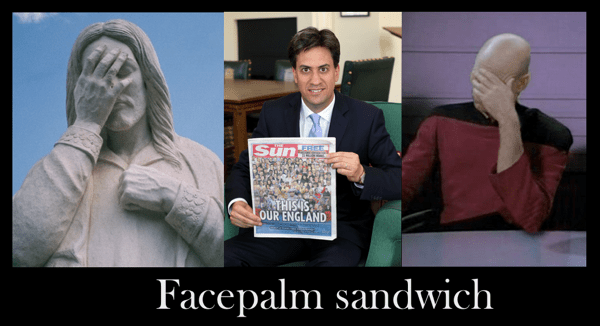
Facepalm sandwich

Words fail me.

No social housing please, we’re Newham

10 Jun

600full charles hawtrey Sir Robin meets a developer who’d rather pay cash than provide social housing

Back at the end of March I submitted a Freedom of Information request to Newham council about the amount of new housing built in the borough since the award of the 2012 Olympics:

Since 6th July 2005 to today’s date:

1. How many dwellings have been built in Newham by private developers?

2. How many of these have been added to the borough’s social housing stock through section 106 agreements?

For both questions, please provide total figures for the borough and a breakdown by ward.

For the purposes of this question, a dwelling means a self-contained unit of accommodation. Self-containment is where all the rooms (including kitchen, bathroom and toilet) in a household’s accommodation are behind a single door which only that household can use.

The due date for a response was 30 April, three weeks before the local elections.

I finally got an answer on Friday, two weeks after the election (make of that what you will). It makes for some pretty dismal reading:

Ward Housing completions from all sources Of which built for social rent (of which delivered through a S106 agreement) Of which built as Council social rented stock
Beckton 467 33 (23)
Boleyn 83 2
Canning Town North 538 113 (93)
Canning Town South 1882 158 (153)
Custom House 196 78 (33) 6
East Ham Central 175 34
East Ham North 132 16 (9) 7
East Ham South 66 12
Forest Gate North 299 76 (61)
Forest Gate South 378 49 (2)
Little Ilford 131 11 (10)
Green Street East 105 0
Green Street West 249 40 (26)
Manor Park 124 6 2
Plaistow North 426 220 (38)
Plaistow South 184 9 1
Royal Docks 552 95 (16) 6
Stratford and New Town 2292 475 (363)
Wall End 47 0
West Ham 361 156 (85)
Total 8687 1583 (912) 22

 (all figures are no. of units)

The council’s Core Strategy document says, on the subject of affordable housing:

The Council will ensure that our communities are places where residents can afford to live, and are adaptable to their changing economic circumstances.
To achieve this we will:

1. Aim to ensure 50% of the number all new homes built over the plan period [2004 – 2013] are affordable;

2. Seek all new developments or redevelopments on individual sites with capacity for 10 units or more to provide between 35-50% of the number of proposed units affordable housing, comprising 60% social housing

On the basis of the figures provided to me, that’s a big fat fail. Why haven’t developers been required to stick to the plan? Why are blocks of apartments being built that can be advertised to overseas ‘investors’ as ‘100% private; no social housing’?

In recent years Newham has received millions of pounds from central government in new homes bonus and next to none of this has been spent on housing, despite the acknowledged need for more affordable housing in the borough. 

Newham has also been handed millions in payments from developers in lieu of social housing provision where “exceptionally” it has been judged impractical to provide it.

Hopefully (I’m not holding my breath) our newly elected local councillors will ask the questions residents want answered: where are the affordable homes we desperately need and where has the new homes bonus and S106 money been spent?

It was 20 years ago today

9 Jun

On the eve of the Newham North East by-election – 20 years ago today – Alec Kellaway, the sole opposition councillor and Liberal Democrat candidate, defected to Labour.

His friends and supporters who had campaigned tirelessly for him for weeks were devastated. It was, they said, a bitter blow.

So congratulations to Councillor Alec Kellaway on 20 years as a member of Newham Labour party. I’m sure the champagne is on ice at Building 1000.

Turns out

9 Jun

Turnout

Newham’s electorate and turnout at borough-wide elections since 1964 (source: LBN)

Year Electorate Turnout
1964 179,870 29.4%
1968 177,134 25.1%
1971 183,134 29.4%
1974 176,445 22.5%
1978 176,760 31.1%
1982 163,758 31.4%
1986 160,536 34.9%
1990 157,951 36.5%
1994 151,895 37.6%
1998 139,273 28.4%
2002 157,505 25.5%
2006 187,702 34.5%
2010 195,058 52.74%
2014 195,419 40.6%

A few random observations:

Firstly, citizen engagement with local politics remains appalling low. Only once in the history of the borough has turnout exceeded 50% and that was driven by the general election being held on the same day. Even the lure (ahem) of the European elections wasn’t sufficient to get 60% of voters to bother.

Why don’t more people make the effort? This isn’t just a Newham problem. Across London turnout for local elections hovered around the 40% mark. Despite having come a long way from the low point of 22.5% turnout in 1974 there’s a looming crisis of democratic legitimacy.

The lazy answer is that we just need to make voting easier. But it’s already ridiculously easy: polling stations are within walking distance and open for 15 hours; postal votes are available on demand. It has to be about making local politics relevant and engaging people in conversations about things that are important to them and their communities; it has to be about making people feel their vote will count; and it has to be about making local politics more than just getting the vote out once every four years.

Secondly, take a look at the size of the electorate in 2010 and 2014. Thousands of new homes are being built in the borough and there’s been a significant increase in over-crowding. We know the local population is rising rapidly, yet the number of registered voters has grown by less than 400.

Does that strike you as odd?

Then there’s the difference between the size of electorate for local elections and for the European election.

According the results published by Newham, turnout for the Euros was 43.6% based on an electorate of 173,606. That’s almost 22,000 less than for the local election.

People entitled to vote in local government elections are all also entitled to vote in European elections – British citizens, Irish citizens, Commonwealth citizens and EU citizens living in the UK. So where did all those voters go? Were people who wanted to vote in the European election turned away?

New community lead councillor

5 Jun

Community Lead Councillor

Councillor Rohima Rahman has been named as the new community lead councillor for Forest Gate.

The announcement was included in a list of Sir Robin’s new line-up of cabinet members and advisors published on the council website.

Our previous lead councillor, David Christie, has been promoted and is now mayoral advisor for ‘Small Business Programme and Local Enterprises’.

It is a strange appointment. Councillor Rahman does not represent either of the two Forest Gate wards, nor does she live here.

Councillor Mas Patel of Forest Gate South qualifies on both counts, but he has been appointed as lead councillor for Stratford and West Ham.

Besides Mas Patel there are many other councillors who are local residents, or who represent us, and are not otherwise occupied advising the mayor or scrutinising him – Seyi Akiwowo, John Gray, Alan Griffiths or Rachel Tripp, to name just a few.

Why could Sir Robin not have given one of them the job?

Getting things in proportion

4 Jun

PR Council

Newham council would look very different under PR

Last week the Hackney Citizen reported that in their borough the Greens would have won seven seats under a proportional voting system, whereas they actually got none – despite getting more than 20% of the vote.  In total PR would have delivered twelve opposition councillors, rather than the seven actually elected (four Tories, three LibDems).

Things in Newham are even worse.

For the second election running, not a single opposition councillor was elected, despite one-third of voters choosing candidates from parties other than Labour. According to the council’s own results webpage, the Conservatives got 24% of the vote.

Using exactly the same analysis as the Hackney Citizen – applying the proportional representation system used in the European elections to the Newham results – the Tories would have won twelve seats, making them the largest opposition group. And, despite standing in only a handful of wards, UKIP would have two councillors.

Labour would have won all three seats in six of the 20 wards – Boleyn, Canning Town North, Forest Gate North, Little Ilford, Stratford & New Town, and West Ham – and two in all the rest. UKIP would have taken a seat in Canning Town South and in Custom House, with the Tories taking a seat in each of the 12 remaining wards.

How did I work this out?

The system used in the European election relies on voters selecting a single party, rather than vote for individual candidates as they do in ‘first past the post’ elections. To get around this I averaged the votes for the candidates for each party. I did this in every ward.  From this I could then apply the D’Hondt method to calculate the results.

Taking Forest Gate South as an example, this is the actual result:

Candidate Party Votes
Masihullah Patel Labour 2209 Elected
Dianne Walls Labour 2095 Elected
Winston Vaughan Labour 2023 Elected
Mahboob Rizu Ahmed Conservative 993
Asif Choudhary Conservative 976
Tim Roll-Pickering Conservative 693
William Heron Liberal Democrat 293
Niall Mulholland TUSC 238
Dieutane Jean Parson Christian Peoples Alliance 179
Malcolm Williamson Christian Peoples Alliance 159
Ionel Vrancianu Independent 101

This gives an average party vote of:

Party Votes
Labour 2109
Conservative 887
Liberal Democrats 293
TUSC 238
CPA 169
Independent 101

Since Labour has the most votes they win the first of the three seats available.

For the second seat the votes for each party are divided by the number of seats they have won, plus 1. So Labour’s vote is divided by two and the other parties are divided by one (so they stay the same), which gives us:

Party Votes
Labour 1055
Conservative 887
Liberal Democrats 293
TUSC 238
CPA 169
Independent 101

Labour still has the most votes and wins the second seat.

For the third and final seat the votes for each party are again divided by the number of seats they have won, plus 1. So now we divide the original Labour vote by three, as it has already won two seats, and the other parties stay the same:

Party Votes
Labour 703
Conservative 887
Liberal Democrats 293
TUSC 238
CPA 169
Independent 101

In this round the Conservatives have the most votes, so they win the last seat. Forest Gate South has two Labour and one Conservative councillor.

A note of caution

These are only approximations since there’s no way of calculating with absolute certainty the result under proportional representation because of the differences between this system and first past the post. There’s also no way of knowing if changing the voting system changes people’s voting behaviour. Or if a different voting system would encourage more parties to stand candidates in more seats.

But it does provide a reasonable basis – using real results and a system actually used in the UK – to argue that our current voting system for local government is broken. It delivers an unfair result and a council that does not truly reflect the diverse political opinions of the community it is meant to serve.