Archive | March, 2026

Dude, where’s my car?

23 Mar

With the main contenders in May’s elections desperately trying to outbid each other to win the votes of car drivers – free residential parking permits, an hour (or two!) of free parking every day, a new multi-storey car park on Green Street – it’s worth asking… why?

Car ownership is a minority pursuit in Newham. Across the borough, less than half of households own a car or van. And there isn’t a single ward where car ownership exceeds 60%. In every single ward at least 40% of households won’t see a single penny of benefit from free permits or high street parking. But they will suffer the consequences of more traffic, more pollution, more noise and less safe streets.

It makes no sense whatsoever.

Ward

Total HHs

HHs with no car

% no car

Stratford

6801

4776

70.22%

Stratford Olympic Park

4513

3105

68.80%

Royal Victoria

6745

4276

63.40%

Canning Town South

2795

1729

61.86%

Maryland

4521

2641

58.42%

Canning Town North

3830

2229

58.20%

Plaistow West & Canning Town East

5824

3170

54.43%

Forest Gate South

5864

3147

53.67%

Plaistow North

5752

3001

52.17%

West Ham

5338

2774

51.97%

Royal Albert

3660

1811

49.48%

East Ham

4299

2099

48.83%

Boleyn

4566

2189

47.94%

Manor Park

4688

2213

47.21%

Green Street West

4136

1938

46.86%

Plaistow South

4215

1974

46.83%

Custom House

6195

2866

46.26%

Green Street East

4440

2053

46.24%

Forest Gate North

3802

1738

45.71%

Little Ilford

5065

2292

45.25%

Plashet

2948

1292

43.83%

Wall End

4597

1971

42.88%

Beckton

5485

2249

41.00%

East Ham South

5435

2178

40.07%

TOTAL:

115514

59711

51.69%

Source: Office for National Statistics, 2021 UK Census

“Car is a necessity not a luxury,” says Cllr Mirza, Newham the Independent candidate, in his election materials. Given half of all residents in the borough don’t own a car, I wonder how he thinks they survive. Does he imagine they are all sat at home, unemployed and starving because they can’t get out to find a job or go to the shops?
A Failure of Leadership

19 Mar

Ballot box
“We will consult properly and use community ballots to make sure decisions on important changes to your local street and environment are made by you.” So says Forhad Hussain on his current election leaflet, under the heading ‘Leadership you can rely on.’

Similarly, Newham Independents candidate Mehmood Mirza promises to “cancel all proposed LTNs and properly consult on the existing ones.”

When local politicians champion “community ballots” or “proper consultation” on schemes like low traffic neighbourhoods, they frame it as ‘democracy in action’—giving residents the final say on their streets. The reality, however, is that this is an abdication of leadership at precisely the moment when communities need it most.

The fundamental problem with these ballots is that they reduce complex policy decisions to binary choices. Traffic management isn’t about whether people like or dislike a scheme in isolation. It’s about balancing competing needs: child safety versus driver convenience; air quality versus journey times; long-term health outcomes versus short-term disruption. These are exactly the kinds of trade-offs we elect representatives to navigate on our behalf, using evidence and expertise alongside public input.

Moreover, the playing field for these ballots is far from level. Well-organised opposition groups, amplified by outside actors with their own agendas, flood communities with disinformation. Claims about emergency vehicle access, economic decline, or displacement of traffic are often exaggerated or outright false, yet they resonate emotionally because people are nervous about change. Meanwhile, the diffuse benefits—cleaner air, safer streets for children, reduced through-traffic, less noise pollution—are harder to mobilise around, even though the evidence supporting them is strong.

As a result communities become battlegrounds. Neighbours who previously coexisted peacefully find themselves on opposite sides of an artificially sharpened divide. Social media arguments replace constructive dialogue. The ballot doesn’t build consensus; it entrenches positions and creates winners and losers. Conflict instead of cohesion.

True leadership means making difficult decisions based on evidence, even when they’re initially unpopular. Of course it means consulting communities and listening to concerns: schemes can be adapted where legitimate issues arise—but ultimately it’s about taking responsibility for the outcome. Politicians who instead defer to referendums are passing the buck, hoping to avoid accountability by ‘listening to the people’.

If a scheme is genuinely worthwhile, the mayor and council should implement it, monitor its effects, and be prepared to modify or reverse it based on real-world outcomes. This is governance. Community ballots, by contrast, are a recipe for division. Elevating the loudest voices over the best evidence isn’t leadership, it’s the exact opposite.

Newham deserves better than politicians who mistake populism for democracy and ‘community ballots’ for governing.

Free Parking Isn’t Really Free

11 Mar

Parked cars

Two of the leading candidates for mayor of Newham in May’s election are promising voters “free parking.” Labour’s Forhad Hussain says he will give residents an hour a day, anywhere in the borough. Mehmood Mirza of the Newham Independents has trumped that, offering 2 hours a day.

While that parking might ‘free’ in the sense that drivers don’t have to pay for it, it comes at a very considerable cost to the wider community.

Free parking is presented as a simple way to support residents with the cost of living and help local shops. The logic seems intuitive: if parking is cheaper, more people will visit the high street. But that ignores a well-established concept in transport economics known as Induced Demand.

Induced demand is what happens when the cost or difficulty of a particular activity is reduced. When something becomes easier or cheaper, people do more of it. In transport, this principle is most often discussed in relation to road building—new road capacity tends to attract additional traffic which quickly wipes out the advantage of having built it. The same dynamic applies to parking.

If parking becomes free, especially for short stays, it changes how people make everyday travel decisions. When parking costs money or requires effort—finding a machine, worrying about time limits—people think twice before driving a short distance. They may walk, cycle, or combine several errands into one trip. Removing the cost component changes that calculation. Suddenly, a quick car journey for a single item or a short visit feels worthwhile – it’s ‘free’ so why not?

As a result, free parking generates extra trips that would not otherwise have occurred. People may drive for errands they previously would have walked; make several separate trips instead of combining them; or return multiple times during the day because each visit includes a free parking period (neither candidate has explained how they would prevent people abusing the system like this). Even if the number of parking spaces remains unchanged – road space is a finite resource – the number of vehicle movements increases.

Parking spaces are limited, particularly in busy town centres like Green Street, Stratford and Forest Gate. When there’s a free hour of parking these spaces are often occupied by very short visits—coffee pickups, takeaway collections, or quick errands. These trips generate more traffic but do not necessarily contribute much to the local economy.

At the same time, the increased turnover of parking spaces means more cars circulating through the area: drivers searching for spaces, pulling in and out of bays, and making short journeys between nearby destinations. Research has shown that a notable share of city traffic consists of vehicles simply looking for some where to park. And all of those cars are generating pollution – exhaust fumes, brake pad dust, and micro-particles of tyre rubber.

Free parking can also have unintended consequences for the broader transport system. When driving becomes artificially cheap, it weakens the relative attractiveness of other ways of getting around. Walking, cycling, and public transport all become slightly less competitive compared with the convenience of driving door-to-door. Over time, this can reinforce car dependency and increase traffic volumes on local streets. In dense urban environments like Newham, that brings knock-on effects such as congestion, noise, and poorer air quality. These impacts affect everyone, including the very large number of residents who do not drive. 

Giving residents free parking for an hour (or more) daily sounds fair, but it isn’t. Only half of Newham households own or have access to a car, so the benefits are skewed to towards those well-off enough to own and run a car, while everyone faces more traffic, noise, and pollution.

Parking policy is not just a revenue issue – though it definitely is and giving up millions of pounds a year in income will have knock-on consequences elsewhere in the council budget – it’s a transport management tool. Pricing and regulation help balance access to public space with the need to manage traffic and support healthier, more sustainable travel choices. 

In short, while free parking may appear attractive, it comes with consequences. By lowering the cost of driving, it t encourages more car journeys—particularly short ones—adding pressure to already busy streets and undermining wider transport and public health goals. And in a borough with an epidemic of inactivity and obesity, it is the worst possible policy.

And there’s more…

8 Mar

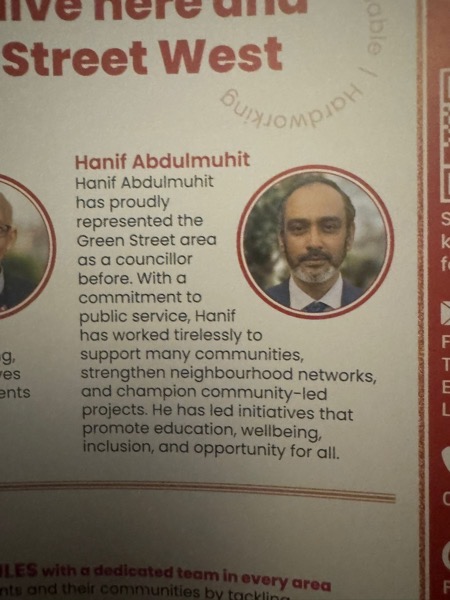
Hanif Abdulmuhit on a Labour leaflet

It seems that I was guilty of a couple of bits of understatement in Friday’s post about former councillor Hanif Abdulmuhit.

First of all, he is not just campaigning for Labour, he is a candidate in Green Street West, the seat he previously held for both Respect and Labour. 

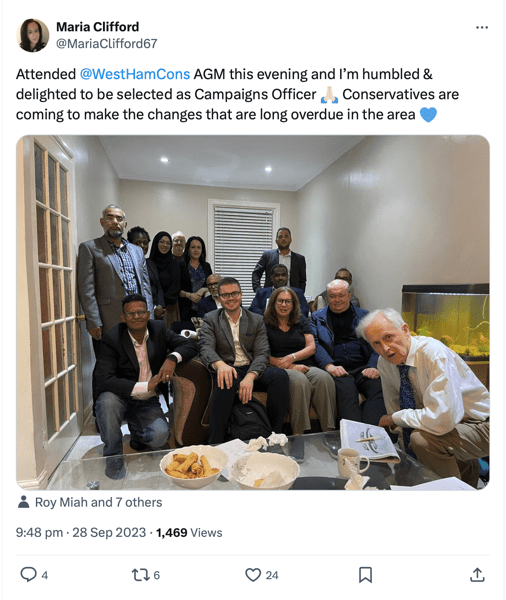
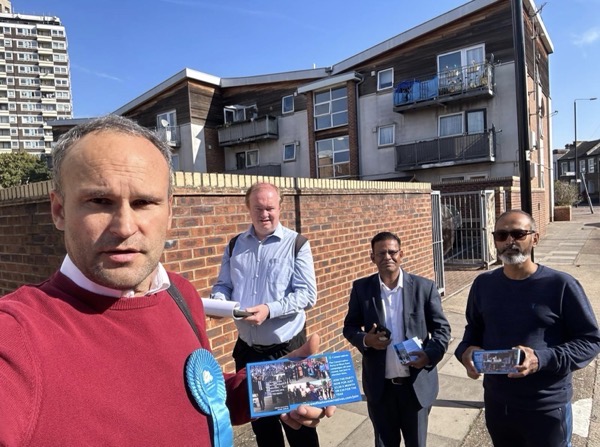
And secondly, his support for the Conservatives went beyond now-deleted social media posts – he joined the party and campaigned for it.

Tory AGM Tweet

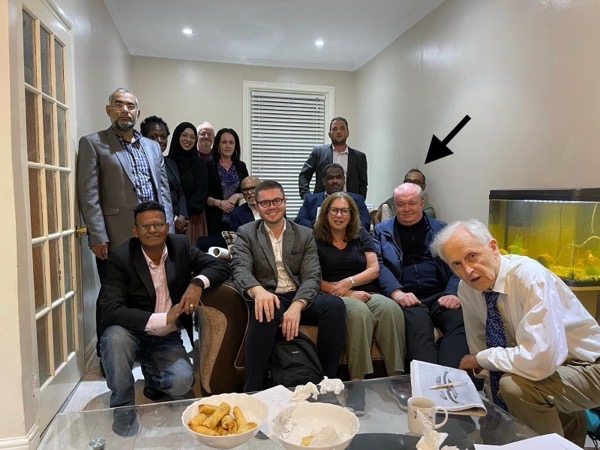
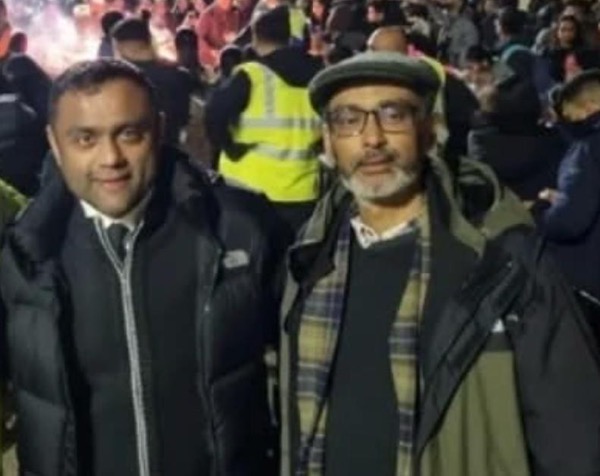
This tweet is from September 2023 and Abdulmuhit is there, at the West Ham Conservative’s AGM. He’s on the right, partly hidden by Tim Roll-Pickering’s head.

An arrow pointing at Hanif Abdulmuhit's head

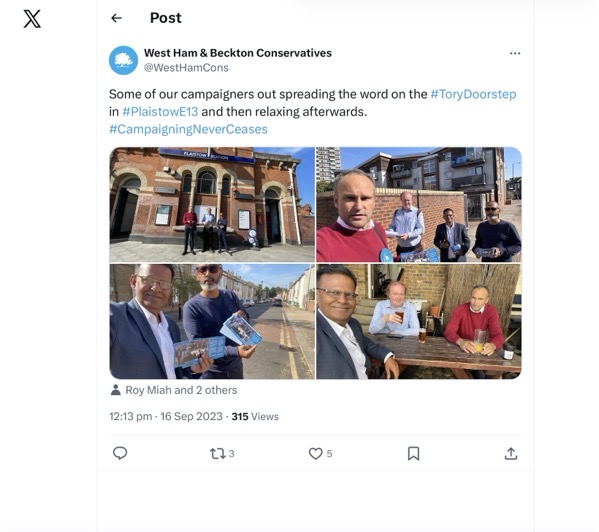
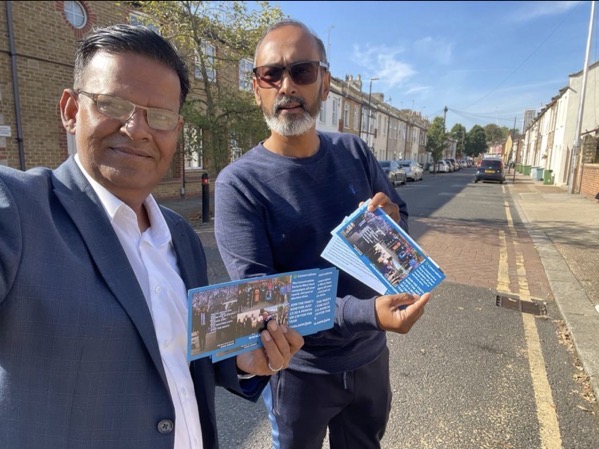
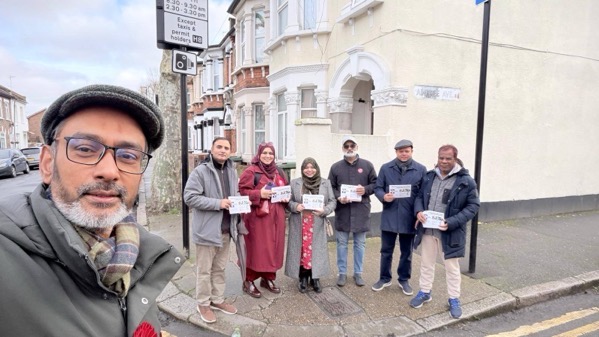
And here he is campaigning for them.

Tory canvas.

Hanif Tory canvassing.

I guess the Labour selection panel’s due diligence on his social media history wasn’t as diligent as it should have been.

A man for all seasons

6 Mar

Hanif Abdulmuhit campaigning in 2026

Hanif Abdulmuhit out on the Labour campaign trail

While we’re on the subject of people changing parties – not especially unusual in the small world of Newham politics – let’s talk about Hanif Abdulmuhit, who is currently out campaigning for Labour ahead of the upcoming local election. 

Abdulmuhit began his political life as secretary of Newham Liberal Democrats. He then joined George Galloway’s Respect party, winning a council seat in 2006, defeating Labour incumbents in the process, and standing as the party’s London Assembly candidate for City & East in 2008. As Respect collapsed in on itself, he completed the remainder of his term as a Labour councillor, sat out the 2010 elections, and then returned — fully reconstructed — as a Labour member in 2014. He went on to serve as a mayoral advisor for Building Communities and community lead for Green Street in the administration of Sir Robin Wales.

That second Labour stint lasted until 2022, when he was deselected by the NEC panel charged with picking the party’s candidates. There were suggestions that he was the victim of dirty tricks in the run-up to the selection process, and he took it very badly. In social media posts, subsequently deleted, he announced his support for the Conservatives.

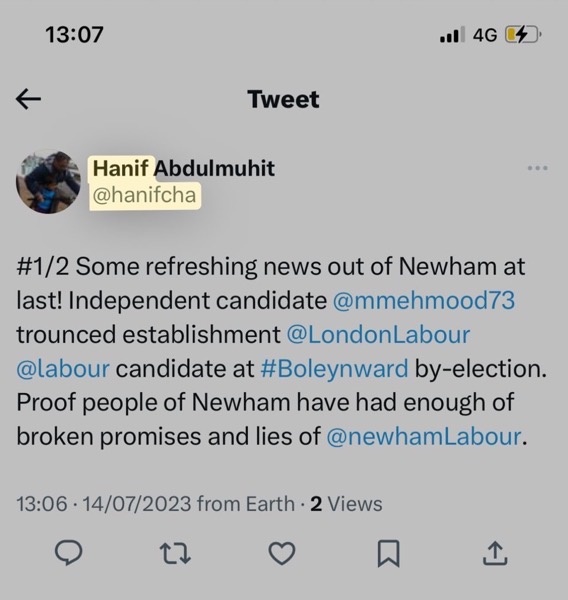
Abdulmuhit’s bitterness towards his former party was on open display in July 2023, when he posted gleefully about Labour’s defeat in the Boleyn ward by-election. “Some refreshing news out of Newham at last!” he wrote, celebrating the victory of independent candidate Mehmood Mirza and describing it as “proof people of Newham have had enough of broken promises and lies of Newham Labour.”

The irony — or the problem, depending on how you look at it — is that Mehmood Mirza is now Labour’s principal opponent in the Newham mayoral election. The same man whose victory Abdulmuhit publicly cheered, whom he held up as a symbol of Labour’s failure and the community’s rejection of the party, is today the candidate Labour most needs to defeat. 

The contradictions do not end with his serial party-hopping. Abdulmuhit was also posting views that sit strikingly at odds with Labour’s national platform and Newham Council’s own stated priorities.

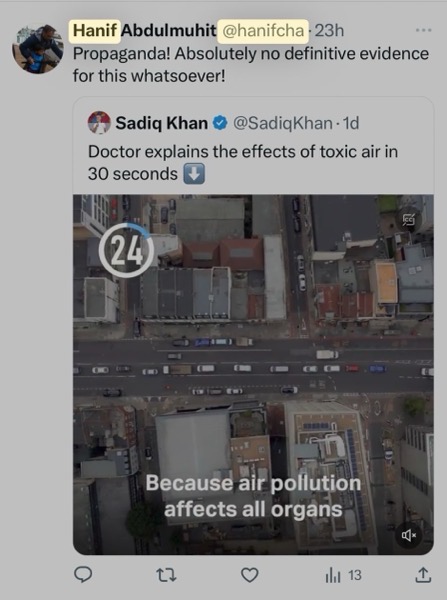
When Sadiq Khan shared a video explaining the health effects of toxic air, Abdulmuhit dismissed it as “Propaganda! Absolutely no definitive evidence for this whatsoever!” — a remarkable claim given that the scientific consensus on the harm caused by air pollution is overwhelming. Newham is one of London’s most polluted boroughs; the health consequences for its residents are not an abstraction.

.

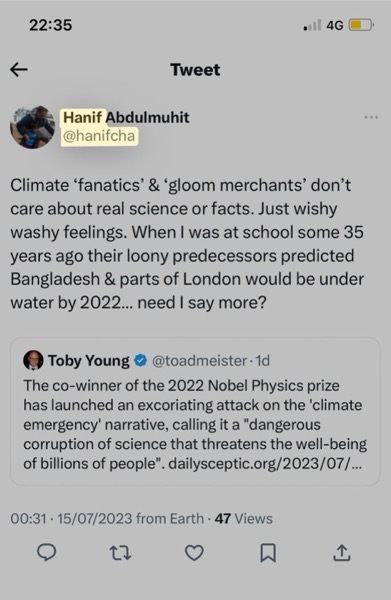
He also amplified a Toby Young article from the Daily Sceptic — a well-known climate-sceptic outlet — approvingly characterising climate scientists as “fanatics” and “gloom merchants” driven by “wishy washy feelings” rather than science. These are not merely heterodox views within the Labour family. They are positions associated with the right flank of the Conservative Party and its outriders, not with a movement that has made clean energy and environmental action central to its offer to voters.

Newham Council has declared a climate emergency and committed to ambitious net-zero targets. Labour nationally has staked significant political capital on its green agenda. A Labour activist publicly aligning himself with Toby Young on climate science is not a minor quirk — it is a meaningful ideological statement.

Hanif Abdulmuhit spent eight years as a Labour councillor before being deselected. He then publicly celebrated Labour losing a council seat, specifically praising the independent candidate who is now Labour’s main opponent in the mayoral race. He has dismissed the scientific evidence on air pollution as propaganda and shared climate-denying content from a right-wing sceptic outlet. He has also, at various points in the more distant past, been a Liberal Democrat and a Respect councillor.

None of this is secret. It is all a matter of public record — or was, before it was deleted along with the rest of his Twitter/X account.

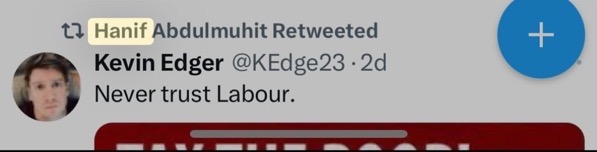
The question worth asking is not why Abdulmuhit wants back in. Political calculation is a constant in Newham, and the motivations of someone who has navigated this many different party loyalties are presumably pragmatic. The real question is why Labour would want him close to its campaign — and, more pointedly, why it would welcome back someone whose loudest recent contribution to Newham politics was cheering on the very candidate Labour is now trying to beat. And who retweeted this kind of thing:

Voters are entitled to know who is working on behalf of candidates they are asked to support. In a contest where Labour’s credibility and trustworthiness in Newham is itself at issue, the company a campaign keeps matters.

Forhad and Hanif

Having someone whose political journey spans the Lib Dems, Respect, Labour, the Conservatives (however briefly), and back again — and who was publicly delighted by Labour’s embarrassment less than two years ago — seems, at best, an unusual choice.

Are they related?

4 Mar

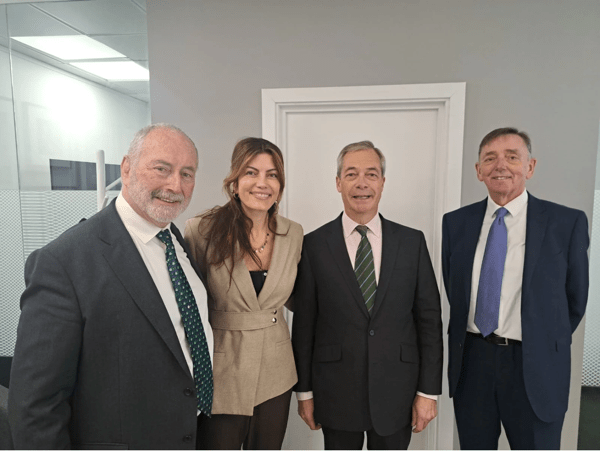
Clive Furness (with Laila Cunningham, Nigel Farage and Sir Robin Wales on the far right)

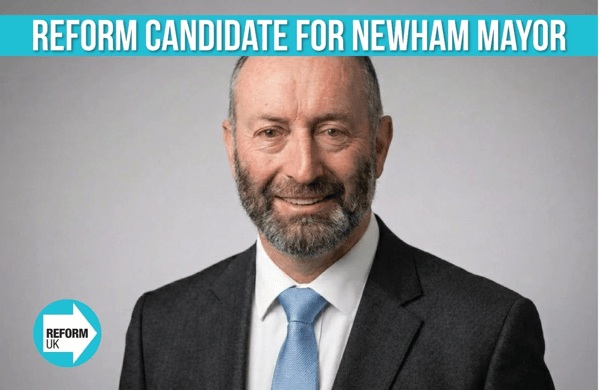
Reform’s mayoral candidate. A man who looks a bit like Clive Furness, but younger, thinner and with much darker hair.

Are they related?

Journey’s End

4 Mar

Wales Furness Reform.

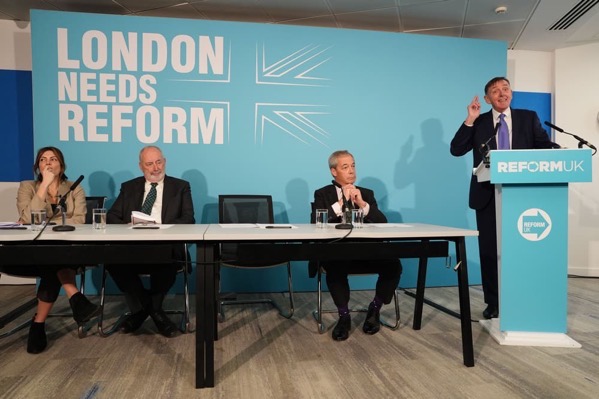
Robin Wales and Clive Furness with Nigel Farage (picture via London Evening Standard)

Well, it was bound to happen sooner or later. Sir Robin Wales and his long-time ally and fellow Blue Labour acolyte Clive Furness have defected to Reform UK.

Wales will be joining as ‘Director of Local Government Development’ and Furness will be the party’s candidate for Mayor of Newham.

Both men have long promoted a politics well to the right of mainstream Labour opinion and their recent piece in Spiked about why they left the Labour Party was merely a trailer for this announcement.

This blog was largely founded as a way for me to express my disgust and amazement that Wales, a man who so clearly possessed no Labour values whatsoever, was in any kind of leadership position at all, much less the all-powerful and unchallengeable directly elected mayor. And it turns out, in the end, I was absolutely right.

Those currently running what remains of the Labour Party in Newham – hollowed out by five long years of suspension – should have a long hard think about their decision to turn their backs on the last eight years and embrace the politics of the previous 20.

Wales and Furness have gone. Good riddance. Their politics should go with them.


Update: Wales’ new title at Reform is Director of Local Government Development, not Director of London Local Government as I previously had it. Apologies.