Archive | Newham RSS feed for this section

Verging on the ridiculous

9 May

The late Guardian journalist Simon Hoggart coined the phrase “the law of the ridiculous reverse”, which states that if the opposite of a statement is plainly absurd, it was not worth making in the first place.

It is entertaining to apply this to some of the statements in Newham Labour’s election manifesto. For example:

Labour will do the best we can to protect the services residents value

Would any party promise the opposite? They might win points for honesty but not many votes.

Or how about this:

Labour will continue to fully assess the effectiveness of all initiatives designed to reduce crime and will act appropriately to make them more effective.

The thought of the mayor promising to abandon assessment, act inappropriately and deliberately make crime reduction initiatives less effective is amusing but absurd. 

Labour will … ensure that our young people and adults are provided with greater and better choice.

As opposed to offering lesser and worse choices perhaps?

There are many others to choose from, but this one is my favourite:

we are reviewing the spend on public health to make sure that the money is targeted effectively on programmes which actually make a difference

And there I was expecting a promise to throw public money around like a drunk sailor on shore leave without regard to the consequences!

Talking of promises…

8 May

Vote Green 2014

The London Green Party is launching its campaign for the European and local elections today. 

You can read their manifesto for Europe and find out more about their local candidate for mayor, Jane Lithgow.

It is inconceivable that Jane will beat Sir Robin, but a vote for her would not be a waste. Every vote for another candidate is a vote for a different kind of politics in Newham; a vote that says there are other voices that deserve to be heard.

The European election is, unlike the local vote, proportional. Whoever you vote for, your vote will count towards electing an MEP that speaks for you.

Promises, promises

8 May

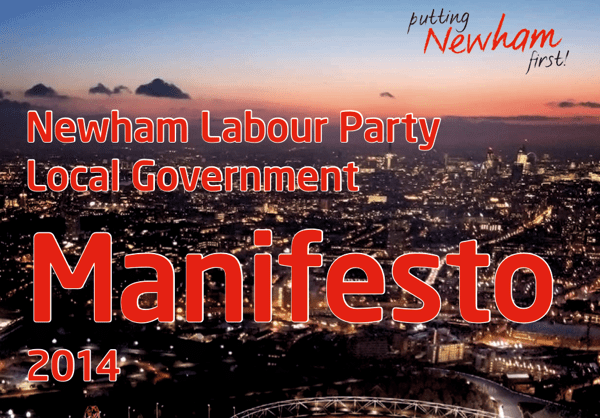
2014 manifesto cover

With just a couple of weeks to go until the election Newham Labour party has finally – after much prompting on social media – put its manifesto on its website.

It contains 18 “promises” of things Sir Robin will do over the next four years.

Download a copy so you can keep a careful eye out and see what he actually achieves. 

Mapping the candidates

7 May

Where the candidates live

Where do the candidates for mayor and council live?

You can see the whole map, including the colour key for the pins, on Batchgeo

Eight stages of loss

7 May

Yesterday I blogged about the need for electoral reform in local government and mentioned an Electoral Reform Society paper, Towards One Nation: the Labour Case for Electoral Reform.

That features a chapter called ‘Too much of a good thing’ which looks at how ‘safe’ councils with overwhelming majorities for one party are eventually lost. It is worth quoting the section on the process of degeneration at length: long-term residents of Newham will be struck by a sense of familiarity:

1. Taking voters for granted. In an environment where 40% of the vote on a 30% turnout is enough to win a ward, and usually a substantial council majority, a dominant party does not have to be particularly good at contacting the voters in its core areas. Turnout in those areas will tend to fall and the party’s efforts will concentrate on squeezing the other parties out of their remaining footholds.

2. Autocratic style of government. The internal processes of debate and scrutiny on the council start to fail. When opposition parties become too small they will often fall short of the minimum size required to constitute a Group, and therefore lose administrative back-up for their activities. Small opposition parties will find it difficult to look beyond parochial ward issues and mount a full critique of the council administration. Official council business becomes formal, with decisions being taken at best at the majority Group level and often by a Cabinet or just a Leader, with the Group also acting as a rubber stamp.

3. Bad decisions. Concentration of power and a lack of scrutiny lead to bad decisions being taken, and an arrogant attitude towards people who question those bad decisions – be they from the small number of opposition councillors, the local media, independent local bloggers or from within the majority Group.

4. Splits in the ruling party. Factional differences within the majority Group become more common and more divisive, sometimes leading to formal splits with some members going Independent. Nature abhors a vacuum, and a party with a local monopoly on power will often end up manufacturing its own opposition.

5. Hidden electoral weakness. The lack of connection between the leadership of the council, and the lack of effort put into elections, leaves the council majority strong but brittle. Any crisis could trigger the coalescence of a local opposition movement and the lack of engagement with the electorate means that just by going out and listening to voters the new rivals will look good.

6. Electoral collapse. The result will tend to be a sudden and indiscriminate collapse of the previous majority party, and the replacement political force may not be a constructive alternative.

7. Incompetent local government. Electoral collapse will usually be followed by a chaotic period of poor local governance by inexperienced councillors.

8. Recrimination and scandal. Skeletons start falling out of the cupboard about prior errors and scandals during the period of complacency.

This pattern of events, even if not every step of the process takes place, is recognisable in several authorities where Labour had previously held overwhelming majorities on the council including Doncaster, Hull, Stoke-on-Trent, Burnley and Slough.

Newham is obviously now at stage 3. From what I hear, stage 4 may be imminent. Disaffected Labour councillors may not formally split off into an independent group, but Sir Robin is not universally loved even within his own party and infighting within the Labour group could lead to significant ructions.

What happens then is anyone’s guess. But it won’t be pretty.

Labour’s interests as a party – and our interests as residents – would be better served by this not happening.

As uncomfortable as it may be for Sir Robin, a democratic opposition exercising its proper function of scrutiny would help his administration deliver honest, efficient local government in our interests – particularly those most in need of high quality public services.

The winner takes it all

6 May

Agnetha is sad

Agnetha is sad because her vote in the Newham council election will be wasted

If history is any guide, on 22 May the Labour party in Newham will win about 65% of the vote and 100% of the seats on the council.

Sir Robin and his band of merry men (and those closest to him are all men) will celebrate a great victory and carry on exactly as before.

The 35% who didn’t vote Labour will again have no voice and no representation. Sir Robin will face no tough questions, no challenge and no scrutiny from anyone who doesn’t already agree with him.

Does it really have to be this way?

As long ago as 1913 the Independent Labour Party, forerunner of today’s Labour party, argued that

“No system of election can be satisfactory which does not give opportunity to all parties to obtain representation in proportion to their strength.”

In January the Electoral Reform Society published Towards One Nation – the Labour Case for Electoral Reform [link downloads a PDF]. The report argues that by tolerating electoral deserts – places like Newham where there are no Tories, Lib Dems or Greens; as well as places where Labour itself has no voice – the party “is colluding in alienating people from political activity.”

Parties only have limited resources of finance and activism, and people understandably grow tired of throwing their money, time and effort at a hopeless cause. The more committed activists may be willing to travel to campaign in a marginal seat, but most people prefer to be active in their own community. 

In Newham, I doubt this argument holds much sway. Who cares if the opposition are demoralised and frustrated? All the better for us! 

But Sir Robin should beware.

Effectively locking a proportion of voters out of representation is bad not only on democratic grounds, but because the withering of opposition does not produce more wholesome politics.

Although Newham has so far been resistant to the far-right, you only need to look to what happened in Barking and Dagenham in 2006 to see the consequences of a complacent and neglectful Labour party with no traditional opposition voices: the election of 12 BNP councillors.

There is also the matter of good governance. As executive mayor Sir Robin has free rein over almost every significant area of policy. All that keeps him in check is oversight and scrutiny from councillors. But where all of those councillors come from the same party, what hope is there for genuine accountability? We know from experience the answer is ‘none.’ 

For 2014 we are stuck with ‘first past the post’ and the continuation of a one-party state. But a Labour government elected in 2015 could change things. And there is hopeful precedent:

Whenever the opportunity has arisen, Labour has recognised the importance of choosing fairer voting systems over First Past the Post. The first Blair government made a positive choice to endow new democratic institutions – both the Scottish Parliament and Welsh Assembly – with electoral systems considerably fairer than Westminster’s. And in 2007 a Labour-led coalition introduced the Single Transferable Vote (STV) for local elections in Scotland.

Local government in England struggles with a huge democratic deficit: fewer than half the electorate bothers to vote;  councils that should be the closest to and most engaged political institution with their communities seem remote; and there is little space for new and interesting voices.

The system is ripe for democratic reform and in Newham the need is urgent.

Fair and balanced

2 May

Despite the election, the council website continues to promote Sir Robin and his fellow Labour candidates

The small handful of residents that actually open the Newham Mag will have been surprised that the past two editions have been entirely free from pictures of Sir Robin Wales. This is because election rules require public authorities not to do anything that would appear to favour one candidate or party over another.

Strangely, that memo doesn’t seem to have reached the editor of the council website. The homepage continues to display a prominent picture of Sir Robin next to the caption ‘Meet the Mayor’. Clicking through takes you to a page with four more pictures of him.

The latest news section has a carousel of five pictures at the top, two of which feature the mayor. The picture accompanying the ‘Every OAP a ping-pong player’ story (shown above) also features several prominent Labour candidates for council.

But the council website is relatively restrained compared to the Newham Recorder. As an independent publication it is not bound by the election rules that constrain the Mag.

The three editions since the election was formally announced have featured Wales’ picture ten times. He’s been mentioned in stories sixteen times; the other candidates have been mentioned just once each, in a list.

The most recent edition even included a lengthy opinion piece by Sir Robin on why it is important we should vote, accompanied by a large photo of the man himself, just to remind you who it is you are meant to vote for.

The Recorder has pulled out all the stops to ensure maximum coverage for the man they know will be signing off the council’s advertising budgets for the next four years.

There’s nothing illegal about what the Recorder is doing, but readers are entitled to ask where the coverage is of the other candidates? If it’s important that we vote – and it is, it really is – then it’s vitally important that we make a properly informed choice.

Besides Sir Robin there are Tory, Liberal Democrat, Green, UKIP, Trade Unionist & Socialist Coalition, Communities United & Christian Peoples Alliances candidates for mayor. That’s quite a range of choices. Doesn’t the Recorder think its readers deserve proper coverage of all mayoral candidates, including opinion columns & pictures?

Local newspaper publishers have been vocal in calling for central government to get tough on council newspapers like the Newham Mag, which they characterise as ’town hall Pravdas’. Their case is undermined when supposedly independent papers like the Recorder fail to be, er, independent.

In the US the utterly biased right-wing ‘news’ channel Fox News has long used the slogan ‘fair and balanced’ to describe itself. The Newham Recorder should consider adopting it too.

Hat-tip to Mike Law for the stats on the Recorder’s coverage

A conversation with Hanif Abdulmuhit

29 Apr

Frustratingly WordPress won’t display embedded Storify content, so you’ll have to click the link below.

Apologies.

Manifesto, what manifesto?

28 Apr

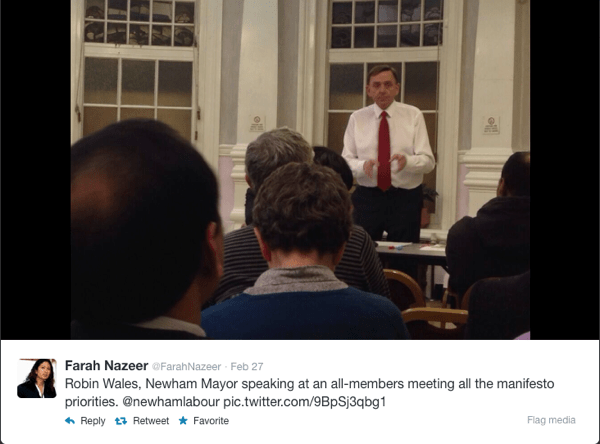
Manifesto meeting

So if Sir Robin was able to tell Labour members back in February what would be in the party manifesto for the local elections, why are voters still being kept in the dark?

With less than a month to go to polling day there’s no sign of it on the Newham Labour website. Where is it?

Sir Robin and – in all likelihood – his 60 councillor candidates will be elected in May. Shouldn’t we have some idea, beyond a few bland bullet points on a leaflet, what they plan to do for the next four years?

Other local parties have produced excellent manifestos, with detailed proposals. For example, Plymouth Labour Party and our neighbours in Tower Hamlets.

The difference is that those parties are in genuine contests where they are fighting for every vote; where there is competition between competing visions for the future of their areas.

But Newham is a one-party state and the local Labour party’s contempt for voters is staggering: they think it better we don’t worry our little heads about trivial things like policies and just gratefully vote them back into office.


Your council candidates

25 Apr
 
Across Newham there are 208 candidates standing for the 60 seats on the council. Broken down by party there are:
  • Labour: 60
  • Conservative: 60
  • Christian Peoples Alliance: 55
  • Liberal Democrats: 11
  • Trade Unionist & Socialist Coalition: 8
  • UKIP: 7
  • Independent: 3
  • Green Party: 2
  • Communist Party: 1
  • Communities United Party: 1

The candidates for the two Forest Gate wards are:

Forest Gate North

  • Seyi Akiwowo – Labour Party Candidate
  • Alan Charles Cooper – Green Party 
  • Lynn Denise Donaldson – Christian Peoples Alliance 
  • Christina Doyle – Christian Peoples Alliance 
  • Shaeb Khan – Conservative Party Candidate 
  • Dawn Lennon – Conservative Party Candidate 
  • Jane Alison Lithgow – Green Party 
  • Brian Maze – Conservative Party Candidate 
  • Christian Moon – Liberal Democrats 
  • Ellie Robinson – Labour Party Candidate 
  • Bob Severn – Trade Unionist and Socialist Coalition 
  • Rachel Tripp – Labour Party Candidate

Forest Gate South

  • Mahboob Rizu Ahmed – Conservative Party Candidate 
  • Asif Choudhury – Conservative Party Candidate 
  • William James Francis Heron – Liberal Democrats 
  • Niall Mulholland – Trade Unionist and Socialist Coalition 
  • Dieutane Jean Parson – Christian Peoples Alliance 
  • Masihullah Patel – Labour Party Candidate 
  • Tim Roll-Pickering – Conservative Party Candidate 
  • Winston Vaughan – Labour Party Candidate 
  • Ionel Vrancianu – Independent 
  • Dianne Walls – Labour Party Candidate 
  • Malcolm Williamson – Christian Peoples Alliance