Newham’s NHS crisis

9 Jan

West Ham’s MP Lyn Brown spoke yesterday in a debate in parliament on NHS services in London. I’m not normally a huge fan of Lyn’s, but the speech is very good. It makes some excellent points about health inequalities and their impact on local people. It also touches on concerns about the future of A&E services at Newham General. It is worth reading in full:

I want to reflect on some of what my hon. Friend [Karen Buck, MP for Westminster North] said at the beginning of her speech and on the sentiments of a letter to The Guardian before Christmas from GPs, emergency doctors and nurses, midwives, physiotherapists, psychotherapists and NHS trusts. Their plea was for a page to be turned in the way we talk about the NHS. We need to talk about the failures in patient care, but we must also recognise that we have some extraordinary abilities in the NHS to reach and look after our communities as well as they do. Sadly, I have been close to the NHS in the past three years, and I have seen excellence and the pits. However, in general, the people who work in our hospitals do a fantastic job.

I wholeheartedly endorse the sentiments of that letter because I fear that the driver for the relentless daily trashing that the NHS receives comes from base political motivation—the softening up of public opinion so that marketisation and privatisation become acceptable. It will not be acceptable. It is not acceptable now and I do not believe it will ever be acceptable, so let us just stop it.

I am not the only one to mistrust the motivation and outcome of the coalition’s top-down, unwanted and wasteful reorganisation of the NHS. I did a survey of my constituents — I like to find out whether my impressions are the same as theirs — and 97% of those who responded said that the NHS would undoubtedly get worse under the new system. When they were asked about their main concern, 60% thought that the money intended for NHS staff and services would end up as profit for private companies. My constituents are very astute.

I want to turn to local circumstances.

In 2006-08, life expectancy for men in Newham was 75.8 years, lower than the London average of 78.2 years. In the same period, life expectancy for women was 2.3 years below the London average at 80.4 years. Even within my borough, there are variations that make the local situation much more complex and challenging. Life expectancy in some wards is 8.1 years shorter than in others. That is massive.

In primary care, the recommended ratio of GP provision is 1.8 GPs per 1,000 of population. In Newham, the ratio is appalling and equates to not much more than half that, at 0.56 of a GP per 1,000 of population. It is small wonder that in my survey, 35% of respondents reported that it is never easy to get a GP appointment, and just 10% said that it is always easy. Many practices—too many—are operated by single GPs, so it is no surprise that the patient experience in Newham is the worst in north-east London.

The primary care trust, before its abolition, had a clear plan for tackling that challenging situation and I enthusiastically endorsed and participated in it. Now, there are no mechanisms in place to root out poor practice and promote the best. I would like to hear from the Minister how she will ensure that Newham has the number of GPs to which we are entitled, and that we have performance and outcomes that are the same as other areas of London.

Incidentally, I would be interested to hear whether other hon. Members here are experiencing the new phenomenon that we have in Newham: dial a diagnosis. When people contact their GP to arrange an appointment, they are initially offered a telephone conversation with the GP. Is that because GPs must bolster the failing 111 non-clinical service, which is now contributing to the difficulties of our A&E departments? Is it to save money, to sift out or deter patients or to ration GP time? Has there been a risk assessment of what that might entail, and does it contribute to the problems that my community is facing? Again, I would like to hear from the Minister about that.

Another statistic from Newham that should be good news is that the incidence rate for breast cancer is 104.6 per 100,000 of population, significantly lower than the UK average of 123.6. However, disturbingly and distressingly, the percentage of women alive five years after diagnosis—the five-year survival estimate—is, at 75%, also significantly lower than the UK average of 83.4%. The reason in part is the take-up rate of breast screening services, but there is anecdotal evidence of women who were part of Barts hospital’s preventative health services being encouraged to go away and become part of the general population, and to present sometime in the future. That encouragement not to continue to attend for breast screening gave a rosy picture of health needs.

The London Health Commission, under the chairmanship of Lord Darzi, has a remit that includes healthy lives and reducing health inequalities. I will be interested to hear what the Minister says in anticipation of the commission’s report, and what assurance she can give that the Government will act on health inequalities.
Let me refer to the Barts health care trust, which is the largest in the country and incorporates Barts, the Royal London, Whipps Cross and Newham General hospitals. Our patch is the growing part of London, with growth in population, complexity, the number of homes and, of course, opportunity. I was therefore grateful to hear the hon. Member for Cities of London and Westminster (Mark Field), who made a well balanced speech, talk about resources being sucked into the large university hospitals in the centre. Even though those of us on the far-flung borders of the east belong to the same trust as one of those hospitals, we experience the difficulties he talked about in relation to Romford.

Rumours abound at the moment that Newham General, as part of the Barts trust, is under threat of reconfiguration—a fascinating new word—to secure the viability of the trust as a whole. When I talked to the trust’s chief executive, he told me that the PFI represented only 10% of the trust’s entire budget and that, given that the budget was large, he did not see the PFI as having major consequences for the delivery of services.

However, there is an accusation that the trust is being a little disingenuous in its public statements that the A&E at Newham General will not be closed. Assurances have been sought that there will be no downgrading without full consultation, but those look weak in the face of a shortage of anaesthetists, for example, who are essential to support a viable emergency service.

Almost half of London trusts are struggling to achieve the 95% standard for patients waiting in A&E. Barts trust is just about achieving that target, but that is because Newham General performs well and helps the trust’s overall performance — a good example of how a local acute hospital catering for a place such as Newham can perform well, while larger hospitals struggle. Given that the future of Newham General’s A&E is under threat, the irony of the situation is not lost on me, and nor will it be lost on my constituents.

In that scenario, it is essential that we maintain Newham General as a fully functioning major acute hospital with a full range of services, including A&E and maternity. Given that we are seeing growth out to the east, it would be irresponsible and downright dangerous for us not to do that. It would also be a complete distraction from the absolute priority of putting in place improved, integrated care services in the community and in primary care.

Finally, I seek assurances from the Minister about the funding formula for CCGs being rolled out across England. In the London context, it is shifting resources from inner-London boroughs, with their younger populations, to boroughs further out, which have older populations.

Newham just happens to have the youngest population in the whole of Europe, apart from some tiny canton somewhere that is almost irrelevant. We will therefore lose substantial amounts, while London as a whole is losing 2.3% of its funding to other areas. I would like reassurance from the Minister that the funding formula will fully take account of deprivation, as the hon. Member for Cities of London and Westminster said, as well as of our population’s high level of mobility, with the health problems that brings with it, and diversity, with the specific demands that that puts on health care.

A good year

4 Jan

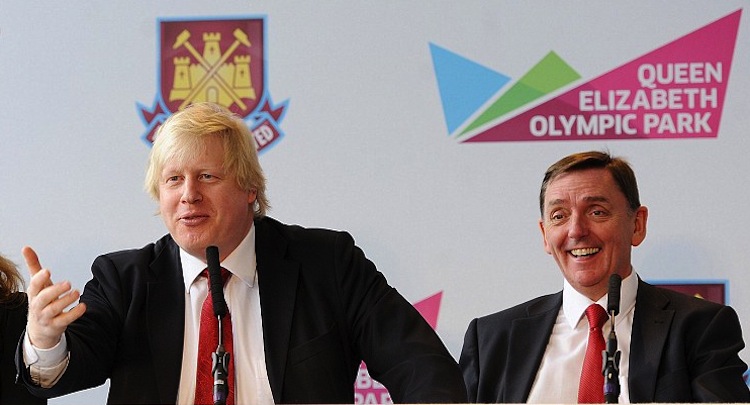
Ironic lectern caption for a woman who has just been handed a new stadium for free

2013 was a very good year – for Karren Brady.

In March the business she runs, West Ham United FC, was handed prime tenancy of a £600 million public asset in exchange for a peppercorn rent and some vague promises about community engagement.

At the same time, Newham council confirmed that it will contribute £40 million to the cost of converting the stadium for the Hammers’ use – ensuring that Ms Brady and her multi-millionaire employers will bear the merest fraction of the expense of relocating their business to swanky new premises.

In September she received a standing ovation at the Tory party conference when she made a speech introducing chancellor George Osborne,

And to top it all off in December she was awarded a CBE for her “for services to entrepreneurship and women in business.”

Usually, people who rely on public money to get by are branded ‘scroungers’ by the Tories; but when it’s handed out to business people they get standing ovations and medals for ‘entrepreneurship’.

Image

Merry Christmas

23 Dec

Merry Christmas

Not so much satire as real life

20 Dec
Sir Robin Wales is always right

See, I am always right. It says so right there.

Legal blogger David Allen Green has decided that government and parliament waste far too much time passing legislation, which is then subject to the tiresome jurisdiction of the courts. Whitehall and Westminster, he asserts, would be better employed doing other things.

So he proposes a modest Act of Parliament, the Something Must Be Done Act 2014. Once it is passed, no other legislation will ever be necessary and the meddlesome courts will be neutered forever.

This would be a piece of satirical genius were it not for the fact that Mr Allen Green has simply lifted and modified Newham’s The Mayor Is Always Right by-law, passed by councillors immediately after the first mayoral election in 2002.

Even if Newham residents are unfamiliar with the exact text of the by-law they will immediately recognise it from its impact on daily life in the borough:

Section 1:
The Mayor of Newham shall have the power to do anything, and nothing the Mayor does will be ultra vires.

Section 2:
The power given by Section 1 of this by-law shall include the banning of things by the Mayor.

Section 3:
The things to be banned referred to in Section 2 of this Act shall be the things which the Mayor of Newham says are bad for us.

Section 4:
What is bad for us for the purposes of Section 3 shall be determined by the Mayor of Newham with regard either to (a) headlines in the Newham Recorder this week and/or (b) the headlines the Mayor of Newham would like to see in the Newham Recorder next week.

Section 5:
Any person
(a)  voicing opposition to a determination made under Section 4 of this Act; or
(b)  acting in breach of a ban made under Section 1 of this Act,
shall be deemed to not care about the children and/or be soft on crime and anti-social behaviour.

Section 6:
In the event something must be done, the Mayor may at his sole discretion choose a thing to do, and the thing chosen shall be deemed as the something that must be done.

Section 7:
The thing chosen under Section 6 shall not have any rational or proportionate relationship to any intended objective.

Section 8:
There shall be crackdowns, announced from time to time by press release. Any crackdown under this Section 8 shall not endure more than one day after the press release in which it is announced.

Section 9:
There shall always be new penalties. And these penalties shall always be deemed tougher than the previous penalties and so shall be called ‘tough new penalties’ until superseded by the next ‘tough new penalties’ when they become ‘the old ineffective penalties’. However, any ‘tough new penalties’ under this Section 9 shall have no greater effect than ‘the old ineffective penalties’, even if announced as part of a crackdown under Section 8.

Section 10:
Within the boundaries of the London Borough of Newham this by-law extends beyond the rule of law.

Reading this in parallel with Mr Allen Green’s version, it is striking how little he has had to amend the original text to make it fit his comedic purpose. But what he thinks of as satire is actually real life here in Newham.

For richer, for poorer (but mostly poorer)

6 Dec

George Osborne claims that the UK economy is recovering and experiencing strong growth, thanks to the austerity policies pursued by the Coalition government since 2010.

But ordinary people can’t see any recovery at all. For them, all they see are stagnant wages and rising prices. There is a cost of living crisis.

Look at Newham. The table below shows the average (median) income for full-time workers living in the borough between the start of the financial crisis in 2008 and 2012.

2008 2009 2010 2011 2012
Avg Income £25,521 £26,154 £26,998 £26,489 £26,666
Annual % Change 2.48% 3.23% -1.89% 0.67%
Overall 4.49%

In 2011 average income actually fell for Newham workers. And the overall increase across the 5 years has failed to keep up with prices. So people – even “hardworking people” in full-time jobs – are getting poorer.

The table below shows the annual change in the Consumer Prices Index (CPI), which is the government’s preferred measure of inflation. It also shows what would have happened to average incomes in Newham if they had keep pace:

Annual CPI 3.60% 2.20% 3.30% 4.50% 2.70%
Avg Income £25,521 £26,440 £27,021 £27,913 £29,169
Difference -£286 -£23 -£1,424 -£2,503
Cumulative -£4,237

Over five years Newham people have lost out on over £4,200 of income. For a city banker or a hedge fund manager that’s just a rounding error on their bonus. But for ordinary people it’s the difference between keeping the heating on during a cold snap or not; the difference between the whole family eating dinner, or just the kids.

This is recovery for the rich – the rest of us are still stuck in the recession. And George Osborne doesn’t care.

Image

16 shades of Robin Wales

25 Nov

16 shades of Robin Wales

The current issue of the Newham Mag contains an extraordinary 16 pictures of the Mayor.

Even by the Mag’s Pravda-like standards, this must be some kind of record.

Could there be an election coming up, I wonder?

Community affairs

8 Nov
The Community Affairs team. What exactly  does Richard Crawford do?

The Community Affairs team. What exactly does Richard Crawford do?

Congratulations to Forest Gate councillor Ellie Robinson, who has been appointed to the Mayor’s cabinet as “Executive member for Community Affairs (North) and Safeguarding”.

Likewise to Plaistow South’s Forhad Hussain, who is now “Executive Member for Community Affairs (South) and Capital Projects”.

With Ellie looking after community affairs in the north of the borough and Forhad the south, both sitting in cabinet, what exactly is there left for councillor Richard Crawford to do as ‘Senior Executive Member for Community Affairs’?

As he’s currently pocketing close £43,000 a year in allowances from the council, I think we should be told.

Sir Robin’s slightly more expensive iPad

1 Nov

Sir Robin Wales has been shamed into handing over an extra £79 for the iPad mini he received as a gift on his recent trip to China.

A Freedom of Information request by @StopCityAirport asking for the basis of the original £130 valuation received this response:

The initial £130 valuation was provided verbally to the Mayor’s Office based on a Council officer’s research of local equivalent prices. No documentation is held to support this initial valuation. The Mayor paid this amount and a declaration was made to reflect this, in line with the Council’s policies for the declaration of gifts and hospitality. When he did this the Mayor queried the amount and the methodology by which it was established and asked for an independent valuation to be undertaken via the Council’s Interim Monitoring Officer.

A revised valuation was provided by officers on the 18th September on behalf of the Council’s Interim Monitoring Officer of £209.62. The Mayor then paid in full the revised amount advised and the relevant declaration was amended to reflect this.

The revised valuation is now in line with the ex-VAT price of a 16GB, wifi-only iPad mini.

But if you believe the Mayor himself initiated the re-valuation or the date this is claimed to have happened you probably have fairies living at the bottom of your garden.

As with the Brighton College nonsense it is an unnamed official who is at fault for inaccuracies in the Mayor’s declaration of interests, not Sir Robin himself.

Even if this is true, it isn’t good enough: it is Sir Robin’s register of interests; they are his declarations of gifts and hospitality. He and he alone is responsible for ensuring they are accurate; he must be accountable when there are errors.

A question of priorities

15 Oct

This year’s exam paper for prospective Labour party candidates in Newham has come light. Here is one of the questions:

You have a choice about where to spend council taxpayers’ money. Do you:

  1. Invest £40 million in the already publicly-owned Olympic stadium so that the multi-millionaire owners of West Ham United can move their football club, which competes in the world’s richest league, into swanky new premises; or
  2. Spend £41,000 to support an innovative hostel for single mothers that provides tailored help as well as shelter to homeless young women in the borough?

Candidates who answered (1), congratulations! You clearly understand the Mayor’s priorities. Your prize is a place on the ballot in next year’s elections and a tidy £10,800 a year in allowances.

If you answered (2), please leave your party membership card at the door on your way out. Newham Labour is no place for the likes of you.

The Brighton College Mystery – part 2

10 Oct

Following up my post last month about the curious business of Sir Robin wrongly declaring himself to be a governor of one of England’s most expensive independent schools, I asked Newham for an explanation.

That request got passed to Information Governance. They asked me to confirm if I wanted to file an FOI request and to state what information I wanted. My reply was to the effect “Are you serious? Wouldn’t it be easier to just send me an explanation?” They ignored that, so I filed an FOI. That prompted an extraordinarily rapid response. The following day I got this:

We can confirm that Sir Robin Wales was approached to become a member of the Board of Governors of the London Academy of Excellence in October 2011. Although he accepted this appointment in November 2011 he stepped down shortly after – in April 2012 – due to diary pressures.

The invitation to join the London Academy of Excellence Board of Governors was received on Brighton College letterhead. Unfortunately, officers incorrectly recorded on the Council’s Register of Members Interests and subsequent Mayoral Proceedings minutes as “Board of Governors at Brighton College”.

Sir Robin Wales has never been invited to join the Board of Brighton College.

So some hapless junior clerk was at fault, not the Great Man himself.

Perhaps understandable for the register of interests, but in the minutes of a meeting? You’d have to be especially cloth-eared to record the Mayor saying “I’m a governor of the London Academy of Excellence” as “I’m a governor of Brighton College” when the agenda item under discussion is about the London Academy of Excellence. And shouldn’t the Mayor at least check the minutes of Mayoral Proceedings? If he had done so he would instantly have spotted the error.

I looked up the annual report and accounts for the London Academy of Excellence for the period 23 May 2011 to 31 August 2012, which covers the time Sir Robin now says he was on their governing body.

On page 4, under ‘Constitution’ it says, “Details of the governors who served throughout the period except as noted are included in the Reference and Administrative Details on page 3.” (my emphasis added)

The list of governors on page 3 does not include Sir Robin Wales.

I contacted the London Academy of Excellence directly and yesterday they very kindly responded:

We invited Sir Robin to join the Board of Governors in mid-Oct 2011. He replied on 20 Dec 2011, saying that he could not take part in the interviews on 13 Jan 2012 but that he would be happy to be a governor. He formally resigned from the governing body prior to the meeting on 27 Sept 2012.

Although the dates don’t quite tie up with the entries in the Mayor’s register of interests or with the statement the Information Governance team provided, it seems that Sir Robin was a governor, albeit briefly, of the London Academy of Excellence. The omission of Sir Robin’s name from the school’s annual report must simply be an unfortunate oversight which the school needs to correct.

But even if this whole Brighton College nonsense turns out to be a cock-up rather than a conspiracy we should be no less concerned. This shows a very casual attitude to record-keeping and accountability by Sir Robin and those working closely with him. The register of interests is a significant public document: it’s how we can tell if our elected representatives are looking after our best interests or theirs. Minutes of council and committee meetings should be faithful records of what actually happened. The public must be able to rely on their accuracy.

In Newham, that is clearly not the case.