FOI updates

16 Jul

Last month I submitted two freedom of information requests to Newham. These have now been answered and both responses were surprising, albeit in different ways.

The first request asked about the costs associated with the council’s YouTube monitoring unit. I wanted to know how many ‘law enforcement officers’ had been involved, how much money had been spent and what officers spent their time doing. I also wanted to know what metrics would be used to measure whether or not the money invested had been spent wisely.

Not unreasonable questions and ones you would have thought Newham had ready answers to. But no. The reply I got was – in almost every respect – deficient. To say that

two members of staff are involved but this equated to zero full time equivalents as the work was not undertaken on a full time basis

is simply idiotic. And stating that

no metrics will be used to evaluate [this project], as the successful outcome of removal of the videos is self evident

is patronising and lazy. If it were self-evident I wouldn’t be asking, would I?

I am surprised the reply passed through internal quality assurance checks before being sent out. Needless to say, I have requested a review and some supplementary information. This has not yet been acknowledged.

The second request asked, straightforwardly, how much the Labour party paid to use space at Newham Dockside for Ed Miliband’s big speech on social security reform. This was a party political event, not a civic one, so it was fair to assume that the council would charge for the use of its facilities. The answer I got was not at all what I expected.

Newham said they didn’t charge Labour anything because the event took place in

a non-chargeable public space within the building.

Read that again. I did. Just to make sure I hadn’t got it wrong the first time.

There’s a part of Building 1000 that is public space, which the council will not charge you for using if you want to hold an event. Even a party political event.

If that’s genuinely the policy, then fair enough. But has Newham really thought through the potential consequences of that?

I can imagine that next April, ahead of the local elections, any number of people might want somewhere to launch their campaign to be mayor. Or their party’s manifesto. Where better than the very building they hope to be elected to occupy a month later? And they can have it for free!

And the council has put itself in the position where it will be almost impossible to say no.

14 Juillet 2013

14 Jul


via Instagram

Complete control

13 Jul

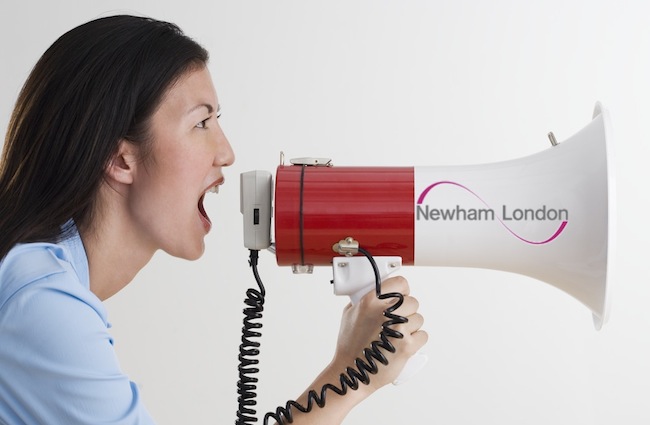
Woman Shouting with Bullhorn

Last week there was a great post on the Guardian’s Local Government Network titled ‘Councils and social media: a desire for digital control still dominates‘.

Although it was about local government in general, it could almost have been written with Newham in mind:

A small study assessing how councils used social media in early 2012 demonstrated the point. Although 96% of authorities surveyed were using social media to post news stories and information, and 90% were promoting specific events and campaigns, only 41% of authorities monitored other forums and blogs. Where they did, only 28% actively engaged with residents on these platforms, with just 9% of councils saying they used social media for two-way communications. Though things may have improved in the last 18 months, the same fears are still holding councils back online.

Think about the way our council communicates with us as citizens and residents – it’s a centralised command and control, one-way process.

That’s why we have the Newham Mag. It’s all about telling us about all of the wonderful things the council is doing; pushing out information out without any conception that people might want to engage in a conversation about the things we really care about. You can’t answer back to a paper magazine.

The way Newham uses digital channels is consistent with this general approach. Although it does have a social media presence, it’s entirely information-based. The official Twitter feed and the Facebook page are filled with announcements about “free events” and suchlike. Trying to get a response if you post a comment or tweet back to them is more often than not a frustrating experience.

It’s such a missed opportunity.

Social media isn’t so difficult. Follow the basic rules (don’t do anything stupid; engage, don’t broadcast) and you have a powerful digital communication tool at your fingertips completely free of charge.

A measure of how wrong Newham gets it is the very small number of ‘likes’ the Facebook page has – just 474. That’s in a borough with over 300,000 residents. More than half of UK residents will use social networks regularly this year, according to eMarketer. And nine out of ten social network users in the country have a Facebook account. So there are probably close to 150,000 Facebook users in Newham. 474 ‘likes’ represents a feeble 0.3% of those.

The council’s Twitter feed is more popular, with almost 2,700 followers. Given the chance, it could be the focus of some really interesting debate, but that would require a change in the governing mind-set.

Allowing local people access to the conversations that go on within the town hall is a good thing. Councils are democratically elected bodies, and their work should be free and open to public scrutiny. The best way to use digital tools to achieve this level of local involvement and scrutiny is to use social media as it was designed to be used.

Social media is about connecting people and sharing experiences. It’s about enabling conversations. It’s also a daily part of most of our lives – we take it almost for granted that we can engage with people and businesses in near real-time.

When political and civic participation is at such dangerously low levels it is verging on the criminal not to use every available tool to reach out and engage.

It’s not all doom-and-gloom though. There are 14 current councillors with Twitter accounts, which they use to varying extents, and a good number of Labour’s new candidates for next year are active users. Hopefully, an influx of younger digital natives will lead to a more open approach.

Maybe they’ll stop talking at us and start talking with us.

Question time for Sir Robin?

10 Jul

Way back in 2010 I wrote a post on the E-democracy forum about Newham setting a world record for the shortest ever council meeting (just 6 minutes). I noted that the council’s own website said that:

“At these meetings the Council makes major decisions, such as deciding the council tax and budget and policy framework documents. It is the real focus for the whole Council to meet and debate major issues and to ask questions of the Mayor.”

Two years later, in August 2012, I found that the website text had been amended. The new version said:

“At these meetings the Council makes major decisions, such as deciding the council tax and budget and policy framework documents.”

Can you spot the difference? Perhaps they thought no-one would notice, but Sir Robin’s disdain for scrutiny has rarely been so obvious.

There’s now an even newer version which sets out the decisions which by law have to be made at full council. It also says:

“The full council is the opportunity for councillors to question the executive [and] chairs of council committees.”

So someone somewhere has given councillors back their right to publicly question Sir Robin!

I hope that the bright-eyed hopefuls recently selected to contest next year’s elections will, once installed in the council chamber, take that opportunity. Holding the mayor to account for his decisions is, in my view, by far the most important part of their job. And it would make a nice change if they actually did it.

Who knows, they might even get answers!

Better late than never

9 Jul

In his big speech today on Labour and the trade union link Ed Miliband announced that there will be an open primary to select the party’s candidate for Mayor of London in 2016:

“Since I became Labour leader, we have opened up our policy making process and opened up the Party to registered supporters. People who do not want to join Labour but share our aims.

“But I want to go further.

“If we are to restore faith in our politics, we must do more to involve members of the public in our decision making. We must do more to open up our politics.

“So I propose for the next London Mayoral election Labour will have a primary for our candidate selection.

“Any Londoner should be eligible to vote and all they will need to do is to register as a supporter of the Labour Party at any time up to the ballot.”

This was an idea I advocated more than a year ago in comments on Councillor John Gray’s blog.

An open primary not only engages a wider group of supporters, it also attracts a great deal of media attention which can then build momentum and the public profile of the chosen candidate going into the election.

While it may have taken Ed a year to catch up with me,  it’s nice to see that he reads John’s blog, even down to the comments!

Next year’s council election results today

8 Jul

This is the full list of Labour party candidates selected this weekend to fight next year’s local elections. Given the electoral history of the borough, the vast majority of these people – and probably all of them – will be elected as Newham councillors on May 22nd 2014:

Beckton: David Christie, Ayesha Chowdhury, Alec Kellaway

Canning Town North: Ann Easter, Kay Scoresby, Clive Furness

Canning Town South: Sheila Thomas, Alan Griffiths, Bryan Collier

Custom House: Pat Holland, Rokhsana Fiaz, Conor McAuley

East Ham Central: Unmesh Desai, Ian Corbett, Julianne Marriott

East Ham North: Paul Sathianesan, Zuber Gulamussen, Firoza Nekiwala

East Ham South: Quintin Peppiatt, Lakmini Shah, Susan Masters

Forest Gate North: Ellie Robinson, Seyi Akiwowo, Rachel Tripp

Forest Gate South: Mas Patel, Winston Vaughan, Dianne Walls

Green Street East: Jose Alexander, Rohima Rahman, Mukesh Patel

Green Street West: Hanif Abdulmuhit, Tahmina Rahman, Idris Ibrahim

Little Ilford: Andrew Baikie, Farah Nazeer, Ken Clark

Manor Park: Amarjit Singh, Jo Corbett, Salim Patel

Plaistow North: Forhad Hussain, Joy Laguda, James Beckles

Plaistow South: Gordon Mackinnon-Miller, Aleen Alarice, Neil Wilson

Royal Docks: Steve Brayshaw, Anthony McAlmont, Pat Murphy

Stratford: Richard Crawford, Terry Paul, Charlene McLean

Wall End: Lester Hudson, Ted Sparrowhawk, Frances Clarke

West Ham: John Gray, John Whitworth, Freda Bourne

Boleyn ward has not yet been able to select its candidates due to a dispute with East Ham CLP. The ward party was unexpectedly suspended last week, despite this being the sole prerogative of the national executive. So expect any of Sir Robin’s favourites who failed to make it in the other 19 wards to be imposed on Boleyn.

Respect yourself

4 Jul


Once upon a time in a land far, far away… 

In 2006 Hanif Abdulmuhit was elected as a Labour-hating, Galloway-loving Respect councillor in Newham.

In 2008 he was Respect’s candidate for the London Assembly in City & East, standing against Labour’s incumbent, the saintly John Biggs.

At the time he said, “We need a party in East London that puts people before profit. New Labour has turned its back on its own supporters.”

And George Galloway commended him, saying “Hanif Abdulmuhit is an excellent councillor… Londoners deserve better than New Labour timeservers.”

Now, in 2013, Mr Abdulmuhit has put all that behind him. He is a loyal Labour man and on the shortlist for the 2014 council elections.

Of course he won’t be the first ambitious local politician to realise that the path to electoral success in Newham requires a change of allegiance. There are at least four current councillors who previously stood for other parties before converting:

  • John Gray stood and lost heavily 3 times as a Liberal Democrat. Since 2010 he has been secretary of the council’s Labour group
  • Patricia Holland also ran unsuccessfully as a LibDem
  • Alec Kellaway was actually elected 3 times as an SDP/Liberal Alliance/Liberal Democrat before defecting to Labour in 1994. He is now Sir Robin’s Executive Member for Business and Skills.
  • Forhad Hussain, now Plaistow Community Lead Councillor, stood in 2006 for Respect

If he is successful Mr Abdulmuhit already has a blog he can revive, proudly bearing the masthead ‘Councillor Hanif Abdulmuhit’. He may want to delete the rest of it though.

Say hello, wave goodbye

3 Jul

This weekend sees Newham Labour party select its candidates for the 60 seats up for grabs at next year’s council elections.

The original 120 applicants have been carefully vetted and a shortlist of 65 agreed from which each ward can choose its trio of nominees. Mike Law has acquired a copy of the list and published it on his blog.

Comparing Mike’s list to one of currently sitting councillors, it is clear that not all of them have made it through. Some will have chosen to retire, but others are paying the price for failing to please the mayor.

Those strapping on the concrete wellies and preparing to be heaved into the Royal Docks are:

  • Paul Brickell
  • Leanora Cameron
  • Nirmal Kaur Chadha
  • Akbar Chaudhary
  • Marie Collier
  • Omana Gangadharan
  • Kevin Jenkins
  • Khalil Kazi
  • Sharaf Mahmood
  • Riaz Ahmed Mirza
  • Mike Nicholas
  • Gavin Pearson
  • Pearson Shillingford
  • Mary Skyers
  • Rustam Talati
  • Alan Taylor

They may be joined by as many as five more after the weekend.

Of course, those nominated to replace them are not 100% guaranteed to collect a minimum of £10,700 a year in allowances for the next 4 years be elected. But they can probably prepare to have the control chips implanted, ready to receive instructions direct from Sir Robin.

Live jazz outside @Number8_FG

28 Jun


via Instagram

Going Overground

28 Jun

Image

Photo by bowroaduk

The government has announced that it will spend £115 million to electrify the Gospel Oak to Barking line. This is very good news for those that campaigned to improve the line, but better news for those that use it.

The incorporation of the line into the London Overground network and the consequent improvements in the service – new trains, clean stations, more frequent running – has unlocked huge demand.

The previous operator, Silverlink, ran an appalling service which unsurprisingly attracted few passengers. When Transport for London took over continuing to use two car trains probably seemed a sensible idea, but now trains are full to bursting during peak times. It’s an extremely uncomfortable experience for many passengers, if they can actually get on the trains at all. I’ve given up using it for my commute home as there’s only a 50/50 chance I’ll be able to board and if I do it’s so crammed I feel in danger for my life if the driver has to brake suddenly.

The obvious solutions would be either to add additional carriages, or to run an even more frequent service to spread customers over a larger number of trains. But adding a third carriage isn’t an easy option. The trains apparently come as a unit, so you can’t just de-couple them and stick an extra bit in between. TfL has to either buy new trains or pay Bombardier a fortune to custom-build and fit middle carriages. For a relatively small number of trains that can’t really be used anywhere else, that’s not especially efficient.

Running additional services is also difficult, as the line is limited to eight trains an hour in each direction. Four of these are reserved for freight, so the current passenger service is maxed out.

Electrifying the line will solve a big part of the problem. The trains that serve the rest of the London Overground can then run on the GOBLIN and they are all at least four carriages long.

It may also mean that new through services can be opened up to Richmond and Clapham Junction. Some peak “congestion buster” services already run to Willesden Junction, missing out Gospel Oak, so the track and signalling are already in place.

Now the money is there, let’s hope work gets underway quickly.