Tag Archives: newham

It was 20 years ago today

9 Jun

On the eve of the Newham North East by-election – 20 years ago today – Alec Kellaway, the sole opposition councillor and Liberal Democrat candidate, defected to Labour.

His friends and supporters who had campaigned tirelessly for him for weeks were devastated. It was, they said, a bitter blow.

So congratulations to Councillor Alec Kellaway on 20 years as a member of Newham Labour party. I’m sure the champagne is on ice at Building 1000.

Turns out

9 Jun

Turnout

Newham’s electorate and turnout at borough-wide elections since 1964 (source: LBN)

Year Electorate Turnout
1964 179,870 29.4%
1968 177,134 25.1%
1971 183,134 29.4%
1974 176,445 22.5%
1978 176,760 31.1%
1982 163,758 31.4%
1986 160,536 34.9%
1990 157,951 36.5%
1994 151,895 37.6%
1998 139,273 28.4%
2002 157,505 25.5%
2006 187,702 34.5%
2010 195,058 52.74%
2014 195,419 40.6%

A few random observations:

Firstly, citizen engagement with local politics remains appalling low. Only once in the history of the borough has turnout exceeded 50% and that was driven by the general election being held on the same day. Even the lure (ahem) of the European elections wasn’t sufficient to get 60% of voters to bother.

Why don’t more people make the effort? This isn’t just a Newham problem. Across London turnout for local elections hovered around the 40% mark. Despite having come a long way from the low point of 22.5% turnout in 1974 there’s a looming crisis of democratic legitimacy.

The lazy answer is that we just need to make voting easier. But it’s already ridiculously easy: polling stations are within walking distance and open for 15 hours; postal votes are available on demand. It has to be about making local politics relevant and engaging people in conversations about things that are important to them and their communities; it has to be about making people feel their vote will count; and it has to be about making local politics more than just getting the vote out once every four years.

Secondly, take a look at the size of the electorate in 2010 and 2014. Thousands of new homes are being built in the borough and there’s been a significant increase in over-crowding. We know the local population is rising rapidly, yet the number of registered voters has grown by less than 400.

Does that strike you as odd?

Then there’s the difference between the size of electorate for local elections and for the European election.

According the results published by Newham, turnout for the Euros was 43.6% based on an electorate of 173,606. That’s almost 22,000 less than for the local election.

People entitled to vote in local government elections are all also entitled to vote in European elections – British citizens, Irish citizens, Commonwealth citizens and EU citizens living in the UK. So where did all those voters go? Were people who wanted to vote in the European election turned away?

Getting things in proportion

4 Jun

PR Council

Newham council would look very different under PR

Last week the Hackney Citizen reported that in their borough the Greens would have won seven seats under a proportional voting system, whereas they actually got none – despite getting more than 20% of the vote.  In total PR would have delivered twelve opposition councillors, rather than the seven actually elected (four Tories, three LibDems).

Things in Newham are even worse.

For the second election running, not a single opposition councillor was elected, despite one-third of voters choosing candidates from parties other than Labour. According to the council’s own results webpage, the Conservatives got 24% of the vote.

Using exactly the same analysis as the Hackney Citizen – applying the proportional representation system used in the European elections to the Newham results – the Tories would have won twelve seats, making them the largest opposition group. And, despite standing in only a handful of wards, UKIP would have two councillors.

Labour would have won all three seats in six of the 20 wards – Boleyn, Canning Town North, Forest Gate North, Little Ilford, Stratford & New Town, and West Ham – and two in all the rest. UKIP would have taken a seat in Canning Town South and in Custom House, with the Tories taking a seat in each of the 12 remaining wards.

How did I work this out?

The system used in the European election relies on voters selecting a single party, rather than vote for individual candidates as they do in ‘first past the post’ elections. To get around this I averaged the votes for the candidates for each party. I did this in every ward.  From this I could then apply the D’Hondt method to calculate the results.

Taking Forest Gate South as an example, this is the actual result:

Candidate Party Votes
Masihullah Patel Labour 2209 Elected
Dianne Walls Labour 2095 Elected
Winston Vaughan Labour 2023 Elected
Mahboob Rizu Ahmed Conservative 993
Asif Choudhary Conservative 976
Tim Roll-Pickering Conservative 693
William Heron Liberal Democrat 293
Niall Mulholland TUSC 238
Dieutane Jean Parson Christian Peoples Alliance 179
Malcolm Williamson Christian Peoples Alliance 159
Ionel Vrancianu Independent 101

This gives an average party vote of:

Party Votes
Labour 2109
Conservative 887
Liberal Democrats 293
TUSC 238
CPA 169
Independent 101

Since Labour has the most votes they win the first of the three seats available.

For the second seat the votes for each party are divided by the number of seats they have won, plus 1. So Labour’s vote is divided by two and the other parties are divided by one (so they stay the same), which gives us:

Party Votes
Labour 1055
Conservative 887
Liberal Democrats 293
TUSC 238
CPA 169
Independent 101

Labour still has the most votes and wins the second seat.

For the third and final seat the votes for each party are again divided by the number of seats they have won, plus 1. So now we divide the original Labour vote by three, as it has already won two seats, and the other parties stay the same:

Party Votes
Labour 703
Conservative 887
Liberal Democrats 293
TUSC 238
CPA 169
Independent 101

In this round the Conservatives have the most votes, so they win the last seat. Forest Gate South has two Labour and one Conservative councillor.

A note of caution

These are only approximations since there’s no way of calculating with absolute certainty the result under proportional representation because of the differences between this system and first past the post. There’s also no way of knowing if changing the voting system changes people’s voting behaviour. Or if a different voting system would encourage more parties to stand candidates in more seats.

But it does provide a reasonable basis – using real results and a system actually used in the UK – to argue that our current voting system for local government is broken. It delivers an unfair result and a council that does not truly reflect the diverse political opinions of the community it is meant to serve.

Where your councillors live

3 Jun

Councillors map

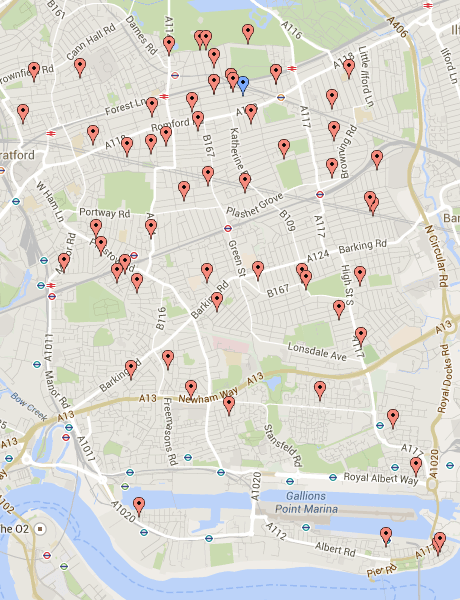
A map showing where the 60 Newham councillors (red) and the mayor (blue) live.

There’s a notable clustering in the north of the borough, with less than a third of them living south of Barking Road.

Poodle

2 Jun

2014 06 02 08 45 00

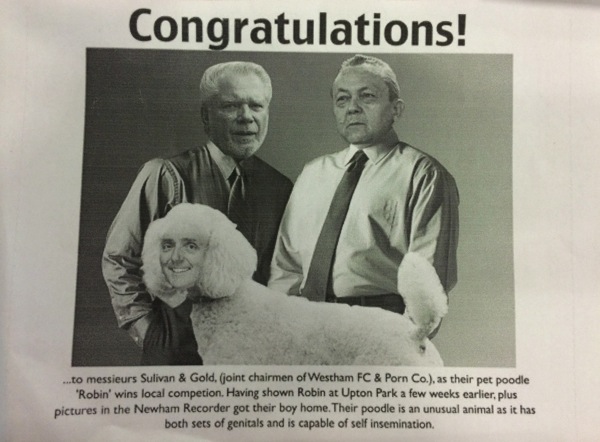
I got back from holiday last night to find this waiting on my doormat. I gather a number of my neighbours have also received copies.

I’ve no idea who’s behind this, or the similar one that appeared just before the election, but they have quite an imagination!

Random election facts

25 May

2014 05 24 17 27 24

  • Largest number of votes cast (ward): Little Ilford
  • Highest turnout (ward): East Ham North – 51.97%
  • Lowest turnout (ward): Beckton – 31.8%
  • Highest personal vote: Farah Nazeer (Labour, Little Ilford) – 2,997
  • Lowest vote (all):  Moriamo Sadiq (Christian Peoples Alliance, East Ham North) – 68
  • Lowest vote for an elected candidate: Anthony McAlmont (Labour, Royal Docks) – 1,201
  • Highest vote for a losing candidate:  Ilyas Sharif (Conservative, East Ham North) – 1,547
  • Beckton had the closest contest, with just 680 votes in it
  • The Conservatives finished in second place in 16 wards; UKIP were runners-up in 3 wards – Canning Town North, Canning Town South and Custom House – while the Green party finished behind Labour in Forest Gate North

In 2010 Labour not only won all 60 seats but had the top 60 candidates ranked by personal vote: no losing candidate in one ward got more votes than a winning candidate in another. That’s not the case this time. The 60 most popular candidates includes 3 Tories – Ilyas Sharif (East Ham North), Ashfaq Ahmed (Green St East) and Durai Kannan (East Ham North). In fact 7 unsuccessful Conservatives polled more votes than Anthony McAlmont, Labour’s lowest ranking candidate.

Ultimately this is meaningless, as the election is fought across 20 wards with varying electorates and turnouts. But it does point to the underlying absurdity of our current electoral system.

Forest Gate results

25 May

2014 05 24 17 24 37

Forest Gate North’s new councillors

Forest Gate North

Candidate Party Votes
Ellie Robinson Labour 2324 Elected
Seyi Akiwowo Labour 2126 Elected
Rachel Tripp Labour 2120 Elected
Alan Charles Cooper Green 562
Jane Alison Lithgow Green 559
Shaeb Khan Conservative 548
Dawn Lennon Conservative 490
Brian Maze Conservative 480
Bob Severn TUSC 222
Christian Moon Liberal Democrat 206
Lynn Denise Donaldson Christian Peoples Alliance 174
Christina Doyle Christian Peoples Alliance 146


Forest Gate South

Candidate Party Votes
Masihullah Patel Labour 2209 Elected
Dianne Walls Labour 2095 Elected
Winston Vaughan Labour 2023 Elected
Mahboob Rizu Ahmed Conservative 993
Asif Choudhary Conservative 976
Tim Roll-Pickering Conservative 693
William Heron Liberal Democrat 293
Niall Mulholland TUSC 238
Dieutane Jean Parson Christian Peoples Alliance 179
Malcolm Williamson Christian Peoples Alliance 159
Ionel Vrancianu Independent 101

Four more years

23 May

Newham Labour M 004

Newham Labour is celebrating another four years for Sir Robin, despite a big drop in his personal vote compared to 2010.

The Conservatives’ Respect-a-like campaign brought them an extra 2% share, but at considerable cost to their credibility. Tory HQ is said to be investigating their candidate selections and election leaflets.

UKIP’s 3rd place is less alarming than it appears. They were a long, long way back and 6% of the vote is less than their London-wide average. Newham again proves it is blessedly resistant to the far right.

Jane Lithgow of the Greens will be as pleased with her 4% as Lois Austin will be disappointed with TUSC’s 2%.

It looks like the end of the road for the Christian Peoples Alliance. From 4th place to last and two-thirds of their vote vanished. They won’t be missed.

Talking of losers: the Liberal Democrats. Once upon a time they got people elected to the council; now they trail in 6th place with fewer votes than Kamran Malik.

Candidate Party 2014 2010 Change
Sir Robin Wales Labour 47,095 61.2% 64,748 68.0% -17,653 -6.8%
Stefan Mrozinski Conservative 13,976 18.2% 15,330 16.1% -1,354 2.1%
David Mears UKIP 4,960 6.4%
Jane Lithgow Green 3,055 4.0%
Kamran Malik Communities United 2,796 3.6% 6,607 6.9% -3,811 -3.3%
David Thorpe Liberal Democrat 1,757 2.3%
Lois Austin TUSC 1,708 2.2%
Alex Ocan Latim Christian PA  1,625 2.1% 6,503 6.8% -4,878 -4.7%
  Turnout 76,972 40.60% 95,194 50.40% -18,222 -9.8%

Et tu, Kevin?

21 May

Defenestrated Labour councillor Kevin Jenkins provides some acid-tongued advice to residents unsure of who to vote for tomorrow. He suggests asking four questions about each of the candidates:

  1. Do they make specific pledges for your area alongside the general borough-wide pledges?
  2. How are they proposing to keep in touch with their electorate in the ward over the next four years or do you anticipate seeing them again in four years’ time when they want your vote again?
  3. Are they promising to have a regular surgery in the ward each week?
  4. Are they old political hacks or do they have a genuine conviction for your ward and the wider borough? Will they toe the mayor’s or a party line, or vote for what’s best for your area?

That doesn’t read to me like a clarion call to vote for his former colleagues.

Please vote

20 May

Bad politicians

Every year, in November, we are encouraged to remember the sacrifice made by those who fought and died to defend our freedom and our democracy.

This year there’s no need to wait until November.

There are three elections happening in Newham on Thursday and you have the right to vote in all of them. Going to the polling station and marking an X on a ballot is by far a more meaningful commemoration than wearing a poppy.

  • European parliament: You have one vote, which you can give to the party of your choice. It’s truly proportional, as London’s 8 seats are allocated in direct proportion to the number of votes each party gets: your vote really counts.
  • Mayor of Newham: You can vote for a first choice and a second choice. If no candidate gets 50% of the first choice votes the top 2 go into a run-off and the second choice votes of the eliminated candidates are counted. Those for the remaining candidates are added to their totals and the one with the most votes wins. Your second choice only counts if you happen to have given it to one of the top 2 candidates. It’s a stupid system, but we’re stuck with it for now.
  • Council: You have three votes. Despite what the big parties might prefer you to believe, you can split your votes any way you like. The three candidates with the most votes in your ward win and get to spend the next four years scrutinising the mayor and holding him (or her) to account. At least that’s the theory.

Please vote.