Archive | Elections RSS feed for this section

And there’s more…

8 Mar

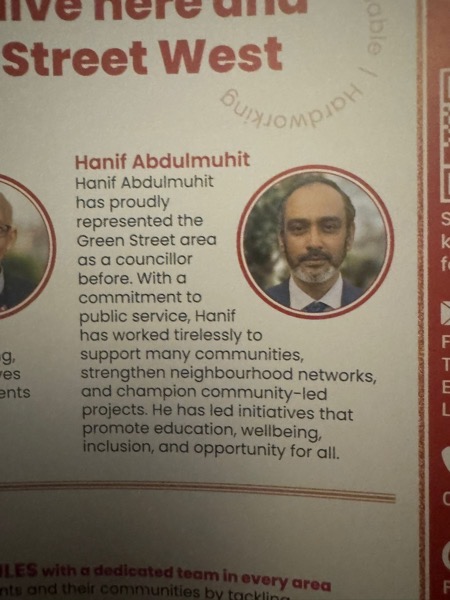
Hanif Abdulmuhit on a Labour leaflet

It seems that I was guilty of a couple of bits of understatement in Friday’s post about former councillor Hanif Abdulmuhit.

First of all, he is not just campaigning for Labour, he is a candidate in Green Street West, the seat he previously held for both Respect and Labour. 

And secondly, his support for the Conservatives went beyond now-deleted social media posts – he joined the party and campaigned for it.

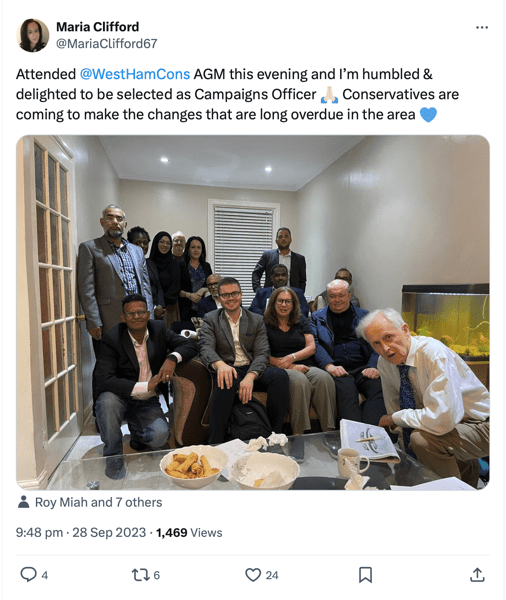
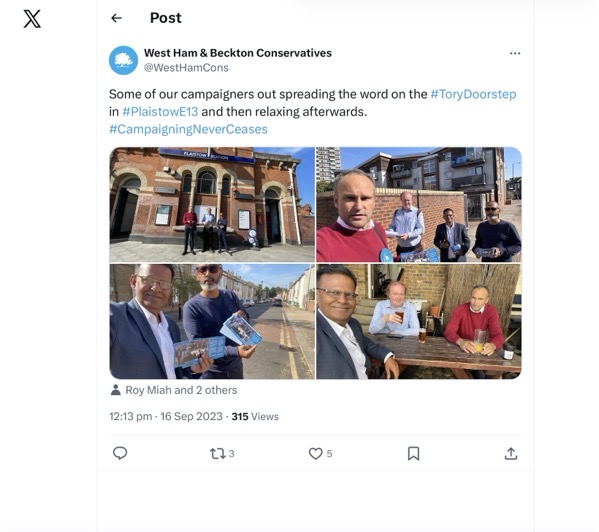
Tory AGM Tweet

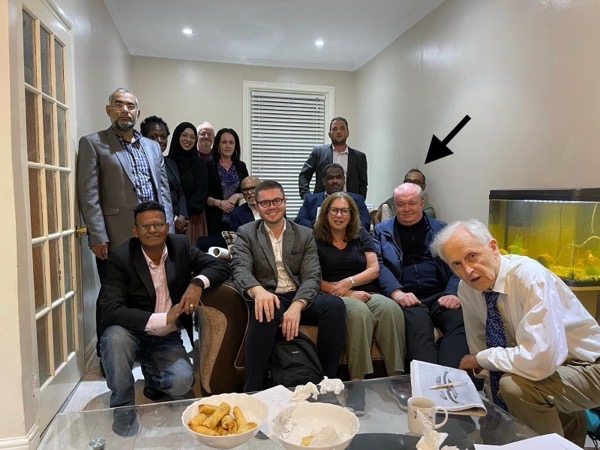
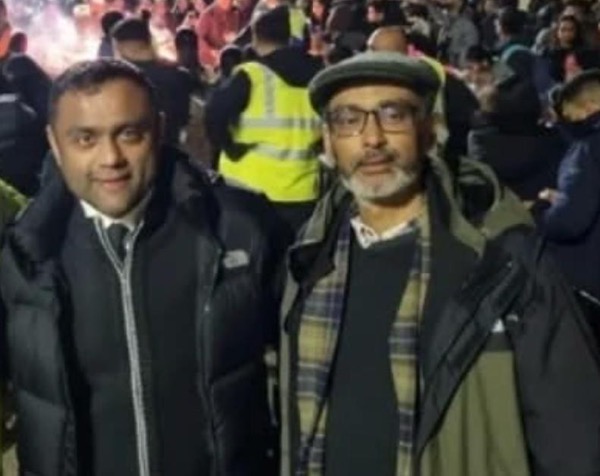
This tweet is from September 2023 and Abdulmuhit is there, at the West Ham Conservative’s AGM. He’s on the right, partly hidden by Tim Roll-Pickering’s head.

An arrow pointing at Hanif Abdulmuhit's head

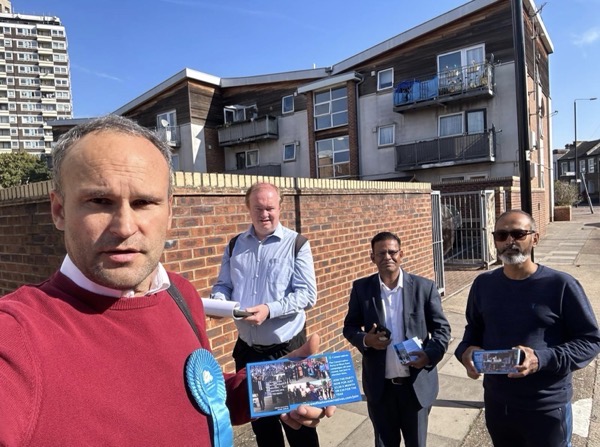
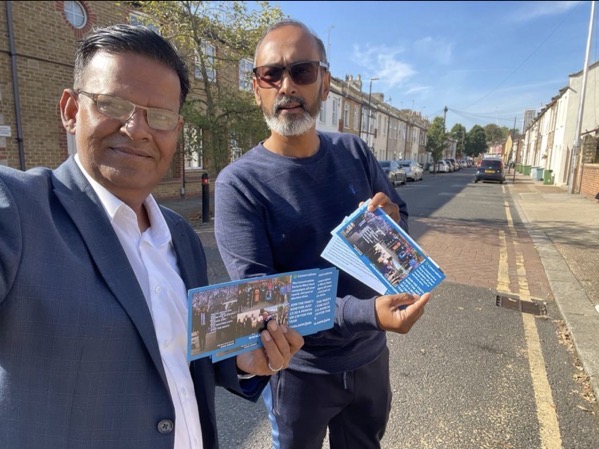
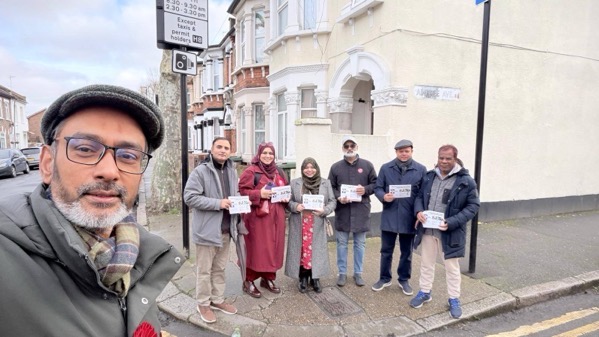
And here he is campaigning for them.

Tory canvas.

Hanif Tory canvassing.

I guess the Labour selection panel’s due diligence on his social media history wasn’t as diligent as it should have been.

A man for all seasons

6 Mar

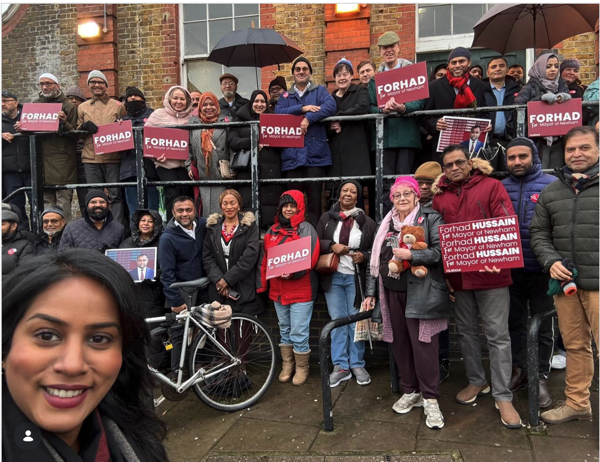
Hanif Abdulmuhit campaigning in 2026

Hanif Abdulmuhit out on the Labour campaign trail

While we’re on the subject of people changing parties – not especially unusual in the small world of Newham politics – let’s talk about Hanif Abdulmuhit, who is currently out campaigning for Labour ahead of the upcoming local election. 

Abdulmuhit began his political life as secretary of Newham Liberal Democrats. He then joined George Galloway’s Respect party, winning a council seat in 2006, defeating Labour incumbents in the process, and standing as the party’s London Assembly candidate for City & East in 2008. As Respect collapsed in on itself, he completed the remainder of his term as a Labour councillor, sat out the 2010 elections, and then returned — fully reconstructed — as a Labour member in 2014. He went on to serve as a mayoral advisor for Building Communities and community lead for Green Street in the administration of Sir Robin Wales.

That second Labour stint lasted until 2022, when he was deselected by the NEC panel charged with picking the party’s candidates. There were suggestions that he was the victim of dirty tricks in the run-up to the selection process, and he took it very badly. In social media posts, subsequently deleted, he announced his support for the Conservatives.

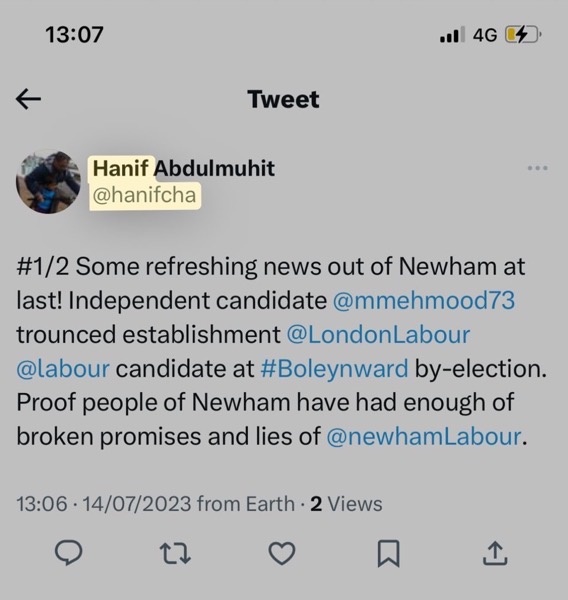
Abdulmuhit’s bitterness towards his former party was on open display in July 2023, when he posted gleefully about Labour’s defeat in the Boleyn ward by-election. “Some refreshing news out of Newham at last!” he wrote, celebrating the victory of independent candidate Mehmood Mirza and describing it as “proof people of Newham have had enough of broken promises and lies of Newham Labour.”

The irony — or the problem, depending on how you look at it — is that Mehmood Mirza is now Labour’s principal opponent in the Newham mayoral election. The same man whose victory Abdulmuhit publicly cheered, whom he held up as a symbol of Labour’s failure and the community’s rejection of the party, is today the candidate Labour most needs to defeat. 

The contradictions do not end with his serial party-hopping. Abdulmuhit was also posting views that sit strikingly at odds with Labour’s national platform and Newham Council’s own stated priorities.

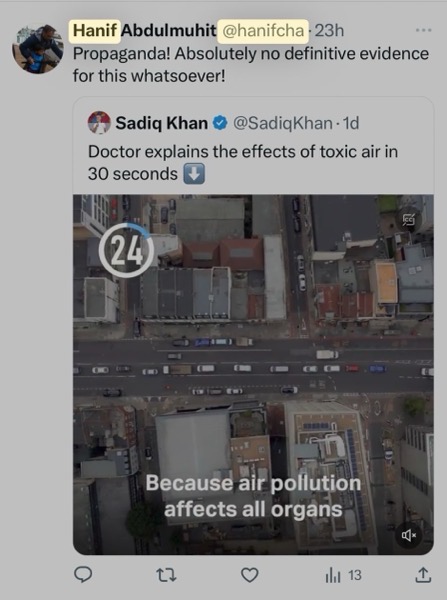
When Sadiq Khan shared a video explaining the health effects of toxic air, Abdulmuhit dismissed it as “Propaganda! Absolutely no definitive evidence for this whatsoever!” — a remarkable claim given that the scientific consensus on the harm caused by air pollution is overwhelming. Newham is one of London’s most polluted boroughs; the health consequences for its residents are not an abstraction.

.

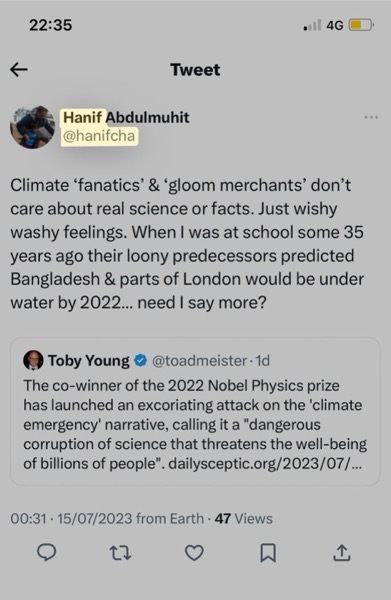
He also amplified a Toby Young article from the Daily Sceptic — a well-known climate-sceptic outlet — approvingly characterising climate scientists as “fanatics” and “gloom merchants” driven by “wishy washy feelings” rather than science. These are not merely heterodox views within the Labour family. They are positions associated with the right flank of the Conservative Party and its outriders, not with a movement that has made clean energy and environmental action central to its offer to voters.

Newham Council has declared a climate emergency and committed to ambitious net-zero targets. Labour nationally has staked significant political capital on its green agenda. A Labour activist publicly aligning himself with Toby Young on climate science is not a minor quirk — it is a meaningful ideological statement.

Hanif Abdulmuhit spent eight years as a Labour councillor before being deselected. He then publicly celebrated Labour losing a council seat, specifically praising the independent candidate who is now Labour’s main opponent in the mayoral race. He has dismissed the scientific evidence on air pollution as propaganda and shared climate-denying content from a right-wing sceptic outlet. He has also, at various points in the more distant past, been a Liberal Democrat and a Respect councillor.

None of this is secret. It is all a matter of public record — or was, before it was deleted along with the rest of his Twitter/X account.

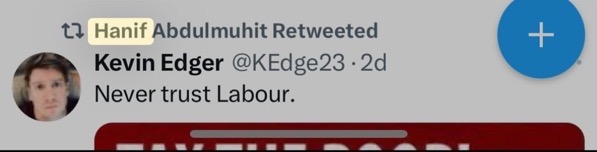
The question worth asking is not why Abdulmuhit wants back in. Political calculation is a constant in Newham, and the motivations of someone who has navigated this many different party loyalties are presumably pragmatic. The real question is why Labour would want him close to its campaign — and, more pointedly, why it would welcome back someone whose loudest recent contribution to Newham politics was cheering on the very candidate Labour is now trying to beat. And who retweeted this kind of thing:

Voters are entitled to know who is working on behalf of candidates they are asked to support. In a contest where Labour’s credibility and trustworthiness in Newham is itself at issue, the company a campaign keeps matters.

Forhad and Hanif

Having someone whose political journey spans the Lib Dems, Respect, Labour, the Conservatives (however briefly), and back again — and who was publicly delighted by Labour’s embarrassment less than two years ago — seems, at best, an unusual choice.

Journey’s End

4 Mar

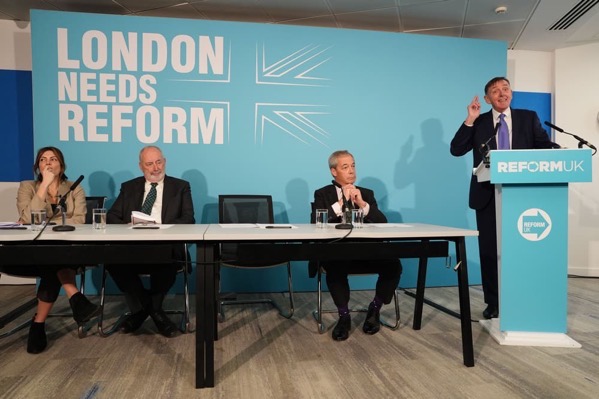
Wales Furness Reform.

Robin Wales and Clive Furness with Nigel Farage (picture via London Evening Standard)

Well, it was bound to happen sooner or later. Sir Robin Wales and his long-time ally and fellow Blue Labour acolyte Clive Furness have defected to Reform UK.

Wales will be joining as ‘Director of Local Government Development’ and Furness will be the party’s candidate for Mayor of Newham.

Both men have long promoted a politics well to the right of mainstream Labour opinion and their recent piece in Spiked about why they left the Labour Party was merely a trailer for this announcement.

This blog was largely founded as a way for me to express my disgust and amazement that Wales, a man who so clearly possessed no Labour values whatsoever, was in any kind of leadership position at all, much less the all-powerful and unchallengeable directly elected mayor. And it turns out, in the end, I was absolutely right.

Those currently running what remains of the Labour Party in Newham – hollowed out by five long years of suspension – should have a long hard think about their decision to turn their backs on the last eight years and embrace the politics of the previous 20.

Wales and Furness have gone. Good riddance. Their politics should go with them.


Update: Wales’ new title at Reform is Director of Local Government Development, not Director of London Local Government as I previously had it. Apologies.

How a new voting system could end Labour’s grip on Newham

2 Feb

Forhad for Mayor.

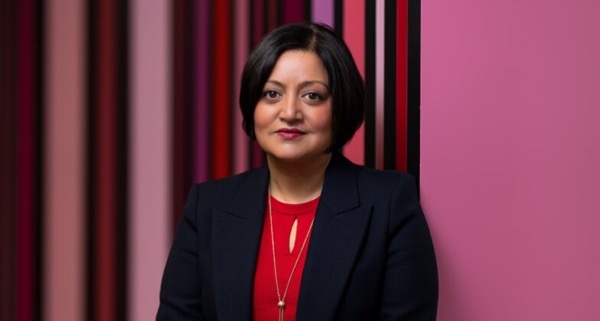
Uma Kumaran MP on Instagram

For decades, Newham has been synonymous with Labour dominance. The borough has consistently delivered some of the party’s strongest results anywhere in the country. But as we approach the May 2026 mayoral election, a perfect storm of a changed electoral system and political upheaval threatens to end that era.

The System That Protected Labour (though it rarely needed it)

Until now, Newham’s mayoral elections used the Supplementary Vote system, where voters could express both first and second preferences. If no candidate secured over 50%, second choices were redistributed between the top two. In practice, this rarely mattered — Labour won outright on first preferences in five of six elections. Only in 2006, when George Galloway’s Respect Party mounted a strong challenge, did Labour need second preferences to win.

Had the Tories not abolished this system in 2022 it would have provided Labour with a crucial safety net this year. Progressive voters could have backed the Greens or another party as their first choice, knowing they could return to Labour via second preferences. Even with Labour’s support weakened by the unpopularity of the Starmer government, the party would likely have benefited from transfers from other progressive voters keen to keep less appealing alternatives out.

That buffer has for the time being disappeared. Despite introducing legislation to reinstate the supplementary vote, parliament has not yet passed it into law, so the 2026 election will use First Past the Post. One vote, winner takes all, regardless of whether they achieve a majority.

Historical Strength, Meet Historic Weakness

To understand how extraordinary the current situation is, consider the numbers. In 2018, Rokhsana Fiaz won with a commanding 73.4%. Even in 2022, when her support dropped significantly, she still secured 56.2%.

Historically, Newham Labour’s candidates have outperformed national polling by 25-40 percentage points. For example, when the party polled 29% nationally in 2010, their mayoral candidate won 68% locally. Newham has always been a Labour bedrock.

Fast forward to January 2026, and Labour is polling at a catastrophic 17-22% nationally — the party’s worst position since monthly polling began in 1983. Even with the usual level of out-performance versus the national party, Newham Labour may struggle to hit even 40% this time.

And with the early messaging from Labour candidate Forhad Hussain suggesting he is running against the current mayor’s record rather than the Opposition, that is doubtful. “Labour’s made a mess of it, vote Labour” is s hard message to sell.

The Challengers Emerge

Given the polls and the change to the voting system, this election is genuinely competitive.

The Newham Independents’ candidate, Councillor Mehmood Mirza, represents the largest opposition group on the council with four seats (or is it five?). His populist platform — council tax freezes, free parking, public events, even more free parking, and free sports gear for every child — taps into dissatisfaction over street cleaning, parking charges, and council governance, as well as anger over Labour’s stance on Gaza. Whether his ambitious spending promises can be delivered within a balanced budget is questionable, but the appeal is undeniable. Promises cost nothing, and by the time voters find out he can’t actually deliver them, it’s too late.

The Green candidate, Councillor Areeq Chowdhury, defected from Labour in 2024. His candidacy provides a direct bridge for disillusioned Labour supporters into another progressive option. The Greens already hold the Stratford Olympic Park ward and are targeting council seats in Stratford, Forest Gate and the Royal Docks. They came second with 17.4% in the July 2024 general election in Stratford & Bow, demonstrating organised support across the borough’s younger and more affluent areas. His promise to “ensure we have a clean, green place to live in” will resonate with those voters.

The central structural problem for Labour is that they and their main challengers sit broadly within overlapping political spaces. They share concerns about housing quality, street cleaning, regeneration, and accountability. Despite his regressive policies on climate and tax, Mirza enjoys the endorsement of Jeremy Corbyn, while the Greens have also attracted support on the Left with positive messaging on migration and calls for a wealth tax.

If Chowdhury attracts environmentally-minded and younger voters, while Mirza consolidates anti-establishment and community-based support, Labour’s vote could be eroded from two directions at once.

Reform UK adds another layer of complexity. Newham is not an obvious Reform stronghold. It is younger, more ethnically diverse, and more urban than the areas where Reform has typically done best. Its core base — older, white, socially conservative voters — is relatively smaller here. But the party’s emphasis on social conservatism and cultural issues may resonate with some older and more religious voters who feel detached from Labour’s current direction. Without much in the way of local campaigning infrastructure they secured around 17% in the recent Plaistow South by-election. Reform doesn’t need to win to make a difference because it draws votes from multiple pools: disaffected Labour supporters, residual Conservatives, and general protest voters. Ten or twelve percent could reshape the contest by lowering the threshold for victory.

The Fragmentation Factor

Put these elements together, and the outcome is unprecedented fragmentation and a potentially knife-edge result. Something along these lines is entirely plausible:

  • Labour: 32-40%
  • Newham Independents: 25-33%
  • Greens: 18-25%
  • Reform: 10-15%
  • Others: 5-10%

Labour might win with barely a third of the vote, meaning a large majority preferred someone else. Alternatively, if one challenger consolidates better or is more effective at turning out its vote, the party could lose out entirely.

The Irony of Simplification

Historically, Newham’s mayoral elections were about majorities – often big majorities. In 2026, they’ll be about pluralities. Labour’s dominance was built on strong first-preference support, reinforced by second preferences when needed. Under FPTP, only the first layer remains. Its proponents claim it’s a simpler system, easier to understand. Ironically, it could lead to a result that is more complicated and unpredictable.

For Labour, the task is clear but difficult: hold the vote together in an unfavourable national climate and prevent further defections. Their current strategy, focusing on parking and traffic management, is seriously puzzling. Why add salience to issues that Mirza is actively campaigning on and at the same time risk alienating younger and environmentally conscious voters, for whom the Greens are already an attractive option? 

For the challengers, the dilemma is opposite. Each has a case against Labour, but collectively they risk canceling each other out. Fragmentation may hand Labour victory by default.

Whatever happens, 2026 will produce a mayor backed by fewer people than any of their predecessors. In a borough long accustomed to clear mandates, that would mark a profound shift in how local power is won — and how legitimate it feels. Labour may be about to learn a harsh lesson about the vagaries of first-past-the-post in an age of political volatility.

So long, farewell

8 Dec

Mayor Rokhsana Fiaz

Mayor Fiaz will be among those departing after the elections in May

The panel tasked by Labour’s national executive to oversee the election of candidates for next May’s elections has completed its work. While we don’t yet have official confirmation of the successful applicants, there are a number of sitting councillors who will be leaving the Labour benches next year:

  • Rokhsana Fiaz, Mayor of Newham since 2018; previously councillor for Custom House
  • Dr Rohit Dasgupta, councillor for Canning Town South since 2018; chair of council and First Citizen of Newham
  • Alan Griffiths, councillor for Canning Town South since 2014, previously represented Park, Forest Gate South and Plaistow North
  • Charlene McLean, cabinet member for Resident Engagement & Resident Experience; councillor for West Ham since 2018, previously Stratford & New Town
  • Simon Rush, secretary of Labour Group; councillor for Plaistow West & Canning Town East since 2022
  • Amar Virdee, councillor for Green Street West since 2022
  • Stephanie Garfield, councillor for Wall End since 2023
  • Joshua Garfield, councillor for Stratford (previously Stratford & New Town) since 2018 
  • Jemima McAlmont, councillor for Wall End since 2022
  • Mohammed Muzibar Rahman, councillor for Green St East since 2022
  • Sarah Ruiz, Deputy Mayor & Cabinet Member for Children’s Services, Education & Sustainable Transport; councillor for Custom House since 2018, previously South, Beckton and Royal Docks
  • Rita Chadha, Cabinet Member for Health & Adult Social Care and Transforming Newham for the Future; councillor for Canning Town North since 2022
  • Anamul Islam, formerly Labour Group chief whip; councillor for Forest Gate South since 2022, previously Forest Gate North
  • Dina Hossain, councillor for Plaistow West & Canning Town East since 2022
  • Carleene Lee-Phakoe, councillor for Plaistow South since 2018
  • Pushpa Makwana, councillor for Plashet since 2018
  • Terry Paul, councillor for Stratford (previously Stratford and New Town) since 2010
  • Winston Vaughan, councillor for Forest Gate South since 2002, previously New Town
  • Dr John Whitworth, Cabinet Member for Air Quality, Climate Emergency & Environment; councillor for West Ham since 2014, and previously 2002 to 2006
  • Nur Begum, councillor for Little Ilford since 2022, sitting as a Newham Independents Party councillor since learning of her deselection

Of course, there are four other councillors who were elected for Labour in 2022 who no longer have the whip. Belgica Guana (Canning Town South) and Lewis Godfrey (Green Street West) sit as ungrouped independents; Areeq Chowdhury (Canning Town North) is now with the Greens and Zuber Gulamussen (Plashet) is the chief whip for the Newham Independents.

Update: Simon Rush has been selected as a candidate in Custom House ward; Rohit Dasgupta has been reselected in Canning Town South.

Remembering Neil Wilson

25 Aug

Cllr Neil Wilson at Curwen Primary School

Newham lost one of its most devoted public servants on July 30th, 2025, with the passing of Councillor Neil Wilson, known affectionately as the “Father of the Council.” A by-election to replace him will be held on September 18th.

Neil Wilson’s journey into local politics began in the early 1990s. After an unsuccessful bid in South Ward (now East Ham South), Wilson found his political home in 1994 when he was first elected to represent Hudson’s Ward. The ward would later become Plaistow South following boundary changes. For the next 31 years, Wilson served the area where he lived, embodying the important principle of local representation. 

In the administration of Sir Robin Wales, he held the Equalities portfolio. More recently, under Mayor Rokhsana Fiaz, he served as Cabinet Member for Health and Adult Social Care.

Wilson’s High Anglican faith was a cornerstone of his life and politics. He was a regular worshipper and trustee at St Alban the Martyr in Holborn and a member of the Society of Sacramental Socialists.

By-election

The contest to fill Wilson’s seat has attracted candidates from all five national parties, plus the local independents. The six candidates standing are:

  • Asheem Singh – Labour Party
  • Md Nazrul Islam – Newham Independents Party
  • Rois Miah – Local Conservatives
  • Sheree Miller – Liberal Democrats
  • Lazar Monu – Reform UK
  • Nic Motte – Green Party

This by-election comes at a tricky time for Newham Labour. The three local constituency parties remain suspended and a new candidate for mayor, Forhad Hussain, has been selected for next year’s elections.

Recent by-election losses in Plaistow North and Boleyn, plus the 2022 defeat to the Greens in Stratford Olympic Park have raised questions about Labour’s grip on the borough. A victory in Plaistow South would demonstrate resilience despite recent controversies, while a defeat could signal deeper challenges ahead of the 2026 campaign.

A lasting legacy

As voters prepare to choose Wilson’s successor, they face the challenge of replacing someone with deep institutional knowledge, a profound commitment to social justice and a determination to do through best for his constituents. 

Wilson served for 31 years, but his legacy extends beyond mere longevity in office. Wilson represented a style of local politics rooted in community connection, principled governance, and genuine public service. His commitment to equality, his role as a mentor to newer councillors, and his unwavering dedication to his community set a benchmark for public service.

The candidates vying for his seat will each bring their own vision for Plaistow South’s future. However, they will all be measured, in some way, against the standard of service that Neil Wilson established over more than three decades of dedicated public service.

On September 18th, residents of Plaistow South will not just be choosing a new councillor – they will be selecting someone to carry forward the democratic tradition that Neil Wilson served with such distinction.

Beckton and Little Ilford by-election results

29 Jul

Two local council by-elections held on 18 July, two weeks after the general election, caused by the resignations of Elizabeth Booker and James Asset.

Beckton

Candidate Party Votes Percent
Blossom Young Labour 597 38.7%
Shahzad Abbasi Newham Ind Party 476 30.9%
Justine Levoir Green 228 14.8%
Maria Clifford Conservative 144 9.3%
James Alan-Rumsby Liberal Democrat 96 6.2%

Turnout was 13.55%.

Little Ilford

Candidate Party Votes Percent
Akthural Alam Labour 884 39.0%
Tahir Mirza Newham Ind Party 738 32.5%
Akm Mahinbur Rahman Liberal Democrat 274 12.1%
Vijay Parthiban Independent 163 7.2%
Mohamadu Faheem Conservative 104 4.6%
Joe Oteng Green 103 4.6%

Turnout was 18.3%.

In my post about the Forest Gate North and Maryland by-elections which were held on the same day as the general election I said that these contests would be more challenging for the incumbents. And in truth I expected Labour to lose Little Ilford. Tahir Mirza, the Newham Independent candidate, had just finished as runner-up to Stephen Timms in East Ham in the general election with around 7,000 votes. He lives in Little Ilford. Surely this was going to be his day. But for some reason his vote did not turn out and Labour’s ground operation ensured that theirs did. I am incredibly pleased for Akthural Alam, who showed tremendous courage putting himself forward again after losing Plaistow North last year. 

The other surprise in Little Ilford was the respectable showing for the Liberal Democrat candidate. Having read his campaign material I have to wonder how much control the national party has over what gets published in their name. Mr Rahman appeared to be fishing for voters in the same pool as Tahir Mirza – overtly anti-Labour and pro-motorist. He also seems to have been asleep for the past two years, as he insisted that there was no opposition to Labour on the council.

In Beckton the excellent Blossom Young held off the Newham Independents in what can only be described as an appallingly low turnout contest. I know it was only two weeks after the general election, but 13.55% demonstrates a shocking level of disengagement by voters.

Hopefully these are the last by-elections in this council term and voters won’t be asked to turn out again until May 2026.

FGN and Maryland by-election results

11 Jul

Two local council by-elections held on the same day as the general election, caused by the resignations of Sasha Das Gupta and Ken Penton.

Forest Gate North

Candidate Party Votes Percent
Liz Cronin Labour 1757 43.0%
Zakaria Bhariwala Newham Ind Party 1073 26.3%
Zahra Kheyre Green 810 19.8%
Malcolm Madden Conservative 251 6.1%
Jamie Bryant Liberal Democrat 192 4.7%

Turnout was 53.35%.

Maryland

Candidate Party Votes Percent
Melanie Onovo Labour 1626 43.0%
Linda Jordan Newham Ind Party 896 23.7%
Chris Brooks Green 712 18.8%
Mary Antwi Conservative 360 9.5%
David Terrar Liberal Democrat 185 4.9%

Turnout was 41.25%.

There were no surprises and Labour held both seats comfortably. The Newham Independents threw everything at the campaigns, with a mountain of leaflets, a small army of canvassers and even digital advertising vans touring the streets, but to no avail. Their brand of grievance-based communitarian populism has a more limited appeal in this part of the borough.

The Greens will be disappointed to have given up second place but their shares here both exceeded the 17.7% they achieved across the entire Stratford & Bow constituency in the general election, despite limited campaigning. 

Neither the Tories nor the Lib Dems did any campaigning. We got a single Conservative leaflet combining their GE and local candidates but nothing from Liberals – not even the standard free post delivery. The resulting vote shares were par for the course. 

Attention now turns to Little Ilford and Beckton, which vote on July 18th. Both will be more challenging for the incumbents.

More council by-election candidates

24 Jun

The statements of persons nominated for the Beckton and Little Ilford by-elections have been published.

Beckton

  • Shahzad Abbasi, Newham Independents Candidate
  • James Alan-Rumsby, Liberal Democrats
  • Maria Clifford, Conservatives
  • Levoir Justine, Green Party
  • Blossom Young, Labour Party

Little Ilford

  • Akhtural Alam, Labour Party
  • Mohammad Faheem, The Conservative Party Candidate
  • Tahir Mirza, Newham Independents Candidate
  • Joe Oteng, Green Party
  • Vijay Parthian, Independent Candidate
  • Akm Mahinur Rahman, Liberal Democrats

The elections will take place on Thursday 18 July. The last date to register to vote is Tuesday 2 July and postal vote applications must reach the council by 5 pm on Wednesday 3 July.

WTF just happened, part 2

14 Dec

Newham Independents camapigners in yellow h-viz jackets

Newham Independent campaigners wearing the uniform of right-wing populism, the gilets jaune

Unless you’ve been living under a rock for the past couple of weeks you’l know that Sophia Naqvi, Mehmood Mirza’s candidate, won the Plaistow North by-election by a handy margin, handing Labour a second consecutive defeat.

Mirza and Naqvi have been joined in a new group on the council by Zuber Gulamassen (Plashet) who defected from Labour. The Newham Independents are now the largest opposition group on the council. Which hands Cllr Mirza an extra £7,900 a year ‘special responsibility allowance’ as leader. 

What did the local blogs and commentators have to say?

From the Left of the local political spectrum Newham 65 reported

Labour has been comprehensively beaten in Plaistow North by the misnamed ‘Newham Independents’, who generally represent a populist anti-Labour/pro-car platform. On this occasion the campaign undoubtedly focussed on the national Labour Party’s position refusing to call for a ceasefire in Gaza. The failure of local MP Lyn Brown to join Stephen Timms in supporting parliamentary efforts to call for a ceasefire didn’t help the atmosphere.

Newham’s ‘Old Labour’ Right could barely contain their glee

The defeat in Boleyn was a disaster. The defeat in Plaistow North is a humiliation.

Predictably they blamed that humiliation on the mayor, but added

For the first time in decades, Labour is facing an opposition that wants to win. It is an opposition that builds its support on an ethno-religious communitarian base. Labour currently has no response … But they will have to decide whether they will confront this new party on principle or will appease them in the hope of retaining some of the votes, say in parliamentary elections. Meanwhile they face a campaign that aims to attack local Labour and its record at every opportunity.

Writing for the On London blog, Lewis Baston observed

There is an electoral malaise in this ancestral Labour heartland at the moment. Mirza polled only eight per cent in the mayoral election in 2022 as an Independent candidate but would clearly be doing better now as leader of what amounts to a local opposition party. After all, Lutfur Rahman and Aspire returned to power in neighbouring Tower Hamlets last year with a familiar blend of Leftist and Islamic rhetoric, populism and somewhat conservative campaigning on issues like Low Traffic Neighbourhoods.

However, the hurdle at which past challenges to Labour’s hegemony in Newham have fallen is the ability to campaign across the whole borough. That is a bigger task than picking off a ward or two where issues and personalities come together. Mirza’s political operation is not yet ready for that. Even so, its growth is a headache for Labour in a borough where the party has become accustomed to winning everything.

Mirza and his followers have already started to address that last point, inviting applications to be his candidates in a swathe of wards across the centre of the borough from Green St West to Little Ilford. Those selected are encouraged to be ‘community champions’ for their wards. It should be a wake up call to Labour and an antidote to complacency among its sitting councillors.