Archive | Newham RSS feed for this section

Of power and patronage

29 Apr


Hands up who wants Sir Robin to be mayor for another four years?

On Friday it was announced, to no surprise whatsoever, that Sir Robin Wales had been re-selected as Labour’s candidate for Mayor of Newham.

Given the choice in a ‘trigger ballot’ between keeping the incumbent and running an open selection process, party members chose not to give themselves a choice. It’s a deeply depressing decision.

Writing for Left Futures back in January Jon Lansman asked why Labour’s most powerful politicians – its directly elected mayors – are the least accountable and explained why it was inevitable that Sir Robin and the other incumbent mayors would win these ‘trigger ballots’:

Because they have no challengers.

Why do they have no challengers? Because as well as the power and the patronage, they can carry on long as they wish. It’s a vicious circle.

Of course, each Mayor has their own personal style and different levels of willingness to tolerate criticism. But the value of the patronage in these boroughs is far more significant than in Parliament where MPs are paid a minimum of £65,738. In Newham, London’s poorest borough, the £15,856 which Sir Robin Wales dispenses (on average), in addition to their basic allowance of £10,829, to 29 of Newham’s 60 Labour councillors (there is no opposition) is not chicken feed. For many, it is their only or main income. How likely is it that a Cabinet member who is full-time, dependent on their allowances of £41,871, will take on Sir Robin in Cabinet or Labour Group never mind in a contest to be a mayoral candidate?

So, in essence, Sir Robin has ensured the loyalty and compliance of those around him. Put simply, those most likely to offer a realistic challenge have the most to lose from making one. And they know Sir Robin is ruthless in his treatment of dissent.

Lansman concluded:

The least that Labour’s executive could do is to ensure that if Mayors are allowed to serve a fourth term, they should at least face a full selection procedure.

Sadly, Labour passed up that opportunity and agreed to the trigger ballot process. With the inevitable outcome.

Crime down across London, but up in Newham

15 Apr

Latest crime figures

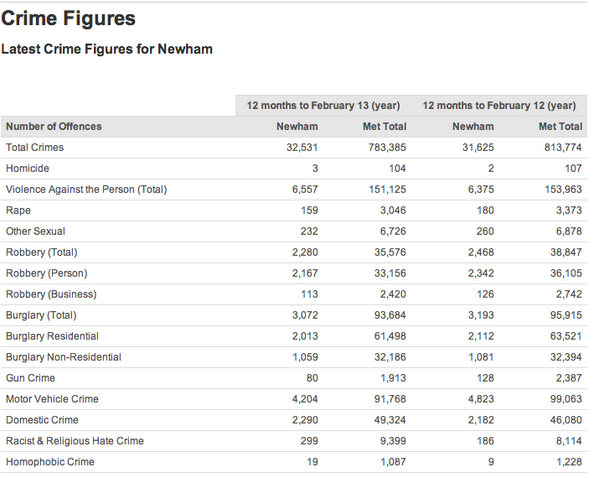
Bad news for Sir Robin Wales. Despite spending millions on his own private police force, buying in additional officers from the Met and blanketing the borough in CCTV, crime is on the rise in Newham:

  • Homophobic Crime – up 100%
  • Racist & Religious Hate Crime – up 70%
  • Homicide – up 50% (though thankfully from a very base)
  • Domestic crime – up 5%
  • Violence against the person – up 3%

Yes, some crimes have reduced – notably robbery, burglary and sex crimes. And there have been fewer crimes using guns.

But overall crime in the borough is up by 3%. By contrast, across the whole of London it fell by almost 4%.

That’s a real embarrassment for someone with Sir Robin’s city-wide ambitions. And the Evening Standard won’t be as docile as the Newham Recorder when it comes to holding him to account.

Perhaps our 60 councillors might like to ask him a question or two as well. After all, isn’t oversight and scrutiny part of their job?

(hat-tip to @StopCityAirport for unearthing the stats)

Turn again, Robin Wales

15 Apr

Despite being on the verge of re-selection – unopposed, of course – as Labour’s candidate for Mayor of Newham in next year’s local elections, Sir Robin Wales wants to be mayor of London.

What’s interesting for Newham people – apart from the happy prospect of waving goodbye to the Dear Leader – is that the London elections are in 2016, exactly halfway through Sir Robin’s next term.

When Labour selected Ken Livingstone as candidate for the 2012 election it did so in the autumn of 2010, a full 21 months ahead of time. And this was following a 3-month campaign in which he defeated former Bethnal Green MP Oona King.

Assuming the London Labour party follows the same timetable, Sir Robin would start his campaign for the nomination barely a month after being re-elected in Newham. If he won that he’d face a long slog round London raising his profile among the voters of the other 31 boroughs.

How much time will he have left to do the job he’s being paid £81,000 a year by Newham council tax payers for?

If I were a Labour party member who’d just cast his vote in the ‘trigger’ ballots I’d be a bit pissed off to discover, just a few weeks later, that our candidate is no longer that interested in the job – that he hopes to serve just half his term before resigning in favour of something bigger and better. And that he’s unlikely to devote much of his time to Newham.

I might also wonder if we have to have an open process to select a candidate for the mayoral by-election in 2016, why not save ourselves the trouble and select someone now who will serve a full four years?

Something else George Galloway doesn’t do…

11 Apr

Collectors's item: George Galloway speaking in parliament

… his job.

George Galloway has missed 87% of all Commons votes during his first year as a Bradford MP and spoken in just seven debates.

Data compiled on website theyworkforyou.com shows that Mr Galloway has taken part in just 13% of the votes over the past year. Most MPs average between 70 and 80%.

He has spoken in just seven debates – the average for MPs being around 30.

Can I respectfully suggest that Mr Galloway spends a bit less of his time in Newham and a lot more of it in parliament working for his constituents? After all, that’s what they elected him to do.

Image

Wales will go on… and on

8 Apr

Wales will go on… and on

This month Newham Labour party is holding ‘trigger ballots’ to decide if they want to run a full, open selection process to pick their candidate in next year’s mayoral election. The alternative is simply to let Sir Robin run again.

The results thus far have been depressingly predictable. Sir Robin will not be challenged.

He will be Labour’s candidate next May and he will be mayor for another 4 years.

Coffee shop review

25 Mar

A few weeks ago Phil Bradbury, who runs the Woodgrange Web site, asked me to write a review of the two coffee shops that recently opened in Forest Gate.

The review is now live and I’d be very happy if you went and read it. If you have any comments – maybe you disagree with my conclusions – please say so on the Woodgrange Web forum.

Sir Robin loves CCTV

18 Mar

Mayor of Newham, Sir Robin Wales, appeared on the BBC’s Sunday Politics on 17 March 2013 to explain why this borough – already the most spied on in the country – is investing in even more CCTV cameras.

There are already more CCTV cameras in Newham than in the cities of Birmingham and Liverpool combined. But the mayor is buying more and the risible ‘law enforcement officers’ (not to be confused with real police, as the BBC reporter helpfully points out) are being kitted out as mobile video units, secretly filming residents as they go about their business.

Sir Robin claims that “residents love CCTV” and admits – without even a hint of embarrassment – to cutting more than necessary on other services so he can invest in these extra cameras.

UPDATE: Mike Law has written a far more extensive analysis of the Mayor’s comments and CCTV-fanaticism. Well worth a read.

Until the cows come home

7 Mar

Cows_on_wanstead_flatsCattle grazing on Wanstead Flats from ‘Epping Forest Through the Ages’

As many as 500 cattle once grazed grazed freely throughout Epping Forest and many of them made their way down to Wanstead Flats. They were a common sight in the summer months and the cause of occasional traffic hold-ups as they wandered across the roads.

But over time the numbers dwindled and in the 1990s a combination of BSE and foot-and-mouth disease put an end to common grazing.

Many local people want to see the cattle back and the Corporation of London – which manages Epping Forest – has promised on several occasions to look at it. In the early 2000s a small herd was released into the northern part of the Forest and I remember attending a residents meeting with a representative of the Corporation who said they were looking at doing something similar in the south.

Sally Hayns, the Public Affairs Manager for the Corporation of London, sent the following email to Linda Powell, a member of the Newham Issues Forum on E-Democracy.org, in June 2005 in response to a question about returning cattle to the Flats:

We do get quite a few calls asking us when the cows are going to return to Wanstead Flats. As you are probably aware, they were Commoners cattle that were turned out onto the Forest during the summer months by the Commoners who are legally entitled to do so under the 1878 Epping Forest Act. Most of the cows were turned out in the northern half of the Forest but, as they are free-ranging, they tended to gradually make their way down to the southern end because of the better grass. The 1878 Act still applies and Commoners can still turn out their cattle but the numbers doing so declined from the 1950s onwards
due to changes in farming patterns/economics and petered out altogether following the BSE crisis in the 1990s.

The Corporation agrees with your views in terms of the importance of the cattle to the aesthetic qualities of the Forest as well as to the appearance of many areas of the Forest, including the Flats, and the wildlife interest. Many areas of the Forest are deteriorating in terms of scrub encroachment and the resulting loss of plants and invertebrates and many of the open views are being lost. Trying to replicate the impact of cattle grazing with machinery and staff is expensive, more invasive and less effective generally. Accordingly in 2002 the Corporation subsidised a Commoner to turn out some barren English Longhorn cows onto the central area of the Forest as a trial to monitor the impact and with a herdsman to keep an eye on them. There is no economic benefit to the Commoner to do this – he just happens to believe that it is good for the Forest.

We do now need to look at the possibility of extending the grazing to other areas of the Forest and the Flats is one of those. We are currently working on an Integrated Site Plan for Wanstead Flats which brings together proposals for managing the nature conservation, recreation and heritage aspects of the Flats over the coming years. One of these proposals is returning cattle to the Flats. The proposals will be going out to public consultation in a few weeks time so we will be asking people if they would like to see cattle returning to the Flats and, if so, how they might best be managed to deal with issues such as roads and traffic, harassment by people/dogs, etc. the views of your group would be very welcome but it is quite a complex issue.

Complex indeed and nearly eight years later there is no sign of progress. I’m afraid I don’t know the outcome of the consultation on the ‘Integrated Site Plan’ for the Flats and I’d be grateful if someone could point me in its direction.

As Ms. Hayns rightly says, the quality of the land is deteriorating and mechanical intervention is more invasive, more expensive and less effective than grazing cattle. It is surely time the cows came home.

Not wanted here

6 Mar

Here’s a small but important fact about Newham: unlike several of our neighbouring boroughs, no candidate from a fascist party has ever been elected to office.

In fact, there hasn’t even been a BNP candidate on the ballot for a council election since 2002.

Whatever else you may want to criticise our mayor for (and there’s plenty) this is one thing he can be rightly proud of. Despite ongoing economic deprivation, under-funding from central government and an ever-evolving racial mix the far right has never managed to gain a foothold here on his watch.

But while the BNP is nowhere to be seen, there are others who see political advantage in spreading fear and suspicion, people who see an opportunity for personal gain in sowing the seeds of hatred and division. We must reject them too.

Clockwork

1 Mar

Image

About 10 years ago I started a local website called forestgate.com (I still own the domain name and use it for email, though the site is long gone). Of all the emails I received about the site, by far the most common request was for information about an artist who once lived and worked in Forest Gate, L Kersh.

Mr Kersh specialized in what he called “horological collages” – pictures made up from bits of clocks and watches, like the example above. These works have travelled far and wide and their owners were keen to know more about the artist and his work.

I posted a number of these requests on the site and, quite remarkably, various members of Mr. Kersh’s family got in touch. They were proud to know how much pleasure people continued to get from his work:

I found your website on a link from Ebay while I was trying to find work done by Len Kersh.

I am proud to say he was my Uncle, he was married to my Aunty Marion (my Mum’s Sister). I remember as a child going over to over to see them regularly at their house in Station Road, Epping, Essex, UK.

I have fond memories of him and remember him being a lovely Uncle. His Wife now lives in Spain but stays in touch with My Mum on the phone & sometimes pops over to the UK to visit her.

Another wrote:

Just want to let you know that Len Kersh was my uncle and he passed away a few years ago. He had three daughters and I would love to have contact with them.

I live in Sydney, Australia. Thanks to the internet I was able to find cousin Nigel and would love to find these other cousins. I actually met one of them at the factory in 1977.

and cousin Nigel also got in touch:

L (Len) Kersh of London was my grandfather’s nephew. Len’s father, Jack Kersh and my grandfather, Michael Kersh were brothers. They were born in Riga in Latvia, and emigrated to the United Kingdom (Sunderland in Jack’s case, and Glasgow, in my grandfather’s case), where they lived out the rest of their days.

The story goes that Len was a “bit of a lad” in his youth, and got into all sorts of trouble. He eventually left home in Sunderland, and made his way to London. There he lost touch with his family, but made good by developing an idea with which he had helped a family member do a school project – the making of collages from old odds and ends. Ultimately this developed into his “horological collages” with which so many people are now familiar the world over.

I only recently made contact with Jack Kersh’s side of the family as he and my grandfather apparently fell out over some matter, and never saw one another again. It was only by chance that the daughter of one of Len’s brothers, Bennie Kersh contacted me from Australia. I now have the missing pieces of our family tree, and it’s quite something.

I don’t know what happened to Len, but I do know that his brother Charles is still alive and well and living in South Africa, where I am in contact with him through his son, also named Jack. I’ve asked him for further information about Len, but I’m not sure if he will have any further information beyond what I have described above. I do know that Len, Bennie and Charles had four sisters – Ethel, Elsie, Eva and Rose, and I’d love to know what became of them and of Len’s children, if he had any.

I hope that fills in some of the missing information on my distant cousin.

As can be seen from the certificate of authenticity that accompanied every piece he produced Kersh’s studio (or “factory” as his niece called it) was at 332 Romford Road. Sadly, there’s nothing now there to tell the world that this was where Kersh worked.

Image